
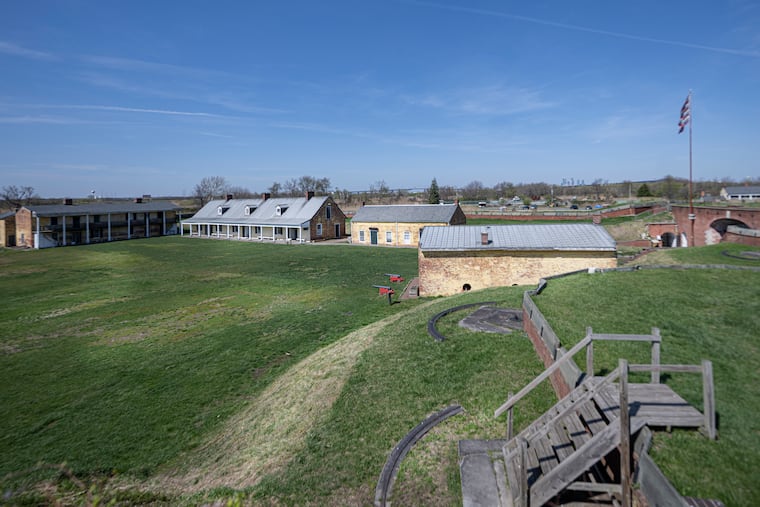
Fort Mifflin, from its perch overlooking the Delaware River, is one of Philadelphia’s most historic sites, having withstood the fiercest bombardment of the American Revolution — nearly 1,000 cannonballs an hour over six days.
It later served as a Civil War prison camp for the first prisoners of Gettysburg.
Yet the fort receives zero federal or city dollars and relies on a budget of $100,000 to $200,000 a year, depending on how many people pay to visit and how well fundraising efforts go.
“Our budget is pretty much a shoestring,” said Craig Buffington, Fort Mifflin on the Delaware’s cheery executive director, and a former Boy Scout troop leader.
Because Fort Mifflin is isolated, it doesn’t draw tours and foot traffic like historic attractions in Old City.
Built on Mud Island, it is battered by persistent flooding made worse by sea level rise. One building’s brick exterior is bowed. Wood is rotting on multiple buildings. A pedestrian bridge is giving way. The grounds are saturated much of the year.
In short, Fort Mifflin needs help.
“The list is nearly endless,” Buffington said.
A new tide gate
A new tide gate should go a long way toward alleviating flooding.
The gate, built in 1920, has been failing for years, leaving the grassy grounds mushy many days as the tide flows in unchecked. Mud Island has been reconnected to land since the 1800s, but retains the name.
The gate is a project of Philadelphia International Airport (PHL), which was built on the adjacent Hog Island, another former island that has been reconnected to mainland. Philadelphia owns both the fort property and PHL.
Heather Redfern, a PHL spokesperson, said the $4.15 million construction of the tide gate should begin soon.
For Buffington, the fix can’t come fast enough.
Why Fort Mifflin floods
Fort Mifflin is shaped like a bowl, with ramparts and high ground protecting the sunken parade ground, which falls below the high tide mark. The fort’s moat rises and falls with the river’s tide. Buffington said sea level rise exacerbates the problem.
By restoring control over water levels, the new gate should allow the perpetually soggy ground time to dry out and water levels at the moat to remain constant.
The U.S. Army Corps of Engineers owns part of Mud Island and uses it to dump dredge spoils from the river.
“It’s really like a bathtub,” Buffington explained. “When it rains, all the water from the Army Corps next door and the marshy areas at the airport comes here.”
Currently, areas like the historic walking path outside the fort’s walls and the front section near parking become so muddy that visitors either cannot walk on them or have to cross makeshift plywood bridges.
The new gate will also help with severe flooding caused by storm surges that have historically submerged the fort’s bridge and walkways, and sent water flowing into the original bomb shelters and fortified vaults where Revolutionary soldiers stored gunpowder.
“We’ve had a couple key wall breaches in the past,” Buffington said. “Last one was about two years ago. … The tide gate will help tremendously.”
‘We don’t have the money’
Even with a new tide gate, Buffington said, Fort Mifflin still faces a daunting list of deferred maintenance. Fort Mifflin, which had a $164,340 balance in its last tax filing, in 2023, manages operations on its own.
The hospital building, which dates to 1824 and now houses the main office, has been inundated. Floodwaters from an October 2025 storm rose to the building’s doorjambs and cut off access so that staff had to craft a makeshift bridge out front.
Its cedar roof recently had to be replaced, requiring more fundraising. But other woodwork, such as balustrades, rails, and fascia, is rotting or broken.
The commandant’s house was damaged in a fire in the 1980s and would take about a million dollars to properly repair, Buffington estimates. It was designed in 1796 by Pierre “Peter” Charles L’Enfant, who planned Washington, D.C. Its roof was repaired and the walls were shored up, but the interior remains damaged. Buffington would love to have it fixed, he said, but “we don’t have the money.”
About 10 years ago, the officers’ quarters were damaged in a fire, but winds later blew off the roof. Fort Mifflin had to raise money to fix that, and repairs were completed about two years ago. The quarters still need more work.
One wall of the original commissary, now a gift shop and public restroom, has bowed from excess moisture and constant flooding. The wall needs to be repaired. The bathrooms do not work, so visitors use portable toilets.
Buffington said there is no money to fix either.
Meanwhile, grants are getting harder to obtain with federal budget cuts, he noted. Other matching grants are difficult to get because Fort Mifflin cannot gather the initial matching money needed to qualify for them.
“We get nothing from the federal government, nothing from the state, nothing from the city,” Buffington said, noting that city officials do offer guidance and were instrumental in getting the tide gate.
Buffington, who has a background in business, applied last year for the executive director position. But he first formed a connection with Fort Mifflin in 2008 while visiting with scouts and hearing of reported hauntings.
Since taking the helm, has tried to beef up visits. Buffington estimates about 20 people come through on a typical weekend day. He collects the money, works the front office, and conducts tours.
Last Saturday, Fort Mifflin hosted an author’s day with 20 writers on hand to sign books, and it is opening a speakeasy on April 25 as a fundraiser.
Fort Mifflin’s battle reenactments are a draw, along with cannon fire demonstrations at 1 p.m. each Saturday and Sunday. It hosts sleepovers and field trips. People rent the facility for weddings and other events, Buffington said.
The nonprofit Fort Mifflin on the Delaware is overseen by a 12-member executive board and has one other full-time staff member. It pays for some help on weekends and also taps a handful of volunteers.
Haunted Fort Mifflin
Buffington brings an affinity for Fort Mifflin’s paranormal offerings. The fort opens for private investigations and holds candlelight ghost tours. Guests have reported various paranormal encounters, especially with a female spirit named Elizabeth.
Buffington said he frequently experiences paranormal activity in his office, such as phantom footsteps and the sound of doors opening and closing. He has gotten so accustomed to it that he no longer pays attention.
The original powder magazine, also known as the fort’s casemate 11, which served as a solitary confinement cell for prisoners, had been buried and inaccessible for 130 years. It was unearthed by accident after being exposed by a sinkhole in 2006. William H. Howe, a union deserter, was executed in the casemate in 1864, and is a paranormal legend at the fort. Walking through the casemate is a spooky experience.
Fort Mifflin has its charms beyond the paranormal, including sweeping views of the Delaware River, intact Revolutionary-era buildings, and even a wall where visitors can touch a dent from a cannonball.
Airplane aficionados like Mattson Gray, 24, from Gibbstown, Gloucester County, routinely gather at the fort’s highest point to view planes taking off from PHL.
“I love it,” Gray said of Fort Mifflin, as he and friend Ryan Devers used binoculars to watch planes one day last week.