
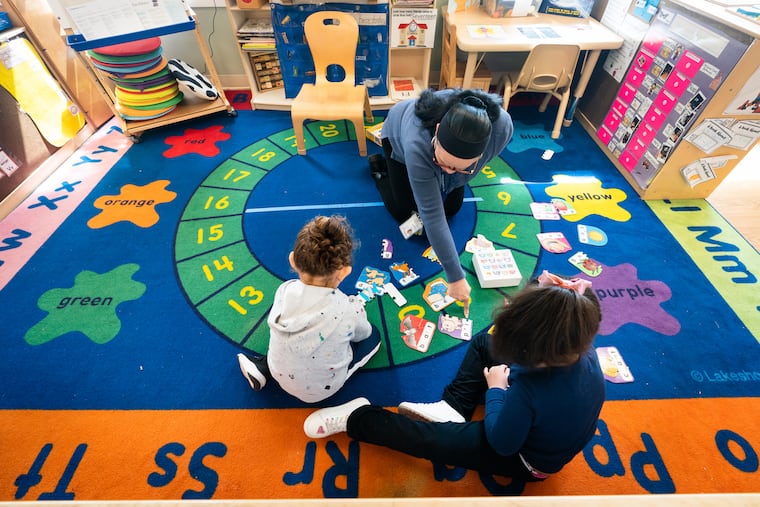
Childcare providers are sparse in some parts of Philly and in a number of the city’s suburbs, including some high-income communities, a new report says.
Areas in which licensed childcare is scarce include parts of the Northeast and the River Wards, Bryn Mawr, Ridley Park, Marple Township, and Chesterbrook in Pennsylvania, as well as several South Jersey communities, according to new data from the nonpartisan Center for American Progress.
The share of children living in childcare deserts across the U.S. has declined slightly since 2018, but it remains high. Last year, 46% of children under the age of six lived in these areas nationwide, down from 51% in 2018, the report said.
Researchers define a childcare desert as an area in which there are at least three children under the age of 6 for only a single licensed slot for care. To identify these areas, researchers compared capacity and location of licensed childcare centers based on government records, with Census population data.
“Childcare is an investment not only in children’s early education and development but also in the broader economy,” researchers note in the report. “High-quality early learning puts children on a trajectory for greater educational attainment, higher adult earnings, and better health outcomes. It also ensures parents can work or attend school and participate in their local economies.”
Yet, childcare has been facing a national crisis: staff generally earn low wages — about $30,000 a year on average in the Philadelphia region — so the industry has been dealing with high employee turnover and staffing shortages.
Meanwhile, families are spending much of their earnings on childcare, the report notes, so raising prices in order to pay staff more could result in centers having to shutter because of unaffordable services.
When parents call out from work or lose their jobs because of childcare issues, it costs Pennsylvania’s local economy $6.65 billion annually, the Inquirer reported in 2024.
How severe is Pennsylvania’s childcare shortage?
In Pennsylvania, 5.1% of children under 6 years old live in areas with no access to licensed childcare, according to the report.
Many more Pennsylvania children have inadequate access to care, the report outlines.
A quarter of Pennsylvania children under 6 years old live in places where there is only one licensed childcare slot for every 10 children or more. And 45.2% live in areas where there are between three and 10 children for a single licensed slot.
Meanwhile, the report notes, almost 70% of U.S. children younger than 6 live in a home where all parents work.
Across the U.S., poorer access to childcare tends to be found in rural areas, and in areas where Hispanic or Latino families predominantly live, researchers note in the report.
High cost of childcare
The report also noted that from 2016 to 2023, an increasing number of families report struggling to access their childcare of choice, citing the high costs and lack of availability, according data from the National Center for Education Statistics.
Living in an area with suitable access to childcare is just the first step. Then, families face the burden of paying for the service.
Childcare costs have been rising in recent years nationwide, and families in the Philadelphia area say their monthly childcare bills are comparable in size to a home mortgage payment. Childcare for two children in Philadelphia costs more than rent on average, the Inquirer reported last year.
In 2022, several childcare centers in Philadelphia went on strike demanding better pay for workers and more affordable services for families amid a national day of action under the banner of a “Day Without Child Care.”
» READ MORE: ‘A real crisis’: Five takeaways from a new survey on childcare worker pay in Pennsylvania
The state has been advancing an initiative to curb the staffing issue. Gov. Josh Shapiro proposed in his budget address earlier this year to add an additional $10 million for efforts to recruit and retain childcare workers.
“We don’t have enough childcare workers, and that’s because we don’t pay them enough,” said Shapiro in his February address.
His proposal would expand on a 2025 initiative to pay childcare employees recruitment and retention bonuses. Shapiro proposed increasing the bonus from $450 to $630 after seeing overwhelming demand.
“Simply put, the childcare market does not work for children, educators, or parents and limits the country’s economic potential,” the report from the Center for American Progress notes. “Lawmakers must intervene in this failing market and invest the funding necessary to increase supply, retain a qualified workforce, and address the high costs that families face.”