
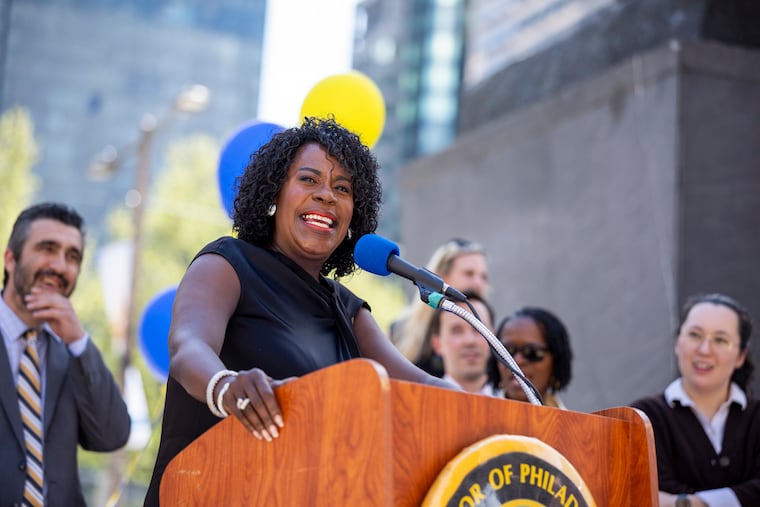
Philadelphia will soon have some of the nation’s toughest local restrictions on federal immigration-enforcement operations after Mayor Cherelle L. Parker on Thursday approved legislation codifying the city’s sanctuary policies and banning ICE raids on city property.
The mayor signed six out of seven “ICE Out” bills that came to her desk after being passed by a supermajority of City Council. She took no action on the seventh bill, a piece of legislation that bans immigration agents from concealing their identities, meaning it will still become law because she did not issue a veto.
The other bills approved Thursday bar federal immigration enforcement from staging raids on city-owned property, prohibit discrimination on the basis of citizenship status, and ban the city from engaging in most forms of information sharing with U.S. Immigration and Customs Enforcement. It effectively codifies into law the city’s already existing sanctuary policies in which officials do not assist the federal government in carrying out immigration enforcement.
Those practices were previously in place as the result of an executive order. But signing them into law means that a future mayor can’t unilaterally revoke the city’s sanctuary policies.
In a letter to Council on Thursday, Parker wrote that she “affirms[s] the vitality of Philadelphia’s wonderfully diverse and vibrant immigrant communities.”
“My commitment to immigrants and our most vulnerable is unwavering,” she wrote.
» READ MORE: Philadelphia City Council just adopted some of the nation’s most aggressive policies aimed at restricting ICE
The new provisions will take effect in July, 60 days after they were signed.
It had long been unclear how Parker, a centrist Democrat, would handle the high-profile legislative package, which sailed through City Council with a supermajority of support and the backing of Council President Kenyatta Johnson. Parker has generally avoided outward confrontation with President Donald Trump’s administration, and she said little publicly about the effort by Council to respond to the president’s nationwide deportation campaign.
Parker, who took office as mayor in 2024, did not campaign on immigration as a top concern, and she has often said she is focused on her agenda to improve community safety and clean up the city. Aides to the mayor have said her strategy is also to preserve relationships at the federal level and protect the billions of dollars in funding that the city relies on.
Signing the “ICE Out” bills into law is the most overt stance Parker has taken on immigration. And it comes at a time when Philadelphia is already facing increasing scrutiny from Washington over its sanctuary policy, which predates Parker’s tenure as mayor.
This week, the GOP-controlled House Judiciary Committee accused the city of obstructing federal immigration enforcement, and the panel demanded that top law enforcement officials turn over records related to the city’s interactions with ICE.
Parker’s administration had previously expressed concerns that some of the language in the bills could open up the city to legal challenges. But Parker also indicated that she would not stand in the way of the “ICE Out” legislation. She has never vetoed a bill.
» READ MORE: More Pennsylvania police agencies are signing up to help ICE enforce immigration laws
Trump’s administration has in recent months sued other jurisdictions for local anti-ICE measures, namely bans on agents wearing masks. Under federal law, local jurisdictions are generally prohibited from interfering with the basic functions of the federal government.
Parker’s administration has signaled it believes the bill banning law enforcement officers from wearing masks could result in a legal challenge.
City Solicitor Renee Garcia wrote in a letter to Parker that the legislation presents “significant legal problems,” including concerning whether the city has the authority to regulate the conduct of federal agents.
Garcia also wrote that it would be a challenge to enforce, because Philadelphia police officers could be asked to interfere with federal immigration enforcement.
“I am aware that the administration supports the bill sponsor’s intent to require that immigration and other law enforcement operations are conducted in Philadelphia in a safe, transparent and accountable manner,” Garcia wrote. “However, given the current state of the law, implementing the bill at this time would present significant legal and operational challenges.”
» READ MORE: Council President Kenyatta Johnson says Philadelphia can’t sit out Trump’s immigration fight anymore
Johnson said Thursday that he believes the legislation, including the mask ban, would survive a legal challenge.
“Its a good day for the city of Philadelphia,” he said. “It’s an opportunity for us to stand up against a bully who’s advocating for policies that will have a significant impact in terms of creating an atmosphere of fear and intimidation with our immigrant community.”