
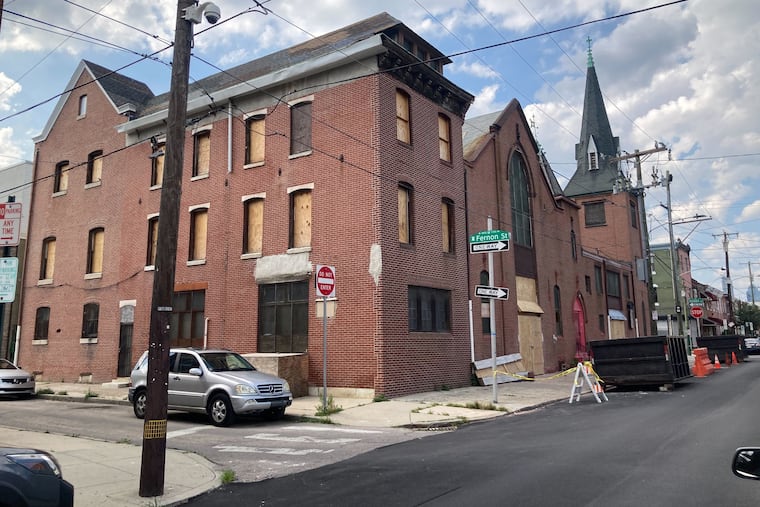
The former church at 1800 Tasker St. is on its way to becoming a brewery, an unusual transition for a historic property.
Most sacred buildings, if they are saved from demolition, are converted into apartment buildings. That transition can prove controversial — as a space previously open to the public turns into private homes — but future residential rents are the most reliable way to secure financing.
“One of the reasons you see other spaces turning into apartments is because it’s more financially possible,” said Dane Jensen, developer of the Point Breeze project.
“This is an act of love for old buildings and being able to keep it a gathering space,” he said. “It definitely is the kind of thing that you have to commit to and stand by. Otherwise I don’t think it’s financially reasonable.”
His partners in the project are chef Patrick Meyers, who formerly worked at Royal Izakaya and Cheu Noodle Bar, and brewer Mark Russell, formerly the lead beer maker at Dock Street. They hope to open in the second half of 2027, although 2028 might be more realistic.
They bought the almost 140-year-old building for $1.75 million in mid-2024 from the Second Nazareth Missionary Church. Jensen said he wouldn’t know the total cost of the project until it’s done, but “it’s definitely too much,” he joked. The project is backed by private funding.
The scale of renovations is daunting. Roughly 200 pigeons were roosting in the steeple, with four feet of droppings distending the ceiling. The building is not insulated and, as with most historic structures, lacks Americans with Disabilities Act accessible infrastructure. Jensen is adding an elevator.
Some of the stained glass and other interior decor is being stored in a warehouse in Grays Ferry until it can be reused.
The basement is rubble foundation and dirt floor, which had been partly covered by pine flooring so warped by water that it undulated. The initial cleaning turned up a lot of dead rats and other detritus.
Water leaks were a pervasive challenge, which date back decades based on Jensen’s perusal of Presbyterian Historical Society archives. The plaster on one of the interior walls felt like a sponge.
“Starting in the 1940s, they’re talking about the roof leak and how they finally got it under control, and then in every year from 1940 to 1978, it was still leaking,” Jensen said. “Either the roof is cursed, or we will finally get the roof leak under control.”
Jensen noted that the previous ownership did all it could to keep the building up, but maintaining a structure of this size and age is an immense undertaking.
“The building had a lot of issues when we bought it, but was clearly well loved,” Jensen said.
The church contains a hodgepodge of alterations and additions, including a slate roof that was built over but not removed during a long ago renovation, and the remnants of an indoor basketball court on a hidden third floor.
In the brew pub, adult-oriented space will be on the ground floor, which will have a bar and kitchen, serving “international pub food,” said Meyers, the chef.
A kids-oriented play space will be on the second floor, fittingly where the Sunday school used to be. The idea is to build a family-friendly space “where a parent can sit down, and their kid can run around and not get hurt,” said Jensen, who has two children. “It’s all about parents sitting down, the joy of sitting.”
The developers declined to elaborate on interior layout and features at this point in the redevelopment.
But Jensen, Meyers, and Russell said they are devoting all their time to the project and, until recently, all three lived in or around the neighborhood.
Jensen, who is a psychologist by training, recently moved to Chestnut Hill and sees this as his opportunity to do a dramatic adaptive reuse project before he settles down to form a private therapy practice.
The partners have been engaging the community. Although some neighbors are skeptical, especially about the fact that no parking will be required, Jensen’s public engagement campaign has won over some critics.
“We’ve had a lot of positive feedback, and we’ve had a lot of people who do not want to see this change,” Jensen said. “We’re trying to address [their concerns] and be transparent and available. That has had some positive impact, but there will always be some folks who would have preferred it stay a church.”
Like many sacred institutions, the former congregation had a shrinking membership, and no successor religious groups stepped forward to take over the care of the building.
Many churches in similar positions are demolished. Some are turned into apartments and, occasionally, single-family homes.
Further community meetings are planned in late May at the St. Thomas Aquinas Catholic School across the street from the church and online in early June.
“I appreciate Dane’s continued outreach to the community and taking the community input into consideration,” said Albert Littlepage of the Point Breeze Community Development Coalition.
“I thought the transformation from a historical church to a bar restaurant concept was a little outrageous,” Littlepage said. “However, after the presentation, I think the family atmosphere works.”
Jensen and his partners got the church added to Philadelphia’s Register of Historic Places, which activated a 2019 law that allows historically significant buildings to be reused without parking requirements and without conforming to the underlying zoning.
The law was passed to preserve more historic buildings like churches, which can be impossible to renovate if parking is required and can get trapped in legal limbo if opponents sue — often leading to demolition.