
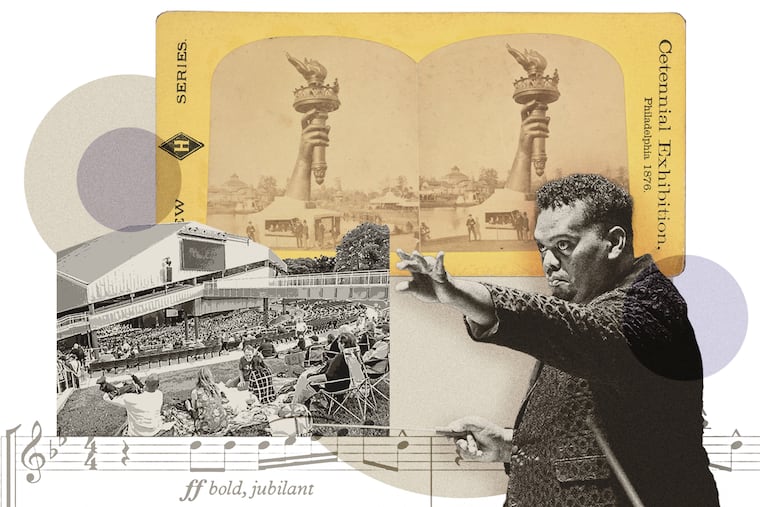
To bring Philadelphia’s Centennial Exposition back to life, Peter Boyer and Mark Campbell could have created a nostalgic musical impression delivered like a sepia-toned postcard lost in the mail for a century and a half.
And, in fact, they have.
The oratorio will premiere Wednesday night at the Highmark Mann in Fairmount Park, the very site of the somewhat now-forgotten 1876 event that wowed roughly a fifth of the nation’s population with marvels of technology, agriculture, culture, and more.
But what the composer and librettist have created is something that is also more deeply personal than merely an account of a World’s Fair that introduced, among other things, an invention called the telephone and foods like Heinz ketchup and the banana.
The great U.S. Centennial Exposition is conjured in A Hundred Years On through five fictionalized characters and others who voice hope, a sense of ambition, progress, and prosperity but also uncertainty about the young country. With the Philadelphia Orchestra, Crossing Choir, vocal soloists, and conductor Anthony Parnther, the piece — commissioned by the Highmark Mann to celebrate its half century and the nation’s 250th — also humanizes the story of Americans who were denied a full voice in society.
In other words, although it celebrates the excitement of the Centennial Exposition, the piece in a sense collapses the span of time between then and now.
“It’s obvious, the relevance to our situation today,” said Boyer. “We’ve made some progress since the 1870s, and then in some ways we have made much less progress than we might have hoped.”
“As I read about this World’s Fair, it was 10 years after the end of the Civil War, the country had just gone through a depression,” said Campbell. “This was a time when it was important for the U.S. to put its best foot forward, but it could not shake itself free from what had happened in recent history. And so there were some real dramatic possibilities there.”
Like Ignatius Thomas, a Black waiter at the exposition’s Restaurant of the South.
“Happy birthday, America,” the baritone sings, “but the speeches and the fireworks — they’re not meant for me.”
And a Polish immigrant named Marion Jozwiak, who sings in a mezzo soprano voice, says she came to America to “find a little hope” but found a “country divided, broken” — and yet still believes it’s a fair land.
“Yes, there are a few mean men who always find a way to speak the loudest and the longest. But after time, their voices die and they’re forgotten.”
In the piece, Jozwiak is standing on the torch of the Statue of Liberty, which, with its raised arm, was displayed at the Centennial Exposition before the statue’s dedication a decade later in New York Harbor.
“I think maybe it’s the most iconic image of this exhibition, it just says so much,” said Boyer. “It says ‘work in progress.’ We’re still a work in progress.”
That the progress is now in retrograde compelled Campbell to go back into the libretto and make changes a few months ago, long after it was finished.
“What we’re facing now — I’m sorry, I’m going to be very frank — with this terrible corrupt government we have, we are facing an autocracy — or, what is the word? Kakistocracy. So I wrote this in a very different place and I had to go back to the libretto and make it darker than it was when it was originally written. It was just sounding too positive to me.”
But if the piece acknowledges pain and exclusion, it doesn’t stint on idealism.
“The story certainly has humor in it, and joy and excitement about where America could be, where America could go, what America could be to the world, and I think that’s the soul of Peter’s music,” said Campbell.
In the way it deals with story, the new piece echoes Ellis Island: The Dream of America, Boyer’s work whose stirring, filmic musical language has generated about 350 performances since the piece’s premiere in 2002.
“I’m pretty clearly identifiable as an American-sounding composer, you know, which is an ambiguous term,” says Boyer, who cites Copland, Bernstein, and John Williams as influences generally.
Here in this new piece, “my love of Sondheim, my love of Bernstein, theatrically speaking, that sort of came through, because the libretto seemed to suggest it.”
Boyer and Campbell collaborated virtually on the piece — Californian and New Yorker, respectively, they’ve yet to meet in person — and they made separate visits to the Free Library of Philadelphia to research the 1876 exposition. They also did the bulk of their work at different times to fit in with other projects. Boyer composed the music while simultaneously writing American Mosaic for the Semiquincentennial. That piece was premiered by the National Symphony Orchestra in February at the John F. Kennedy Center for the Performing Arts.
Both works use visuals. American Mosaic is a collaboration with photographer Joe Sohm, and A Hundred Years On uses projections of images from the exposition designed by video artist Rasean Davonté Johnson, costumes by Millie Hiibel, and stage direction by director Tazewell Thompson.
“They’re similar and yet different in some fundamental ways,” says Boyer of his two pieces, “again with where we are in our country and here we are celebrating this incredible milestone in our history while simultaneously dealing with such disheartening times. And so, what is our role as artists and composers?
“I think it’s an opportunity that this piece can bring some history and some uplift, and that’s not a bad thing.”
“A Hundred Years On” is performed Wednesday at 8 p.m. at the Highmark Mann, 5201 Parkside Ave., along with Julia Wolfe’s “Liberty Bell” and other works. With vocal soloists Mary Dunleavy, Meredith Lustig, Eve Gigliotti, David Portillo, and Malcolm J. Merriweather. Tickets are $18.76 or $50. highmarkmann.org.