
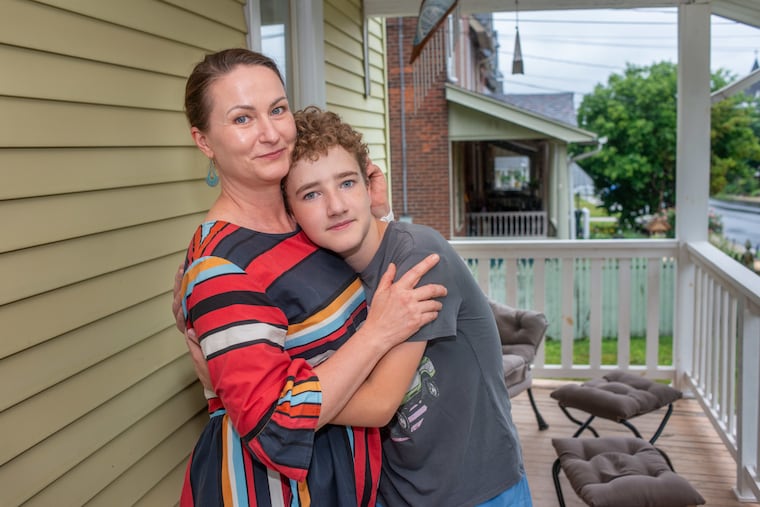
Four years ago Veronika Pavliutina and her three young children landed in Philadelphia after fleeing Ukraine, escaping the war as Russia shelled their home city of Odesa.
Their big shock: The outpouring of care and kindness that greeted them here.
A Mount Airy couple, strangers, invited the family to live in their home ― just move in and take the third-floor bedroom while figuring out next steps. Neighbors delivered meals and clothes and Target gift cards, and others organized events and outings.
Pavliutina, 48, said she’ll never forget it.
But now, she said, it’s time to leave.
Federal pressure on Ukrainian war immigrants has created doubt about the family’s ability to stay in the U.S. and raised fears about what could happen if they do.
The government designation that allows Pavliutina and her children to live here, Temporary Protected Status, expires for Ukraine in October. There’s been no sign the Trump administration plans to renew it, fostering uncertainty among thousands who have worked to rebuild their lives in this country.
TPS, as it’s known, is a humanitarian immigration status that can be granted to nationals of countries embroiled in war, environmental disasters, or other extraordinary circumstances. It allows people to legally live and work here and protects them from deportation.
The Trump administration wants to end TPS for some countries ― and the Supreme Court ruled on Thursday that the administration could lawfully strip protections from more than 350,000 Haitians and 6,000 Syrians, leaving them vulnerable to removal.
Pavliutina has felt the changed government attitude toward immigrants, the ICE arrests and detentions, the common resentment and casual hate.
“More and more I can see, it’s becoming not safe,” she said in an interview at the family’s home in Perkasie, Bucks County. “I may not be their target for now, but we don’t know.”
She and her two younger children, Nina, 15, and Yegor, 12, ― Polina, 19, is studying in South Korea ― intend to move to Italy in mid-July. Pavliutina doesn’t know anyone there, but for a family that is again starting over it’s a logical choice.
In Italy, Ukrainians escaping the war can receive a Permesso di Soggiorno per Protezione Temporanea, a fast-track residency permit that provides work authorization and access to health care.
“It makes me very sad to know they’re leaving,” said Richard McIlhenny, who with his wife, Marissa Vergnetti, welcomed the then-newly arrived family to live in their Mount Airy home. “I’m excited for their new adventure, but sad that it’s not here.”
Russia struck the southern city of Odesa on the first day of the war, Feb. 24, 2022, blowing up warehouses and air-defense systems and killing at least two dozen.
Pavliutina told her children they needed to leave, and fast. They fled by car and eventually reached friends in Serbia.
Meanwhile, 4,700 miles away in Philadelphia, McIlhenny, a real estate agent, and his wife, a preschool teacher, watched the war unfold on TV and decided to become actively involved in helping refugees.
McIlhenny contacted a childhood friend who was working in Ukraine, asking if perhaps there was a family in need. The friend knew of someone, a single mother with three children.
The Russian invasion drove a mass exodus, with an estimated 6.9 million Ukrainians leaving the country by the end of 2025, according to the Migration Policy Institute in Washington. Another 3.7 million were displaced internally, forced from their homes to other parts of the country.
The United States opened its arms. And the Philadelphia region, home to one of the nation’s largest Ukrainian communities, helped lead that effort. Churches, civic groups, and families organized to help new arrivals navigate housing, employment, and schools.
Now tens of thousands of Ukrainian war immigrants face uncertainty.
“The protections Ukrainians rely on in the United States are quietly but dangerously eroding,” Krish O’Mara Vignarajah, president and CEO of Global Refuge, said in a statement earlier this year. “We’ve even seen Ukrainians swept up by immigration enforcement.”
The Trump administration placed an indefinite pause on applications for the main Biden-era humanitarian program, “Uniting for Ukraine.”
That effort admitted more than 200,000, but now expired work permits have left many struggling to maintain jobs and housing. Losing legal status can result in deportation, and some have left on their own.
Meanwhile, as of March 2025, more than 100,000 Ukrainians were in the U.S. under TPS, which has faced backlogs and delays. The designation for Ukraine is due to end on Oct. 19, the prospect of renewal clouded as Trump touts his close relationship with Russian dictator Vladimir Putin and criticizes Ukrainian President Volodymyr Zelenskyy.
Since 2022 TPS for Ukraine has been extended twice, each instance a nerve-fraying rise and fall of worry and relief that makes it hard to plan for the future.
Last year, Pavliutina, who has worked as a chef, began thinking it might be time to, as she put it, self-deport.
The children adjusted to the U.S., she said, learning English, making friends, and earning good grades in school. They also hear other kids talking up Trump, whose pledge to deport millions of immigrants was central to his election campaign.
Son Yegor said he’s ready to move, “because I’m tired of America a bit.” Nina did not wish to be interviewed.
Their mother follows the news.
“It’s a little bit concerning, to be honest with you, because you don’t know when exactly it will be triggered to some kind of violence,” Pavliutina said. “For me it’s easier to think about a new country than to stay here with unknown status, with an unknown future.”
She’ll miss their house in Perkasie, she said. In fact, it was a new American friend who provided the private loan for her to buy it, an example, she said, of the extraordinary kindness that’s been shown to her family.
When she hears, “Make America Great,” Pavliutina said, she thinks of the countless big and small acts of caring offered by everyday people, the Americans who help others simply because it’s their nature and think it’s a good thing to do. That’s what makes America great, she said.
“I would definitely keep it in my heart, everything and everyone who was contributing to our life here,” Pavliutina said. “I love the country. I love the people. I just don’t feel safe to stay. And I don’t see the legal way to do so.”