
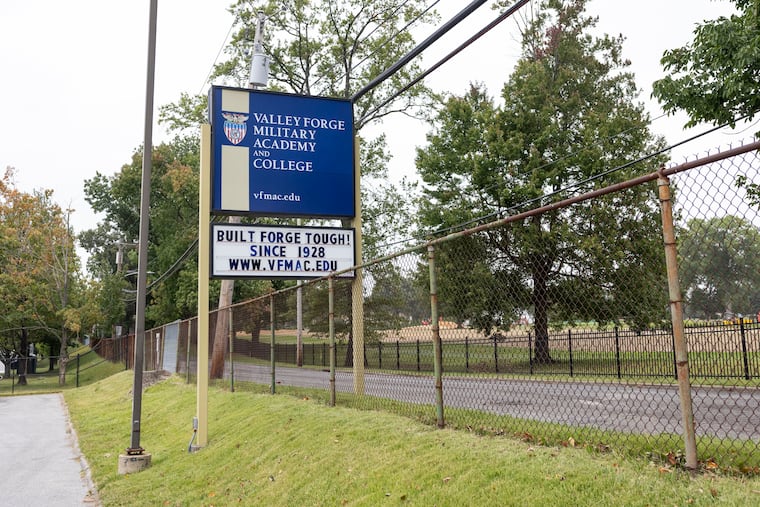
In the winter of 1777-78, after the Second Continental Congress hightailed it from Philadelphia following the British Army’s attack on the city, the revolutionary army of the freshly minted United States hunkered down in Valley Forge, Pa.
Soldiers dropped dead from disease and malnourishment, as they huddled for warmth in little wood huts. Lice ran wild.
By the summer of ’78, American troops, under the leadership of General George Washington, emerged, battered but not beaten, reengaged the British, and turned the tide of the Revolutionary War.
In that short time, Valley Forge became synonymous with American perseverance and resilience.
Reports of Washington, kneeling in the snow and praying for the army’s salvation, became part of popular lore — a powerful image of the revolutionary American spirit, blessed by the grace of God.
Historians debate whether such an appeal even happened. — records show the winter of 1777-78 was mild.
This push-and-pull between myth and reality — between what the United States aspires to, and what it actually is — is embodied in the legendary status of Valley Forge in the American psyche.
It’s a tension that, a new book argues, undergirds a current crisis in American masculinity.
The George Washington school of American masculinity
Journalist and author Jasper Craven argues that the figure of the American male, for better and worse, owes a lot to Washington. Or, at least, to the idea of him championing his country’s freedoms against all odds.
In his new book-length history of American militarized machismo, God Forgives, Brothers Don’t, Craven locates a tension in Washington that proves foundational.
“Washington made efforts to establish himself as a man who was stronger, mightier, braver than he actually was,” Craven said. “[He] captured the American imagination, and was an early, influential archetype on young boys.”
So it followed that generations of boys would attempt to embody a Washingtonian archetype — resilient, brave, dignified — near the site of that mythic winter encampment at the Valley Forge Military Academy (VFMA) in Wayne, Pa. Established in 1928 by a U.S. Armed Forces lieutenant general named Milton G. Baker, Valley Forge promised parents: “Send us your boy and we will return to you a man.”
Craven’s book argues that it was at schools like Valley Forge that the modern idea of the American male was made.
“These military schools represent an extended, expanded, more pedagogical version of boot camp,” he says. “You arrive a young boy, a little bit reckless. Maybe you’re a bully. But very quickly, everyone is stripped of their identities, given matching uniforms, see their heads shaved, and are put into a very grueling hierarchy.”
On paper, this pedagogical vision mirrors America’s notion of meritocracy: everyone starts at zero, and scrambles for rank, and prestige, among the militarized hierarchy. Ribbons and bows are awarded to the most industrious scramblers.
But, as Craven’s book reveals, that ostensibly fair model of achievement can be riven with dehumanization, corruption, and systemic emotional, physical, and sexual abuse. Even the nickname “The Forge” has a double resonance — suggesting both hammering something out in fire, and total fakery.
A history of abuse
As Craven notes in his book: “Between 2015 and 2020, the Forge logged more than 30 incidents of alleged sexual misconduct, from stalking and fondling to rape, as well as fistfights, assault with a knife, even arson.” Cadets as young as 13 were driven to suicidal behavior.
Craven played a key role in exposing these incidents.
God Forgives, Brothers Don’t grew out of his 2022 reporting for Mother Jones magazine, which cast a piercing light on the school’s hallowed halls. His reporting captured not only the violence visited upon “plebes” (military slang for first year cadets) by upperclassmen, but the equally endemic corruption of the school’s administrators, who pocketed hefty tuition fees while essentially operating what one graduate called, “a sleepaway camp for troubled kids with very little supervision … more Lord of the Flies than The Catcher in the Rye.”
(Speaking of Catcher in the Rye: author J.D. Salinger is among the Forge’s more notable graduates, and Craven traces the author’s conflicted relationship with the school, and its disciplinary culture, as a major influence on his fiction.)
In 2025, the VFMA announced its closure; the May 2026 graduating class was its last. The neighboring Valley Forge Military College, a private military junior college, remains operational, having separated from the larger Academy in 2023, amid ongoing scandal. (Representatives from Valley Forge Military Academy did not provide comment for this article.)
Last year, the VFMC became the first school in the country to offer support for President Donald Trump’s proposed Compact for Academic Excellence in Higher Education and received a $1 million federal grant earlier this year.
More than a deeply researched and utterly harrowing inquest into how the American military turns boys into men, Craven’s book doubles as a critique of American masculinity itself: its valorization of violence, its codes of silence, its curated pathologies of aggression and shame.
It’s a dismal vision of chauvinist mock-virility that endures, culturally, Craven said, in everything from the prevalence of Punisher skull T-shirts and bumper stickers, to the vacant bellicosity of President Donald Trump (himself a military school alum who eventually avoided the Vietnam War draft), and the self-styled posturing of Pete Hegseth as “Secretary of War.”
A workable alternative
In the course of his reporting, Craven was disillusioned of any idea that militarized men embody any sort of ideal.
“The best evidence of my book’s thesis,” he said, “is that all these dudes who claim they’re the most macho and militaristic people around are all so jumpy, so self-conscious, and so uncomfortable with themselves.”
“They are so clearly not happy with this identity they’ve constructed,” he said, “and yet are desperate to reinforce all the time.”
Asked if there are any workable alternatives for this conception of the American man, Craven (who is a civilian) draws from a nonmythical figure in his own life: his father, the American activist and filmmaker Jay Craven.
“My dad grew up in Pottstown, Pa. and almost went to Valley Forge, before finding a Quaker school and becoming involved in the anti-war movement,” he said. “There was a moment in America where the peacenik was the prevailing masculine pinnacle. He has his own ‘war stories.’ He was followed by the feds. He was imprisoned. He was beat up. He’s got some scars, which is cool. He even dated Jane Fonda for a bit.”
In tribute — and, perhaps, in aspiration for the future of the American male — God Forgives, Brothers Don’t is dedicated, “To my dad, who taught me how to wage peace.”
“God Forgives, Brothers Don’t: The Long March of Military Education and the Making of American Manhood” by Jasper Craven is available at online and physical bookstores. $29, 352 pages, Atria/One Signal Publishers.