
When Capt. John Walker joined the Philadelphia police force decades ago, prospective officers rarely applied to more than one department, let alone four or five.
Today, job candidates may apply to up to half a dozen departments before choosing where to begin their careers. And competition to hire them is fierce.
After years of the department vying for recruits amid staffing shortages and waves of officer departures, its ranks are rebounding. And Walker, who oversees the police academy’s recruiting efforts, credits that in part to a faster and more efficient method of getting potential officers through the door.
The department has scrapped its long-standing tradition of paper applications and is instead using software that speeds up what was once a monthslong hiring process.
Before, getting an applicant from an introduction with hiring managers to the first day of police training could take up to seven or eight months — or sometimes a year, Walker said.
“The process to get hired here was cumbersome,” he said. “It took almost 118 days after you applied for us to even make contact with you. That was a big problem.”
After rolling out the software, called Guardian, the department says it is ushering recruits into the academy in as little as 54 business days — and it hopes to reduce that span even further.
While Guardian is not solely responsible for the increase in applicants, Walker said, it has nudged the department closer to record recruitment numbers.
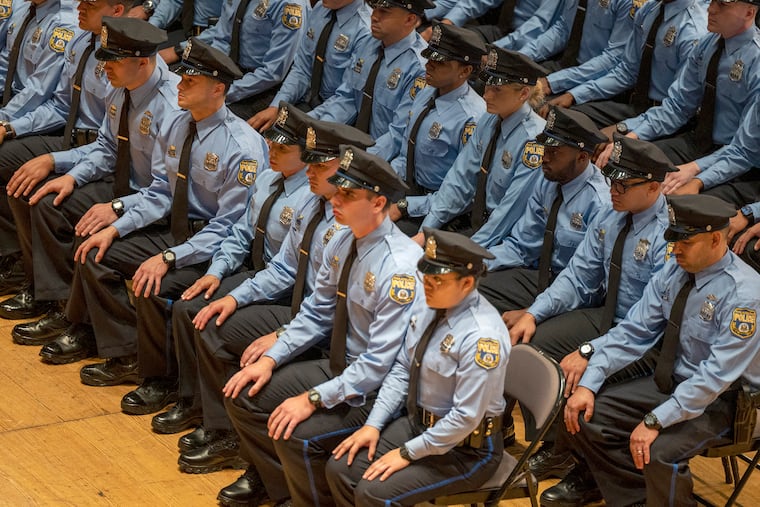
In 2025, the department enrolled 468 officers in training at the police academy, the second-highest number in the 21st century.
Walker is adamant that there has been no drop in the quality of applicants. The California-based company whose software the department is relying on maintains high standards, he said, and is used by more than a thousand law enforcement agencies across the country.
The new system has helped reverse a hiring dearth that began after the widespread protests over police brutality and racial justice in 2020 and continued through the COVID-19 pandemic and beyond.
A year before the protests, the department was at 99% of full staffing, according to Walker. But the numbers soon began to dwindle as diminished interest in policing combined with an uptick in officers leaving the force.
In 2021 alone, 581 of the department’s more than 5,000 officers hung up their uniforms. Officials attributed the drop to retirements, a COVID-era closure of the police academy, and strict local residency rules for prospective officers.
While the department now stands at around 83% of full staffing, Walker said, officials are beginning to see something of a reversal.
Recruitment drives have increased in frequency to more than several times a year, yielding between 1,000 and 2,000 applications each round.
That is a notable step up from 2022, when the department received just 942 applications overall.
Changing technology
Gone are the paper applications of old.
In their place is Guardian’s hiring portal, where prospective recruits can upload copies of their IDs, lists of references, and other documents via computer or on their phones. And the lengthy personal history questionnaires that are standard in the law enforcement industry are now available online, as opposed to requiring a trip to a local police station for paper copies to fill out by hand.
Police recruiters, in turn, use the software to review documents, conduct video interviews, and keep track of a recruit’s medical, physical, psychological, and polygraph exams.
The Guardian software debuted in the city in late 2023, and since then, the time it takes for prospective recruits to go from application to training at the police academy has fallen sharply, to fewer than 60 business days.
Department officials hope to speed things up even more, to about 35 days, Walker said, but it is difficult to schedule the required medical tests and interviews quickly enough to accommodate that time frame. The department plans to hire more doctors to meet demand.
Justin Biedinger, who founded Guardian Alliance Technologies in 2016, said that the company contracts with around 1,300 of the nation’s roughly 18,000 police departments, and that Philadelphia is one of its largest clients.
Biedinger, a former Stockton, Calif., police officer, said the service not only has quickened hiring timelines, but also has increased scrutiny of officers who might not be cut out for a career in law enforcement.
The software allows recruiters to see whether an applicant has been reported for misconduct by another department. And the company uses artificial intelligence to scan social media accounts for red flags such as inappropriate content, guns, or drug use.
“With Guardian,” he said, “these applicants can’t lie.”
To Walker, the biggest benefit of the new system has been the ability to move quickly and hire people who otherwise might have accepted jobs in other departments while they awaited word on applications to work on the Philadelphia force.
“In today’s world, people are not going to wait a year and a half to join this profession, as I did,” he said.
Another benefit of the automated process, he said, is making it easier for out-of-state applicants to apply, drawing candidates as far away as California, Colorado, and Missouri.
And even if the department does not reach its goal of a 35-day timeline, Walker said, the current 55 days “is one of the best in the country. If not, close to it.”