
Has the climate crisis, and related environmental issues, left the building — and data center activism moved in?
Data centers, more particularly the prospect of having them in our communities, have Americans up in arms in a display of bipartisan fury not seen in decades. While it didn’t seem possible, Americans loathe data centers, particularly in their neighborhoods, even more than they did at the beginning of the year, the Pew Research Center found recently (President Donald Trump is a fan).
Locally, Mayor Cherelle L. Parker is setting up a task force to establish boundaries on potential builds in Philadelphia (though there are no concrete plans to build any right now). Once a fan, Gov. Josh Shapiro signed an executive order to impose what he says are the strictest requirements in the country on any developers aiming to launch one in Pennsylvania.
Likely due in part to vocal public opposition in meetings and at protests, supervisors in area townships, including Upper Merion, are either voting against proposals or trying to impose strict limits on construction.
There are some ways in which fear and loathing about data centers (and artificial intelligence in general) intersect with environmental concerns. Notably, some data centers can consume enormous amounts of water. Many of them strain the power grid, rely on fossil fuels, and emit excess heat, particularly in urban areas.
The lower 48 states just experienced their warmest summer in record-keeping history.
But at the moment, many of these admittedly burdensome (and frankly scary) problems lurk somewhere in the future. We’ve got plenty to worry about right now.
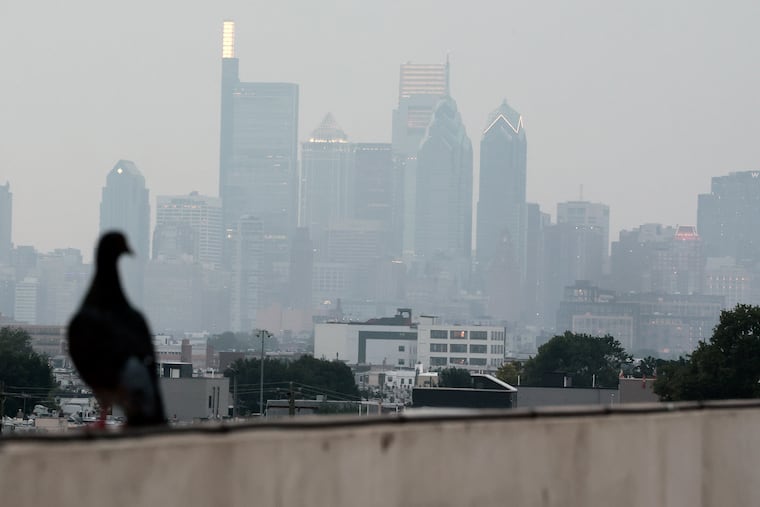
The lower 48 states just experienced their warmest summer on record. In Delaware and New Jersey, rising sea levels threaten both homes and wetlands. This past summer, as in prior ones, smoke from Canadian wildfires (sometimes it comes from fires in the Western United States) around here surged through towns and countryside alike.
That’s not even to mention the devastating effects of fires and rising temperatures in Europe and Indonesia. Melting glaciers in places like Nepal and in traditionally chillier climes like Switzerland are another sign that the metaphorical warning lights are flashing red — whether we believe in climate change or not.
Believers or skeptics, many of the people we encounter often have to cope with the effects of climate change, whether they work on a summer road crew or till the soil on local farms.
A few days ago, I ran into Amanda Newman, the owner of Spotted Horse Provisions, at her booth in the Eagleview Farmers Market in Chester County. With her friend Simon Matthews, she creates an array of pickled vegetables, shrubs, and other locally sourced delicacies. Pointing to the jams, she said with a hint of apology that she didn’t have a lot of berries — they had been destroyed by a spring heat wave, followed by a hard frost. Abnormal, to say the least.
Newman herself hasn’t been immune to a shifting climate. This past summer, she said, she suddenly developed asthma and had to consult a pulmonologist for the first time in her life. His question? “Do you spend a lot of time outside?” He told her that recently, he’s been seeing a spike in local asthma cases.
I found, however, that even in the midst of the data center fever that seems to be sweeping the country, area initiatives to create a healthier planet are thriving (which isn’t to say national ones are unimportant — they are crucial).
Chester County Commissioner Josh Maxwell doesn’t seem surprised data centers are currently dominating the conversation. “There’s a lot more not to like than to like about those places, unless you own them,” he said.
“When you talk about people’s pocketbooks, they start paying very close attention,” he said, adding that he thinks local boards will be prone to nix future data center proposals.
Meanwhile, Chester County is going to continue to do what it can to make progress on creating a greener, more climate-friendly environment locally. “We’re just trying to incrementally do the things that we can do,” Maxwell said. Those steps include making buildings more energy-efficient, limiting the use of impervious surfaces like asphalt or concrete, and managing runoff.
But Chester County leaders have a more ambitious vision in mind — one that seeks to shift, though subtly, the way area communities look at themselves in an era of rapid development and unpredictable weather.
“From an environmental justice perspective, there’s a lot going on that isn’t about data centers.”
Instead of a motley assortment of independent communities, Maxwell said, the next budget will focus on preexisting downtown “villages” — places where responsible development makes sense, while preserving open space and farmland in the more rural areas of the county. Think of the 15-minute city — the urban planning concept in which work, school, shopping, etc., can be reached quickly through a brief walk or short mass transit ride — only in West Chester or Honey Brook.
Chester County plans to propose “affordability, sustainability, and livability” grants to help make this vision a reality.
“From an environmental justice perspective, there’s a lot going on that isn’t about data centers,” said Christina Rosan, a professor in the geography, environment and urban studies program at Temple University who has done extensive research on climate and environmental justice issues in Philadelphia.
Residents who routinely face a host of challenges, including flooding, pollution, illegal dumping, and infrastructure problems, she noted, might be seeing data centers as one more item to add to the list of urban ills they have been combating for decades.
At a time when the federal government seems determined to roll back the clock on national climate initiatives, she said, local efforts, like the successful campaign to close and clean up the old Philadelphia Energy Solutions (PES) refinery in South Philadelphia, matter more than ever.
It’s possible, she added, that suburban activists, now mobilizing to fight data center buildouts and potential pollution, can take a leaf out of the urban playbook. “Data centers in the suburbs are the kind of environmental justice issue the city has been dealing with for decades,” Rosan said, one that may unite cities, suburbs, and rural areas in a common goal — having a say in their own future.
Beneath all of the political drama and social media frenzy, the work of creating a more secure future continues.
I first met Ranger Jared Brandt at a presentation on local history. Those of us in attendance learned that without the four dams built to control water flow in western Chester County, the flooding that still regularly affects communities like Downingtown would have been much, much worse (there were originally supposed to be more than double the number of dams, but oh well).
More than a million people visit Marsh Creek State Park every year, making it one of the most popular state sites in Pennsylvania. Brandt, an environmental education specialist who works there and at French Creek State Park, says his mission is connecting people, which includes clubs and school groups, with the resources they need to be outside.
He’s working to develop more partnerships with local schools. In the process, park visitors and those attending talks, like me, learn about controlling runoff, what happens in a drought, and the source of the water we depend on for drinking and other necessities.
While data centers might be dominating the headlines right now, the work of strengthening community resilience quietly goes on.
“Everything we do is important,” said Brandt. “It can be as simple as a reusable water bottle. How can we do better every day?”
Currently the CEO of Coatesville’s Alliance for Health Equity, Kevin Ressler is also a Mennonite preacher and longtime Lancaster County resident, as well as the former CEO of the United Way of Lancaster County and an advocate for underserved communities. He thinks data centers may be a powerful motivator right now because it’s easy to draw a straight line from their activity to the effect on things like farmland and utility costs.
In the case of climate change, he said, “it’s a challenge to mobilize because fewer people see that direct connection.”
But for those taking the long view, Ressler has got some words of advice seasoned by years of work for justice.
It’s important to remember, even for those exhausted by multiple struggles, he said, that progress can be made — even in a time of frustration and negativity.
“It is the perseverance of individuals who see a brighter day, to continue amid the frustrations and the exhaustions, to continue to demand not only for themselves and their own children, but their neighbors and the individuals they don’t know — and maybe even their enemies — that they also deserve a brighter, better future,” Ressler said.
Using that approach, he said, might prompt people to imagine an alternative future for themselves.
Perhaps that is also true in this case — that in the seeds of the revulsion against huge, impersonal data centers, there is a larger, more hopeful movement brewing.
Elizabeth Eisenstadt Evans is a freelance journalist in Chester County. Her writing has appeared in Religion News Service, the National Catholic Reporter, Sojourners, Christian Century, the Washington Post, and The Inquirer.