
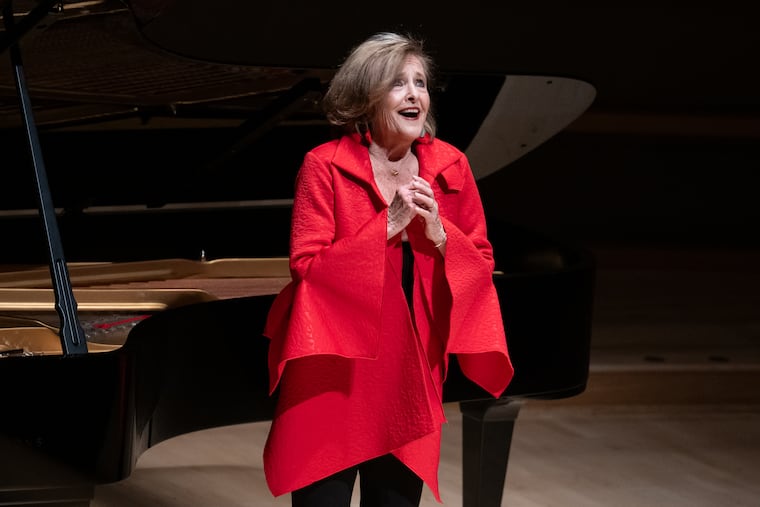
Singers who continue performing beyond the typical farewell date have a special charge: The person behind the voice knows far more than before (about everything), but is there enough voice to support those insights?
The beloved mezzo-soprano Frederica von Stade, now 81, was on thin ice, vocally speaking, when she began selections from Schumann’s Frauenliebe und Leben on Friday at the Kimmel Center’s Perelman Theater. It was a Philadelphia Chamber Music Society program, also featuring three singers from the Metropolitan Opera’s Lindemann Young Artist Development Program.
The thin ice cracked at times but didn’t break as von Stade sang with great purpose afforded by expansive tempos from accompanist Ken Noda. Her honeyed sound was in evidence, but more than ever she sang with infectious commitment. She couldn’t resist saying as much between songs in the final set, Schumann’s Spanische Liebeslieder, Op. 138 — rarely heard because it requires two pianists and four singers of top quality, plus an understanding of the music’s dense textures and the piece’s cultural world.
Most of the program songs (including Schubert and Tchaikovsky) were ensemble pieces written for informal domestic music making that’s unlikely to be in an emerging singers’ repertoire. But that was among von Stade’s starting points some 50 years ago in a recording of duets with recently deceased Judith Blegen (1941—2026). Much of the repertoire lacks masterpiece status, but still needs vocal and linguistic precision for this miniaturist art form.
Von Stade always stayed close to Mozart, Rossini, Massenet, and living composers willing to write to the special qualities of her voice. She once tried big Verdi arias in the safety of her studio, and concluded that she sounded like the cartoon character Minnie Mouse. She has been true to her voice — as well as in this concert where most of the vocal ensembles fit her voice.
Such music can be a heathy counterbalance to more stentorian arias; which is why soprano Jazmine Saunders, who is well-positioned for that, needed time to settle into lighter Chaminade songs that require a cleaner vocal line. In a set of Hahn songs, Jonghyun Park emerged as exactly the kind of lyric tenor in the making that the world needs. Not that art songs are always tidy and genteel. Baritone Yeongtaek Yang took Schubert’s Die Allmacht (Omnipotence) to heaven-storming levels in its dramatic contemplation of the power of God — urged on by the also-imposing pianism of Myra Huang.
Besides mastering their art (as all three singers are definitely doing), the more elusive challenge is harnessing their own personalities. Baritone Yang presented himself like a well-chiseled statue. Soprano Saunders physically reaches out to the audience. But personality needs to live in the voice. Von Stade’s combined warmth and underlying melancholy is one kind of role model, but so is the acclaimed Barbara Hannigan, whose personality arrives in the form of cool ingenuity.
Bottom line: Personality is often the key factor that draws me back to singers time and again. Do I want to von Stade again? Always.