
Some Montgomery County fire departments say they are responding to calls with fewer volunteers, even as house fires burn faster than they used to, according to federal authorities. The volunteer firefighter force has plummeted statewide and nationally in the last 50 years, while calls — mostly for non-fires — have tripled.
Some departments have a mixed paid and volunteer force, but not all towns can make up the difference: All-career fire departments could cost some Montco municipalities almost as much as their police, adding millions of dollars to the budget.
“Everyone is well aware of the astronomical cost it would be for Cheltenham to have an all-career department,” said the township’s fire marshal, Scott Lynch.
Cheltenham and other towns, including Gladwyne, Jenkintown, and Fort Washington, are getting creative to fill boots — with grant-funded recruitment campaigns, subsidized housing, on-site gyms, and stipends — and fire chiefs say it’s helping.
“We are trending in the right direction, which is not something a lot of volunteer fire companies can say these days,” Fort Washington Fire Company Chief Andrew Rathfon said. “We’re doing everything we can.”
Pennsylvania fire companies depend on dwindling volunteer force
Pennsylvania was home to the first volunteer fire company in the United States and, outside of major cities, remains heavily dependent on them: In 2023, at least 70% of Pennsylvania’s registered departments were all or mostly volunteer.
But their ranks have shrunk: In the 1970s, the statewide force numbered roughly 300,000 volunteers, according to data shared in a Pennsylvania state Senate report; by 2018, there were just 38,000.
La Mott Fire Company president Ken Hellendall, who has dedicated more than 40 years of service as a firefighter, remembers when the department had 35 to 40 active volunteer firefighters in the late 1970s. Some worked within running distance from the fire station, at the local bowling alley, beer distributor, or auto body shop.
Changing work patterns — including longer commutes and the rise of dual-income families — have made Pennsylvania volunteers less available, reports in 1998 and 2006 found. In Cheltenham, even the rise of youth travel sports is affecting the volunteer force, La Mott firefighter Dave Schwartz said.
Volunteers have also been priced out of some towns.
“No one can afford to live in Gladwyne,” Gladwyne Fire Company Chief Blaine Leis said.
“That’s the biggest challenge, honestly, for some of the suburbs in recruiting younger people, is the cost of living,” Rathfon, of the Fort Washington company, said.
House fires have become faster and more toxic
As the volunteer force has dwindled in recent decades, fires have become more dangerous for the firefighters who remain.
The oldest homes in the region are often made from natural wood that takes longer to collapse than modern, engineered materials, a 2011 study found.
Newer safety measures like sprinkler systems and fire blocking between stories reduce risk, but the synthetic materials that fill most modern homes can both accelerate the burn and release toxic chemicals into the smoke.
Firefighters used to expect they had about 20 minutes to rescue trapped residents, according to a 2018 Philadelphia Fire Department report. Today, homes can collapse in as little as three minutes, an experiment conducted by the Underwriters Laboratories Fire Safety Research Institute found.
The growing density in suburban towns also presents new challenges, as apartment fires require a larger force to extinguish them, firefighters said. And with so little time to respond, unpermitted home renovations can be deadly.
Investigators of a 2016 Norristown fire that killed four people found the property owners had converted the single-family home into six apartments without a license, meaning the borough never had the opportunity to conduct a rental safety inspection. The building had no fire escapes.
“If it’s an addition on the back on the house and it’s on fire, we don’t know what the construction is — we don’t know what materials were used,” said Lynch, the Cheltenham fire marshal, who is also the township’s building and codes director. “How quickly is there going to be a failure in this part of the house?”
Weighing the expected burn time and the risk to firefighters are part of “decisions you have to make when you’re standing there watching someone’s house burn,” Leis, from Gladwyne, said.
Montco fire companies are recruiting new volunteers
But after years of decline, some companies said they are turning a corner.
A decade ago, La Mott Fire Company was in crisis, officials said. Both numbers and morale were low. The team was disorganized, and there were arguments at fire scenes. Cheltenham imposed three restrictions on the company, including requiring La Mott to respond with at least one other company on calls.
“There was a point that La Mott was looking at being shut down,” said Chief Joe Stuckert, who joined the department from Glenside Fire Company.
When Stuckert and other new leaders came in, they restored standards, fostered a positive culture, and reinvigorated the force, firefighters said.
Now, La Mott aims to continue rebuilding its force, using many of the strategies the company and other Montco departments have seen success with.
That includes economic incentives: La Mott now pays one full-time and five part-time staffers to make sure there is someone at the station who can drive the truck. The county also offers property tax rebates to volunteers — both active firefighters and administrators.
La Mott is also following in the footsteps of Gladwyne, which owns multiple properties to offer reduced rent to firefighters, and Elkins Park — which just expanded its firefighter apartments — by building four one-bedroom units behind the La Mott station.
» READ MORE: Some Cheltenham firefighters could live rent-free under a fire company’s new building proposal
Like several other companies, La Mott also just received a federal grant to fund a recruitment campaign. Jenkintown has netted 15 new volunteers from its recently ended campaign, Fire Chief Ken Lynch said, expanding the force by 60%.
La Mott turned a basement meeting room into a gym, something Gladwyne also has, to encourage volunteers to spend more time there.
Having a mix of programs is most effective, Rathfon said, because each volunteer responds to different incentives.
Telling recruits up front what they are getting into is also important, he said. “We’re not trying to sugarcoat it.”
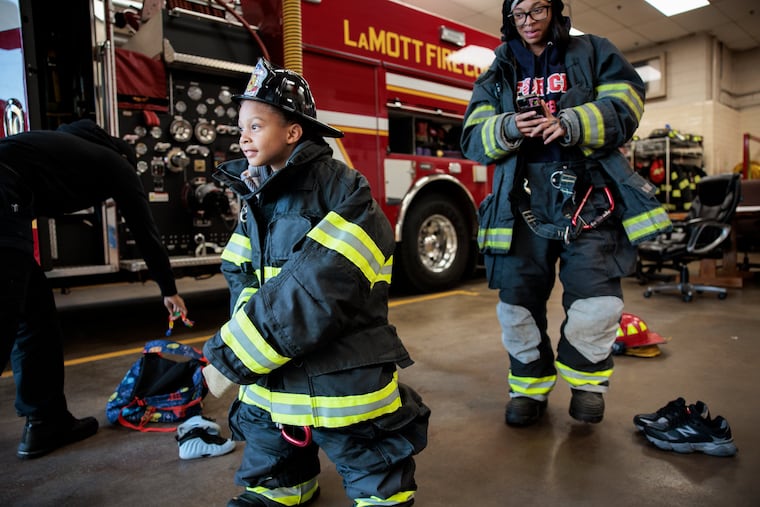
In October, a mom stopped at La Mott’s open garage door to ask if her 5-year-old son could use the bathroom. Soon, the pair were trying on the turnout gear and sitting in a truck.
Hellendall talked to the mom about volunteering.
This suburban content is produced with support from the Leslie Miller and Richard Worley Foundation and The Lenfest Institute for Journalism. Editorial content is created independently of the project donors. Gifts to support The Inquirer’s high-impact journalism can be made at inquirer.com/donate. A list of Lenfest Institute donors can be found at lenfestinstitute.org/supporters.