
Jim Friedlich is CEO and executive director of the Lenfest Institute for Journalism, the nonprofit, noncontrolling owner of The Inquirer. @jimfriedlich
When I was a kid growing up in Verona, N.J., we awoke to two local newspapers on our doorstep: the Star-Ledger and the Verona-Cedar Grove Times. By the end of the day, a third arrived, the Newark Evening News.
The news was local, personal, and community-building.
There was deep, consequential coverage of local school boards, city council, high school sports, and local business. Local news was a part of a virtuous cycle. Each newspaper reflected its community and, in turn, helped to build it.
Today, each of those papers, as I knew them, is gone. The Evening News was shuttered in 1972. The Star-Ledger stopped printing last year, but lives online as part of Advance Publications’ NJ.com. And the Times mainly operates under the banner of Gannett-owned NorthJersey.com.
Those organizations are hardly outliers. The cumulative effect of more than two decades of disruption to the American local news ecosystem has been devastating.
On average, three newspapers shut down per week in the United States, according to research from Northwestern University. The country has lost more than 3,400 newspapers since 2005, a decline of more than a third.
Even worse, the number of working journalists in the United States has fallen by more than 80% since 2002, according to research from Rebuild Local News and Muck Rack.
A decade ago, against this grim backdrop, a perennially optimistic Philadelphia cable television entrepreneur named H.F. “Gerry” Lenfest dared to imagine not just a revival for local news in America but a true renaissance. He posited that some combination of new capital, new technology, new ownership, and new creativity could revive the business of local American news in digital form.
In 2014, Lenfest bought The Philadelphia Inquirer, his beloved hometown newspaper, for close to $90 million. Rather than operate the newspaper for profit, he donated it in 2016 to the Lenfest Institute for Journalism, a new nonprofit organization dedicated to addressing the business challenges of local news throughout the country using Philadelphia as a laboratory.
This year, the Lenfest Institute celebrates its 10th anniversary. The best measure of the institute’s impact is the transformation of The Inquirer, now a national model of revitalization.
Thanks, in part, to investment from the Lenfest Institute and thousands of individual donors, large and small, and sound management by its leadership, The Inquirer is now a profitable, growing digital news business, reaching far more readers with essential coverage of life in Philadelphia through social media, video, its mobile app, its website, and real-time digital news alerts than in print.
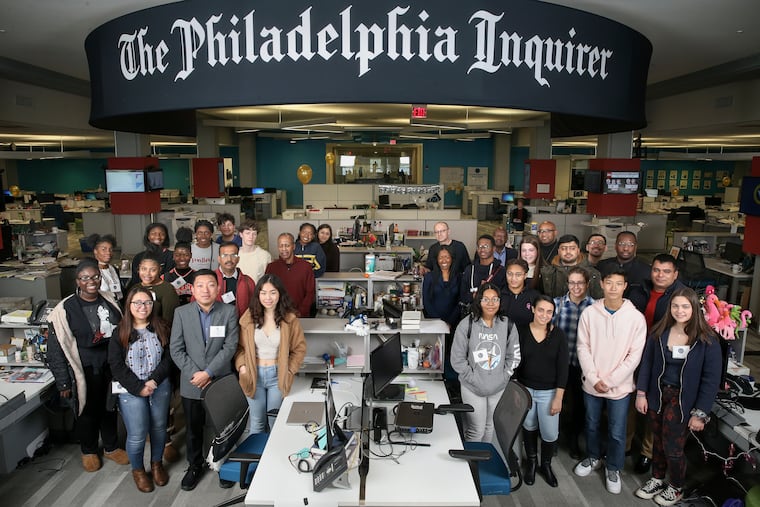
The Inquirer now employs more than 200 reporters and editors, by far the largest reporting team in its region, and operates a thriving internship program and a high school journalism workshop to help train the next generation.
This newspaper, or your most cherished local news organization, is very much deserving and in need of your support.
How do we grade the Lenfest Institute’s own progress 10 years into this mission? We believe we have played a meaningful role in the start of a national revival of local news, and for this we are proud. But the problem we are attempting to solve is immense. The local news industry has not yet moved fast enough or far enough.
Our ambition for the coming decade is to help power a true renaissance in local news — a renewal of growth and creativity. Our goal is not to save struggling newspapers, but to enable a rejuvenation of local journalism’s essential functions — helping to keep powerful institutions accountable and creating a shared understanding of local issues. Nationally, this will require much more capital, much bolder investment, and much greater resolve.
We envision this renaissance for local news in four parts, each proven in one or more American news markets — among them changes in local news ownership, thoughtful new public policy, an embrace of smart information technology, and committed investment in skilled reporters and editors.
The local news industry has not yet moved fast enough or far enough.
Fundamental changes in the ownership and funding of local news have taken hold throughout our region. Major public service news organizations are now owned by nonprofits in Baltimore, Delaware, Harrisburg, Lancaster, State College, Reading, and Pittsburgh, as well as Philadelphia. The Lenfest Institute enthusiastically supports each of them.
Public policy can and should play a stronger role. Last month, new legislation in California added an estimated $200 million over five years to local news in that state, through First Amendment-friendly refundable payroll tax credits that permit government no influence over content.
In Pennsylvania, two proposals in support of local news — HB 2047, which would create a fellowship program in local newsrooms for early and mid-career journalists, and HB 2048, a measure that would establish a Civic Information Consortium to support local news projects — are under consideration by the General Assembly. Both bills have passed the state House of Representatives and are likely to be approved by the Senate in the next legislative session.
The use of new artificial intelligence technology has also proved an encouraging way to advance the reach and power of local reporters rather than to replace them. Through AI, The Inquirer, for instance, now can monitor public meetings in more than 70 municipalities surrounding Philadelphia.
Irrespective of changes in technology — and arguably because of them — news in America needs more boots on the street, a commitment to cover our communities with more reporters, editors, and more diverse news sources providing independent news.
Obviously, this all costs money, and it is worth asking: What is an appropriate national investment in local news? It seems to me that we have just witnessed one useful indicator. Midterm election spending this year was estimated at $11.8 billion — the vast majority spent on local TV and digital advertising, and it turns out much of it was dedicated to attack ads in support of losing candidates. A fraction of the money wasted in these efforts would more than suffice to revitalize the reporting that is the lifeblood of democracy.
We need to make public and private investment in local news — from large contributions to many smaller ones — a serious financial priority to meet a serious national challenge.
Our nation needs a renaissance in local news, and we need your help to make it happen.