
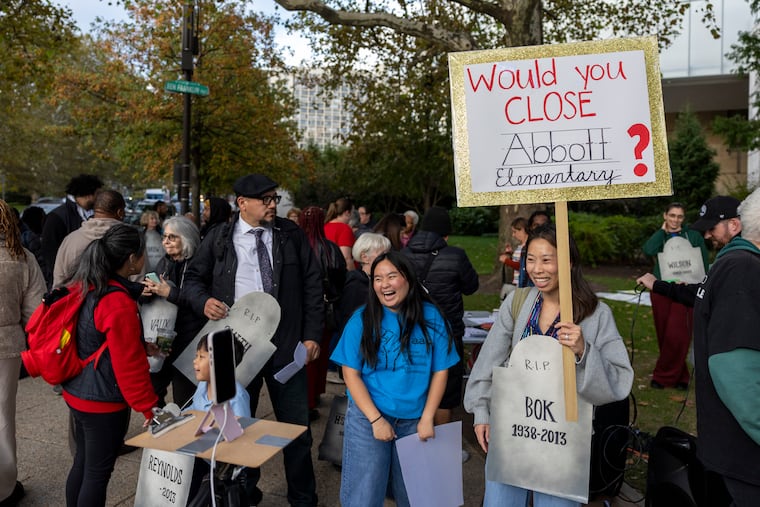
Reginald Streater, president of the Philadelphia Board of Education, opened his testimony before City Council last month by introducing himself as “Reggie from Germantown,” a graduate of two district schools that no longer exist. Germantown High and Leeds Middle both closed. He knows what it means to lose a building. He’s also voting to close 20 more.
The conflict playing out in Philadelphia isn’t only about schools. It’s about the fact that the school district and City Council have different responsibilities for the same places, and the new facilities plan brings that conflict into sharp focus.
On Jan. 22, Superintendent Tony B. Watlington Sr. released a facilities master plan proposing to close 20 schools, colocate six, and modernize 159 others. On Feb 26, he presented an amended final plan to the Board of Education which was updated from 20 school closures to 18. Russell Conwell Middle School and Motivation High School were removed from the closure list.
The district has lost 15,000 students in a decade, carries 300 buildings, many of them 75 years and older, and runs some schools with more than 1,000 empty seats while others are overcrowded. Concentrating students means Advanced Placement courses in every high school, algebra for every eighth grader, and real career and technical pathways. The current spread of half-empty buildings makes all of that impossible to deliver consistently or fairly.
When a school closes, vital community resources close with it.
The facilities plan is doing exactly what it was designed to do. The trouble is that everything it was not designed to do.
A Philadelphia neighborhood school isn’t just one institution. It’s four, sharing an address. There’s the instructional platform: courses, teachers, schedules, the district’s domain. There’s the civic anchor: the building that signals to a neighborhood that its children count, and they belong. There’s the distribution node: where meals are served, where social workers operate, and where there is, most days, someone watching. And there’s the pathway to the future: where a counselor knows a family by name, where a student learns there’s a college or a trade or a life beyond the block.
In places like Kensington, schools have absorbed those responsibilities over time.
When that school building closes, all of those other things close with it. Some of those functions were formal educational programs. Others accumulated because families had nowhere else to go for them. The school became the place where paperwork was explained, problems were addressed and solved, and someone always knew which door to knock on next.
City Council doesn’t get to vote on the facilities plan, but it funds roughly 40% of the district’s $2 billion budget. Councilmember Jimmy Harrity, an at-large member who lives in Kensington, decried that lack of input, but said “the budget’s coming, and we will be looking.” Council President Kenyatta Johnson has signaled he’s willing to hold up city funding entirely.
Residents and families filled the chamber. Parents stood along the walls long after seats ran out, some holding infants, others carrying school backpacks. The hearing lasted hours.
The debate sounded like a disagreement about the plan, but it was really a disagreement about who is responsible for what the plan leaves behind.
What closes with a school building is not limited to instruction. Council’s budget is the instrument for the functions the facilities plan does not govern: housing investment, community infrastructure, colocated services, and neighborhood anchors that exist independent of school enrollment.
The district held 47 public listening sessions and surveyed more than 13,000 people before releasing this plan. The fight at City Hall last month wasn’t because communities weren’t heard. It’s because what they described was a loss that the facilities plan was never designed to address. That’s not a failure of process. It’s a mismatch of jurisdiction.
The district’s plan answers an educational question. What replaces the neighborhood functions housed in those buildings is a civic one.
That answer does not sit with the school district.
Amanda Soskin is a Philadelphia resident and consultant who writes about neighborhoods and civic infrastructure at Neighborhood Fundamentals.