
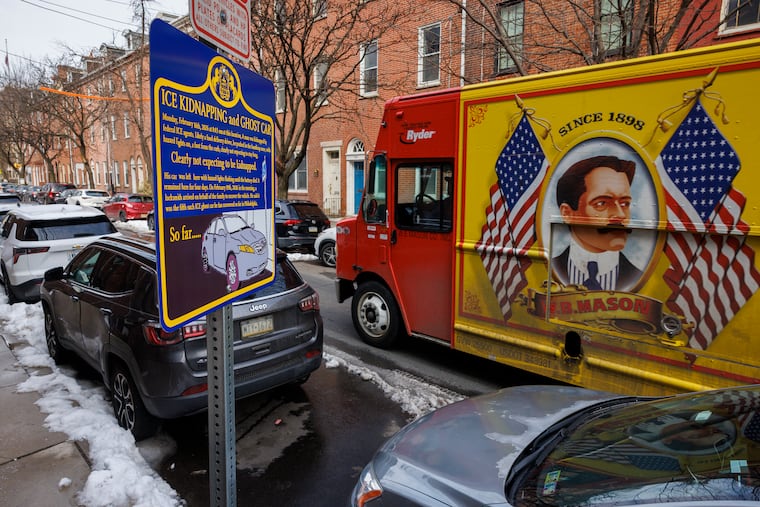
Everyone recognizes the blue-and-yellow historic markers that commemorate important people, places, and events in communities across Pennsylvania, but this one is different.
It stands on Fairmount Avenue near Fifth Street in Philadelphia, where it recognizes not a fabled inventor or bygone colonial battle but something recent and startling ― an ICE arrest.
It took place on Feb. 16, when masked agents descended on a Gopuff delivery driver who had pulled over to make a quick drop-off in Northern Liberties. After he was taken into custody, the car remained there for days, set two feet from the curb in a handicapped space, its hazard lights blinking until the battery finally died.
Of course, the official historic marker isn’t official at all.
It’s an art project, a public call for people to pay attention, created and carried out by Huston West and a fellow artist who goes by the name Emeyewhisky. They wondered what happened to the driver, and thought about how his life changed in an instant.
The sign ― with the familiar Pennsylvania coat of arms at the top ― bears the header “ICE Kidnapping and Ghost Car.”
The “ghost car” terminology borrows from “ghost bikes,” the roadside memorials where a bicycle is painted white and placed at the site where a cyclist was hit and killed by a motorist.
“It’s just what I thought of, when I thought of making something to commemorate the incident,” said West, a musician and artist who lives in the neighborhood. “A lot of people have reached out and said we should do this at all the ICE kidnappings.”
Federal immigration authorities say that the use of such terms is inaccurate and unfair, that they lawfully arrest migrants who have no permission to be in the country and who in some cases have committed criminal and even violent offenses.
Immigration and Customs Enforcement officials in Philadelphia said that on the morning of Feb. 16, officers conducted a targeted action and arrested Abdulasen Nazarkhudoev. ICE said he was unlawfully in the U.S., and claimed to be a Russian citizen.
He was taken to an ICE facility in Philadelphia ― court records show it was the Federal Detention Center in Center City ― and later released by order of a judge, pending further immigration proceedings, records show.
ICE referred questions about the sign to city officials, who on Tuesday could not immediately be reached for comment.
As word of the project has spread on social media, not everyone has approved. Some suggested on a Northern Liberties Facebook group that the delivery driver was rightfully arrested.
“Kidnapping or lawful detainment?” one person wrote. “I love this word salad you people play.”
Another posted: “Maybe dude has a warrant. Y’all so quick to jump to conclusions.”
In fact, the arrest was not particularly unusual ― ICE arrests immigrants every day in places across the region, and those detentions often pass unnoticed except by the people affected.
Video recordings circulating online show agents in tactical vests marked “police” approaching the delivery driver’s car. One opens the passenger-side door and reaches inside, apparently to turn off the car or take the keys.
Records show that Nazarkhudoev’s attorney, Mana Aliabadi, filed a petition for his release the same day. On March 4, U.S. District Judge Joshua Wolson, who was appointed by President Donald Trump, ordered his immediate release.
Aliabadi said her client, who lives in Philadelphia, entered the country in 2022 and was released on his own recognizance as he pursued asylum. He has a work permit, driver’s license, and Social Security card.
He faces no criminal charges, she said. She declined to discuss his home of origin, as citizenship is often a crucial issue in asylum cases.
Asylum is a legal U.S. process designed to protect people fleeing persecution. In the past, asylum-seekers were rarely bothered as their cases went forward. That has changed in the last year under Trump, as asylum-seekers, green-card applicants, and refugees have been arrested and held by ICE.
At the same time, federal judges in Philadelphia and across the country have repeatedly ruled against the administration’s mandatory-detention policies, which require custody for nearly all undocumented immigrants as their cases proceed.
The policy means that people have to individually challenge their confinement through what are known as habeas petitions ― a demand that the government bring a detained person to court and prove that they have been legally imprisoned.
Around the country, ICE arrests have increased dramatically as the Trump administration pursues what the president promised will be the largest deportation campaign in U.S. history.
When Trump took office, about 40,000 immigrants were held in a national network of detention centers, that figure growing to more than 70,000 in mid-January ― a 75% increase. More people are being detained in what are known as “collateral arrests,” when ICE acts to arrest one person but encounters others who are also taken into custody.
In Northern Liberties, the events that culminated in an authentic-looking historic marker began when a neighbor in a Signal chat alerted others that a delivery driver was seen being arrested by ICE.
West walked from his home to look at the car, its flashers blinking.
“A neighbor had laid flowers on the windshield,” he said. “I wanted to put a banner on the car. People were like, ‘Don’t mess with their car.’”
Instead he came up with the design and text for the plaque, while his art partner edited the language and constructed the sign. Emeyewhisky is known for projects that place signs with fake wording on Philadelphia streets.
Ghost cars are a new ― or newly noticed ― phenomenon, the vehicles left behind after their drivers have been arrested by ICE. West said a locksmith who was eventually called to Northern Liberties told neighbors it was the fifth ghost car he had helped recover.
The plaque shows an image of the car, a gray Toyota Camry.
“I wouldn’t have known about this if I hadn’t connected with my neighbors,” West said. “There’s some scary [stuff] going on.”