
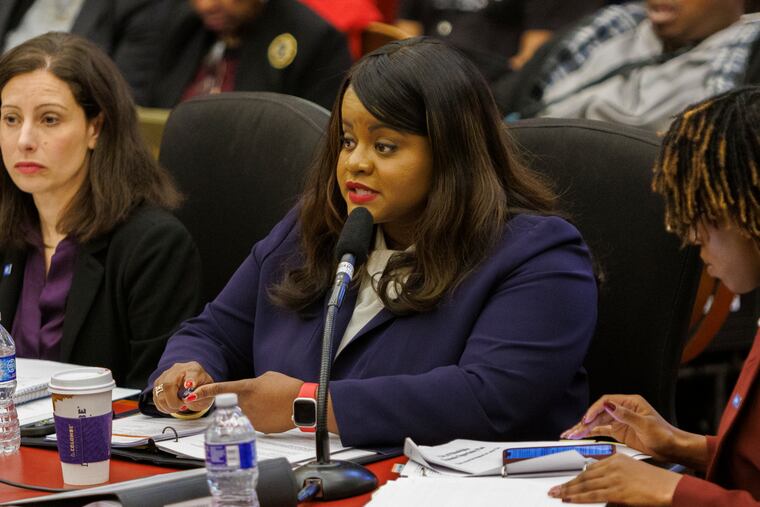
City Councilmember Jimmy Harrity said he’s worried Mayor Cherelle L. Parker’s proposed $1-per-ride tax on rideshare services will hurt residents who rely on Uber and Lyft to get to work.
Council President Kenyatta Johnson questioned why the $1 tax, which will aid the Philadelphia School District, wasn’t included Parker’s initial budget proposal given that the school system’s financial woes were well-known.
And Councilmember Cindy Bass said simply, “I don’t like it.”
Parker’s $7 billion proposal for the next city budget would largely preserve the status quo on most big questions regarding city taxing and spending policies. But on the first day of Council’s seven weeks of planned budget hearings, the mayor’s plan for throwing the school district a lifeline got as much attention as anything related to city government.
Parker two weeks ago initially pitched a 20 cents-per-ride fee, which would send the district about $9.6 million per year. On Monday, she announced she was revising the proposal to $1-per-ride, which would generate about $48 million per year for schools. She said she made the change after the administration learned more about the district’s $300 million deficit.
Councilmember Cindy Bass said she wasn’t a fan of the proposed fee, whether it was 20 cents or $1 per ride.
“I don’t like it. I don’t think most people like it,” Bass told reporters Tuesday. “I know a number of people who really have come to rely on Uber and Lyft as a reliable means of transportation to get” to work and school, she said.
Bass said she needs more information before deciding how she’ll vote on it.
“I don’t like the tax in general, but we will see,” Bass said. “There needs to be some value to it. I’m not exactly sure yet that we’ve seen that there’s the value that we really need to see.”
Parker on Monday said she was quintupling the proposed rideshare fee to prevent the district from having to follow through on its plans to plug its budget gap with painful cuts.
“I’m putting this proposal on the table because we need to do all that we can so that students don’t have to suffer from these devastating cuts,” Parker said.
Finance Director Rub Dubow said Tuesday that the administration chose the rideshare fee to help plug the school district’s deficit in part because it is in effect a progressive tax, meaning wealthier people would pay a higher share of the revenue it generates because they are more likely to use Uber and Lyft.
“When we looked at who uses ride share companies, as income goes up, there’s more usage,” Dubow said. “That was important to us to understanding who uses it.”
‘I don’t like it’
Councilmember Jim Harrity, a Democrat who represents the city at-large, said he’s concerned about the impact on low-income residents, saying one of his neighbors uses Uber as many as six times a day to get to work and transport his children.
Harrity asked the administration to explore capping the number of times a single rider can be charged the fee over the course of a week, saying “we’re adding another tax that somehow we think is not going to affect low-income people.”
“Are we taking into consideration things like thinking about placing a [cap] on how many times we can charge these poor people?” Harrity said.
Councilmember Mike Driscoll, a Democrat who represents much of Lower Northeast Philadelphia, said the proposal is “going to require more discussion.”
“I mean, we went from 20 cents to a dollar in two weeks,’ Driscoll said. ”So I want to know what that’s about. … I think we’re far from where we need to be.”
And Councilmember Jamie Gauthier, a West Philadelphia Democrat, said the city needs to balance the needs of the district and residents.
“Our School District desperately needs more revenue — but we need to be careful about new taxes that we know will fall on consumers, especially if they won’t stop the closure of our neighborhood schools,” Gauthier said in a statement Monday.
Not all Council members who commented on the fee Tuesday were skeptical.
“It’s genius,” Councilmember Curtis Jones Jr. said. “Usually we go right to vices — cigarettes, alcohol, things like that. We went to something that is an emerging transportation mode. I think it’s probably going to get passed on [to consumers], but the people I talk to don’t care about the dollar. If it helps us out of a $300 million budget deficit, it’s painless.”
One reason Council may have given the plan such a frosty reception is the district’s recently announced facilities plan, which calls for closing 20 schools and has been criticized by some lawmakers. Johnson indicated Tuesday he may use the proposed tax as leverage to ask for concessions on the facilities plan.
“There are some outstanding questions and concerns from our members just on the basic proposal on the shutting down of schools,” he said, “and that’s really where my focus is right now.”
‘Those are real people’
Asked what the city will get in return for taxing rideshare services, Parker’s chief of staff Tiffany W. Thurman pointed to the benefits to Philly schools. The district this week said the increased fee would save 200 classroom positions and that it had found savings internally that will save an additional 40.
“You can see 240 jobs saved,” Thurman told Council. “Those are real people, and those are real results. And while that doesn’t fix the structural deficit — and it doesn’t, it doesn’t in any way fix the structural deficit — it does save 240 jobs, and that’s important to us.”
Thurman said it also strengthens the city’s position in Harrisburg because Philly lawmakers will be able to point to the city’s willingness to generate more revenue locally when trying to convince legislators from elsewhere in Pennsylvania to have the state chip in more.
Local legislators, she said, will be able to say, “This is what Philadelphia did. This is what Philadelphia is doing. Now, let’s do our part to fix the actual structural deficit.”
‘Did they not know?’
School district officials raised the possibility of a financial crisis a year ago.
Johnson, who has often projected a united front with the mayor, on Tuesday asked pointed questions of administration officials about why Parker didn’t unveil the increase in the proposed fee until two weeks after her budget proposal. He asked if Superintendent Tony B. Watlington had been upfront about the district’s deficit.
“When you sat down with Dr. Watlington and his team, did they not know that there was a [deficit] during the first presentation to the administration, before the actual determination that it would reap cuts and layoffs?” he asked.
Parker administration officials said they met with Watlington before the mayor proposed her budget, but that the extent of the financial strain was not known.
Thurman said the administration met again with district leaders in the evening on March 12, hours after Parker delivered her budget address.
“That evening we learned that the deficit was actually much bigger than what was originally reported,” Thurman said. “And as a result, we said, ‘Hey, we’re going to go back to the well. We’re going to see what we can do.’”
After the hearing, Johnson said the school district “should have been more thorough” in ensuring the administration knew the extent of its financial strain.
“That should have been in the rollout from the beginning,” he said, “and everybody would have had all of the information so we can all move forward.”
Staff writer Kristen A. Graham contributed to this article.