
JUÁREZ, Mexico — The only time most Americans think about the southern border, it usually involves violence or fear or both. The bloody aftermath of a cartel shootout or crowds of people pushing at the gates, yearning for a better life across the river. Otherwise, people in the U.S. tend to ignore the area as a wild and lawless land.
Part of that comes from distance — only about 5% of the United States lives in border counties — but a lot comes from the stories we tell about the region, and who gets to tell them. Of course, the border is a hard place to describe, although if I had a dime for every time a New York Times writer has called my birthplace “dusty,” I could afford a nice HEPA filter.
It is a place that is filled with, yes, violence (homicides here at least dipped under 1,000 last year) and yes, dust (2025 was a historic year for dust storms). But as much as these things seem inescapable, they are hardly defining.
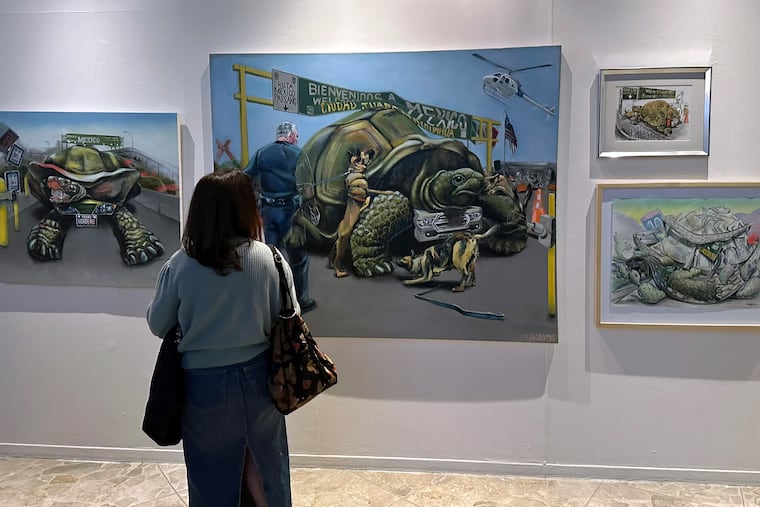
All of this was on my mind as I flew in to see my parents in El Paso, Texas, last week, and my visit coincided with the border sister cities becoming a joint art mecca by hosting three high-profile public events simultaneously. The scholarly Latino Art Now! (LAN) international conference, the Border Biennial, and newcomer Sutura, which billed itself as a binational art encounter, were all happening at the same time.
For Edgar Picazo Merino, who runs the Juárez art nonprofit Azul Arena and who was the lead organizer for Sutura, one of the goals was to spotlight border art by border artists, who, through their lived experience, understand the region’s nuance and sometimes incongruous nature.
“You live in a place that has this heavy symbolic weight,” he told me. “A place of violence, within and without, but also historically a land of possibilities for a lot of people; a place of permeability of culture and language — artists are naturally always trying to understand that.”
Sutura, which translates as suture, was named as a response to Chicana feminist author Gloria Anzaldúa’s definition of the border as an open wound “where the Third World grates against the first and bleeds.” The term, I’m sure, in part, because it sounds pretty cool and incredibly artsy, has become the go-to description of the border in many a postgrad thesis and beyond.
To Picazo Merino, it’s time to move away from that description, or to start seeing art and culture as a potential healer. A way to stitch and come together through collaboration and representation of the different points of view about the border.
“If you keep calling it an open wound, then people are going to keep seeing it as an open wound,” he said. “But it’s division that’s the real injury. Seeing ‘the other’ as the enemy, seeing each other as competition, obstacle, danger.”
Like Picazo Merino, I am optimistic, but one of my favorite pieces I saw during the show was Such Frontera: el Caos and the Noise, an animation art installation which, for much of its runtime, has a rather bleak view of the border — one where the United States looms large and, in the power imbalance between itself and Mexico, it defines the conversation and how the people here see themselves.
Artist León de la Rosa Carrillo, a professor at the Universidad Autónoma de Ciudad Juárez (with degrees from the University of Texas at El Paso and the University of Arizona), wanted to make sure that at an event that celebrated the ties that bind, there would be a reminder that despite the geographic closeness, there can be a chasm between the two countries.
How the border is a tool of division that people like us, who are privileged to have lives on both sides, perpetuate through our use of that privilege. (Pretty heady stuff for a piece that uses humor to disarm and bouncing emoji as its lingua franca.)
“The border is used to racialize us depending on where we were born. It’s used to define what progress is, to define what is a crime, to define who has the right to live here,” he said. “As a lifelong fronterizo, I thought that crossing over meant resistance to that separation, to that domination … now I find it hard to accept that I was always a part of that instrumentalization of the border.”
Still, the animation ends with a glimmer of hope; a possible way to exist within this tension.
De la Rosa Carrillo told me he was going to cross the border Friday for the first time since Donald Trump returned to the White House to be on a panel at LAN, where he planned to explain why he hadn’t visited the U.S. in almost two years.
His (mostly) dark take on the border is not mistaken; in fact, it is part of our nature here. Perhaps it’s that some of the stereotypical personality traits of the two countries — Mexico’s mix of pessimistic stoicism and the boundless optimism of the American character — sit at the heart of every borderlander.
The border may be dusty and violent and riddled with the painful contrasts that exist between the U.S. and Mexico, but the culture produced in that union is special, worth celebrating and exploring with nuance and depth.
To continue with Picazo Merino’s theme, the definition of suture also includes “the seam or seamlike line along which two things or parts are sewed or united.”
Understanding the border means understanding what it means to live in the seam.