
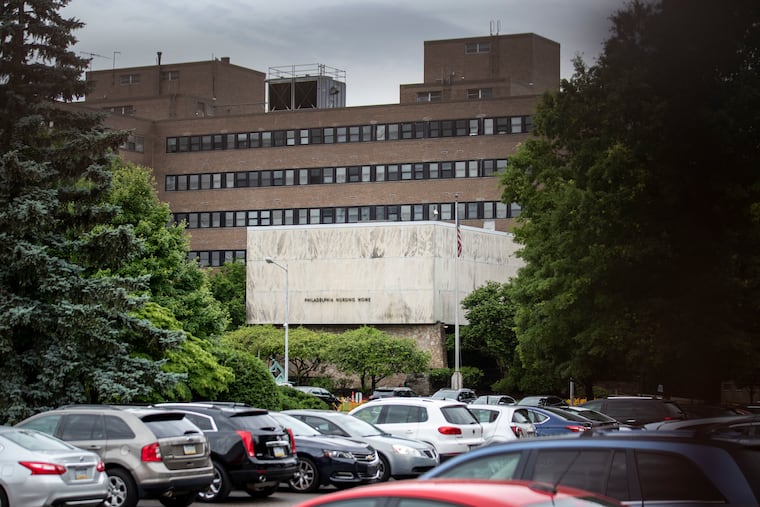
A shelter in Philadelphia’s Fairmount neighborhood that has more than 300 beds and is a critical part of Mayor Cherelle L. Parker’s strategy to address the drug market in Kensington is facing an uncertain future amid a potential zoning battle and lease instability.
Parker wants to spend millions of dollars this year to continue operating “Philly Home at Girard,” a program her administration quietly began two years ago at 2100 W. Girard Ave., a hulking campus owned by the state and the site of the former Philadelphia Nursing Home. The city spent more than $15 million operating the facility in the current fiscal year.
But the city’s lease of the building, which has been in place for 50 years, expires in June, and it’s unclear if a new deal will be inked. Parker administration officials said the city will be considered a “holdover tenant” after June, and that the state can require the city to vacate the property with six months’ notice.
At the same time, land-use issues are complicating matters. In December, the Department of Licenses and Inspections — a part of the mayor’s administration — issued a citation, saying the facility is being used for a purpose other than it is zoned for. Obtaining a special zoning designation could be a lengthy and uphill battle.
Hanging in the balance are hundreds of people who stay in the shelter.
Inside is a mix of traditional beds for people without a place to stay, plus the program for residents in addiction. It is not a drug treatment site — rather, city officials say it’s a “safe haven” where people can stabilize even if they are not ready to enter treatment. Medical services such as wound care are available, and residents can receive mental health support and case management.
Cheryl Hill, director of the city’s Office of Homeless Services, said the population served by Homeless Services at the facility is especially vulnerable — nearly half are over age 55, far above the system-wide average.
The city is in the process of adding 1,000 beds to its shelter stock amid increasing homelessness rates. Parker has proposed increasing the city’s hotel tax, which would generate an additional $20 million a year, to finance that effort.
Still, an abrupt closure of the Girard Avenue facility, Hill said, could mean hundreds of people may “return to the streets.”
“Obviously we would try to do our best to not make that happen,” she said. “But to be able to find another location that can house all the individuals would be a pretty heavy lift.”
It is just the latest set of challenges facing the facility.
In 2022, the city shuttered the decades-old nursing home there after the COVID-19 pandemic devastated the nursing industry. Officials at the time cited financial hardship and a dwindling occupancy.
The city quickly began using the site as a homeless shelter. Operated by Resources for Human Development, the facility had dozens of beds available as emergency shelter for people referred there by the Office of Homeless Services and outreach workers.
There was little pushback. That changed in May 2024, when The Inquirer reported that the new mayor’s administration was expanding capacity and adding new programming at the site to absorb an influx of residents from Kensington. At the time, Parker was looking to make quick progress on a campaign promise to address the open-air drug market there.
Fairmount neighbors were up in arms that they hadn’t been consulted, and they told city officials they worried that their neighborhood would inherit the quality-of-life problems long associated with Kensington.
Also angry was Jeffery Young, Jr., the City Council member who represents the area. He sponsored — and Council approved — multiple pieces of legislation related to the facility, including a resolution allowing Council to subpoena the mayor and a bill preventing the city from signing another long-term lease at the facility.
But over the last two years, tensions between the neighborhood and the Parker administration have cooled substantially.
Dustin Dove, president of the Fairmount Civic Association, said the city has been proactive in communicating with residents and responding to quality-of-life concerns. He said the city convened an advisory council for neighbors to meet regularly with officials.
“They’re in constant communication with neighborhood groups and with neighbors,” Dove said. “I really appreciate that they saw the anger and the confusion that happened two years ago, and they took steps to address it.”
Sharon Gallagher, a spokesperson for the Managing Director’s Office, said the city provides “consistent neighborhood services” around the site, including trash pickup twice a day, an increased police presence, and that service providers make multiple rounds each day around the perimeter of the facility.
Young said earlier this month that complaints from neighbors have slowed considerably, though he said he still “would hope the administration fully funds the quality-of-life issues happening like needles and people roaming.”
“We have asked for Ring cameras, more bike patrol, and other resources,” Young said.
Isabel McDevitt, the Parker administration’s executive director of community wellness and recovery, said the city is committed to working closely with Fairmount neighborhood leaders and is working with Young on the zoning issues.
The site is currently zoned as multi-family residential. The new use is classified as “group living,” which requires a special exception permit be granted by the Zoning Board of Adjustment. The ZBA process can take months, and the board considers input from community groups and the district Council member — in this case, Young.
All that, McDevitt said, is contingent on Council approving a budget for the site. Parker’s budget proposal includes $211 million over five years for both Philly Home at Girard and the Riverview Wellness Village, a city-owned recovery house in Northeast Philadelphia.
Council is currently in the process of budget hearings and negotiations, and lawmakers must approve a spending plan by the end of June. The Managing Director’s Office, which oversees recovery programming and the Office of Homeless Services, is scheduled to testify to Council on Monday.
McDevitt said results inside the facility have been positive: More than two-thirds of the people who receive medical care at the facility are also enrolled in a program for people with opioid use disorder to take medication that helps control cravings, and the average length of stay is nearly four months.
There are often challenges with real estate when it comes to programs for people with complex behavioral health needs, she acknowledged. But she said the city has “a really solid idea of what type of facility we need.”
“Of course it would be a challenge,” McDevitt said of the threat of closure. “But I think we’re in a very solid position to be able to continue these programs, regardless of location.”