
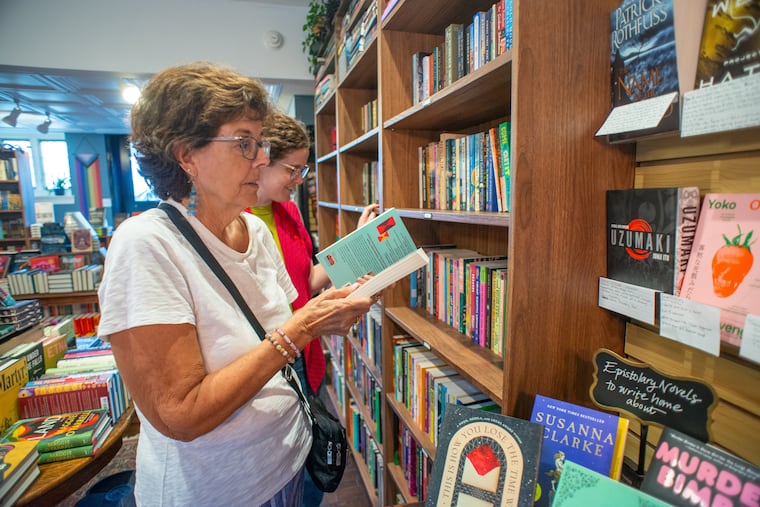
Fishtown Books opened last weekend, the neighborhood’s fifth bookstore. In Manayunk, one couple opened two bookstores on the same street. The August opening of a West Chester fantasy shop wrapped a line around the building, ending early when the shelves were nearly emptied.
Across Greater Philadelphia, bookstores are back.
And despite the growing competition, many sellers said sales are up, mirroring national trends: The Association of American Publishers found the number of books sold via physical retail grew almost 34% over the past five years, outpacing online retail.
“I did not plan for it to be so busy,” said Jackie Botto, 41, of Capricorn Books, which expanded its Jenkintown storefront in July. “We’ve almost doubled our business.”
Screen fatigue, a hunger for community, and a desire to support local businesses are fueling the surge, said sellers — many of whom are investing in niche genres and hosting creative events to meet their customers’ needs.
Readers are reading, book people say
The reading boom isn’t limited to stores. At Jenkintown and Abington libraries — which sit along the same corridor as Capricorn and a new Barnes & Noble — patronage is growing, and both libraries are mulling expansion.
Adult print circulation is up 10% in Abington, and children’s circulation is up 50% since last year. “People are consuming more literature and media in general,” said Abington’s head of circulation Marcus Palm.
And parents are prioritizing reading for themselves and their kids, said the Abington library director Elizabeth Fitzgerald: “There is a bit of backlash to the doomscrolling.”
At Bookmarks in West Chester, some customers have tried ebooks and are returning to print.
“They spend all day working on the computer,” owner Lisa Strohl said. “They’re tired of being on the screen.”
But some apps like TikTok — and its algorithmic niche known as BookTok — are also driving readers to the stacks.
BookTok and tailored offerings draw young readers
“The screen is helping them get back into reading,” said Charity Herndon, owner of Austen’s Shelf in Bordentown. “[BookTok] was the only way to reach the younger generation of readers.”
Sellers like Herndon and Anthony Long — who opened Thrillerdelphia in Manayunk last year after helping his wife open romance-focused Cupid’s down the street — are using both digital and analog strategies to turn new customers into loyal fans by delivering the community hubs they crave.
In a recent Instagram reel, a Thrillerdelphia staffer played a guitar riff to match each book cover he displayed. In November, the store is hosting the horror punk band Blitzkid, a member of which is also an author.
“I know my customers,” Long said. “You can get the eyeballs, but you have to build the intrigue and make people want to come in.”
Active support from local residents is key, many sellers said. Literary agent Eric Smith decided to start the Philadelphia Book Crawl a few years ago. It’s become a kind of Black Friday for bookstores; several said it’s their best day of the year.
“I’m terribly invested in how things go for our local indie bookstores,” Smith said. “I want to see them thrive.”
Barnes & Noble is back
Some credit TikTok with helping to revive a declining Barnes & Noble, which opened more than 60 stores last year and plans another 60 by the end of 2026 after years of losses and an acquisition.
“[BookTok] was absolutely a key point, especially during COVID,” said Barnes & Noble Vice President Janine Flanigan. “I’ve never seen the conversations around books the way we see them now.”
The chain has taken notice of successful indies: a press release for the new store in Abington — where a Barnes & Noble had closed more than a decade ago — highlighted plans for local author events and book clubs.
The Abington store’s stock will be selected more locally, Flanigan said. “The store managers are deciding what to put in front of their customer.”
The private equity-owned company’s shift to localized control only highlights the value of independent sellers, said Buffy Hastings, a co-owner of Farley’s Bookshop in New Hope.
“They got beat by us,” he said.
Botto, who owns Capricorn Books near the new Abington Barnes & Noble and has fond childhood memories of the chain, is optimistic that there’s room for everyone.
“Looking at our numbers we have no reason to be worried, which is great,” she said.
People buying books despite affordability crisis
Richard De Wyngaert, whose Queen Village store Head House opened during the online and big-box-bookstore boom of the early aughts, said those initial customers would always compare him to online vendors.
“Price was all that mattered,” he said. “That two-dollar savings.”
But a few years ago, he noticed a shift — “a new generation who wasn’t raised to think you had to match Amazon,” De Wyngaert said. “By then, we all knew the horrors.”
Sellers say book prices have shot up in recent months, but the customers keep coming.
The relative price hike for other consumer luxuries like airfare may be part of the reason: The consumer price index for “recreational books” has yet to return to its 30-year peak in 2009.
“I have seen this summer someone who’s like ‘I can’t go on vacation, so I’m going to read about Italy’,” Herndon of Austen’s Shelf said.
Readers want to ‘escape’, booksellers say
The genres driving much of the growth in stores with broad selections, sellers said, are romance — especially when mixed with fantasy, a subgenre known as romantasy — and horror.
There are also the blockbuster books they can’t keep in stock, like the sci-fi fantasy series Dungeon Crawler Carl, and a return to the classics.
What these books have in common, sellers said, is they’re totally disconnected from everyday life — or, as Hastings put it, “the realities of living in America in 2026.”
The bestsellers at Austen’s Shelf are “books that allow people to escape,” Herndon said. “People just want to tuck themselves into a different world.”
When Head House opened in 2005, “people thought I was nuts,” De Wyngaert said. “Today you see bookstores … springing up everywhere.”
It’s “good news,” he added, “for a world that needs some good news.”
This suburban content is produced with support from the Leslie Miller and Richard Worley Foundation and The Lenfest Institute for Journalism. Editorial content is created independently of the project donors. Gifts to support The Inquirer’s high-impact journalism can be made at inquirer.com/donate. A list of Lenfest Institute donors can be found at lenfestinstitute.org/supporters.