
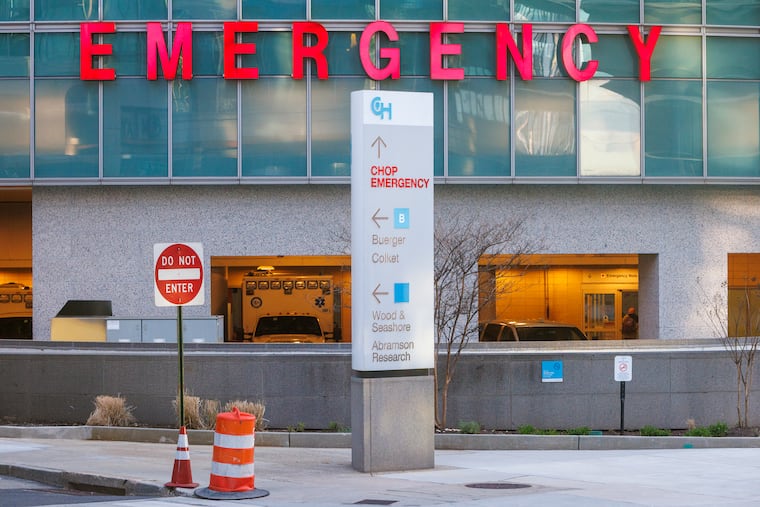
The visitor arrived at a neonatal intensive care unit at the Children’s Hospital of Philadelphia in University City last Friday morning.
Then they visited a family lounge. An atrium. A cafeteria.
At each stop, the person, now known to be infected with measles, potentially exposed others to the highly contagious disease that is particularly risky for young children, city health officials announced this week.
Hospitals have spent years preparing for such incidents, no longer a theoretical concern as Pennsylvania now deals with the nation’s largest measles outbreak this year, which has already sickened more than 760, experts in infectious disease prevention say.
Nemours Children’s Hospital in Wilmington reported an exposure in its emergency room in February, although the state has seen only 23 cases of measles all year.
And across the state in Allegheny County, the University of Pittsburgh Medical Center Children’s Hospital has reported several possible measles exposures this summer.
Health officials did not specify how many babies and others were potentially exposed at CHOP in announcing the exposure late Thursday. Philadelphia health officials have issued only general details on the infected person’s visit, along with guidelines for anyone potentially exposed to the virus over the course of several hours on Sept. 11 at the hospital at 3401 Civic Center Boulevard.
CHOP officials directed inquiries to the city’s health department, and did not respond to questions about the hospital’s measles protocol or whether those would change after the exposure.
City health officials said they’re working with CHOP and state officials to ensure that some of the hospital’s most vulnerable patients — babies in the NICU — receive preventive treatments to protect them from the virus.
Infectious disease experts say hospitals around the country have been monitoring an explosion of measles cases in the last several years.
Pennsylvania as of Friday had seen 767 cases of measles in 2026, with 93 reported in the last week. One in five of people with reported cases has been hospitalized.
State officials have confirmed four measles-associated deaths in the last several weeks, the most seen in the nation in more than three decades, sparking a clash with federal officials over how to characterize the deaths.
“Measles has been up and coming. It’s definitely on the radar of hospitals,” said Ericka Kalp, who directs Drexel University’s infection prevention and control academic programs. “Your risk has increased when you have multiple measles cases within your vicinity.”
Every year, hospitals work on an infection control risk assessment, monitoring rising diseases around the country and internationally, and developing plans on how to treat sickened patients.
That could include triaging patients with respiratory illnesses and isolating those with suspected cases in special rooms, said Kalp, who was not involved in the response at CHOP.
Screening visitors to a hospital is tricky, she said.
“We can ask visitors and the public not to visit if you’re sick, and visitors need to take it upon themselves to not go to the facility if they’ve been around a particular exposure,” she said.
But some may not know they are ill: A person can be contagious for four days before measles’ telltale rash appears.
The virus can linger in the air for up to two hours and infect nine in 10 unvaccinated people exposed to it.
Pregnant women, babies under six months, and some immunocompromised people are among the groups who cannot be vaccinated. Their protection depends on nearly everyone else in a community being vaccinated to prevent the disease from spreading.
But more parents have opted against vaccinating children for religious or philosophical reasons in recent years, The Inquirer has found, leaving hundreds of area schools and communities vulnerable to the spread of the virus.
“When you see fewer people are becoming vaccinated and they have less immunity, it opens up a portal of spread,” Kalp said. “We’ve always trained for this type of thing.”
Treating those exposed
City health officials said CHOP is giving “a preventive antibody product” to infants in the NICU to prevent them from acquiring measles or developing severe disease.
Doctors can administer immunoglobulin, a treatment made from the plasma of adult donors, that helps boost a baby’s antibodies to infectious diseases like measles, said Sarah Long, a Drexel pediatrics professor and a physician specializing in infectious disease physician at the Bristol-Myers Squibb Children’s Hospital in New Brunswick, N.J.
In an outbreak, she said, hospitals can consider limiting visitors to prevent exposures, especially for a virus like measles, which is particularly dangerous for young children and kills about 1 to 3 for every 1,000 infected.
But responding to measles cases or exposures can require a hospitals to expend extensive resources.
“It’s an enormous number of meetings, manpower, education about IDing cases early, and sequestering as soon as a patient comes in with a fever,” she said. “It’s an enormous amount of money, gowning, gloving, and masks.”
The latest rise in cases — and rising anti-vaccine sentiment — frustrates Long, who treated children during Pennsylvania’s last major measles outbreak in the early 1990s, which sickened 1,400 people and killed nine children.
Now she’s worried again about vulnerable children. Nearly a third of Pennsylvania’s cases this year have been reported in children under the age of 18, and two of the measles-associated deaths involved infants.
“It makes me just angry, angry, angry. There are so many catastrophes in children’s healthcare that are not preventable,” she said. “To have catastrophes that are preventable is just unconscionable.”