
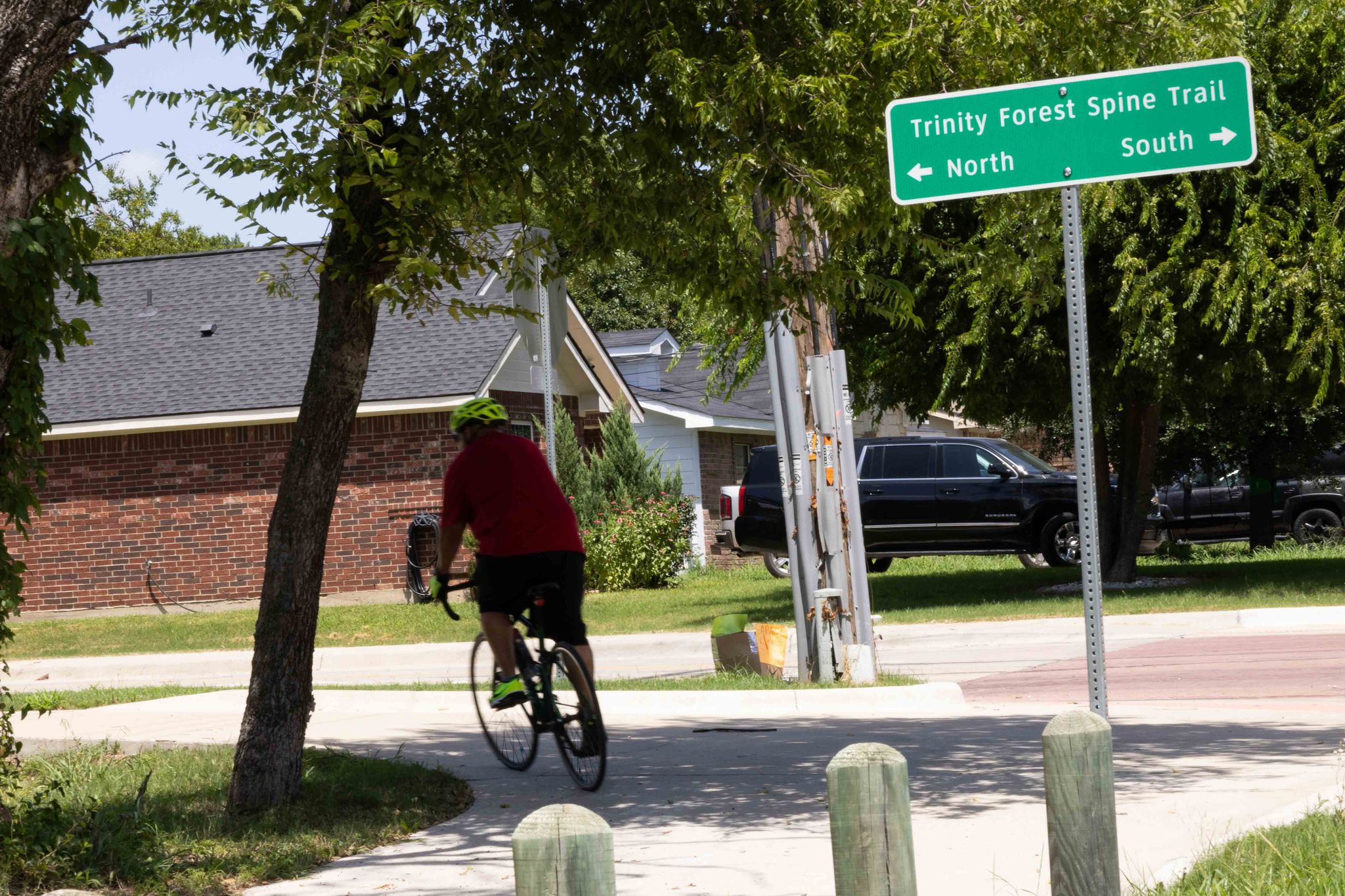
The Trinity Forest Spine Trail, which cuts through southeast Dallas, will soon connect to miles of other pathways, along with Parkdale Lake, to expand pedestrian and bike access for the area.
The Dallas City Council greenlit a nearly $16.1 million construction contract to provide a 12-foot-wide trail which starts near Samuell Boulevard and Interstate 30. The project is part of a 50-mile loop around the city being headed by nonprofit The Loop Dallas. Neighborhoods like Buckner Terrace, Urbandale and Parkdale are expected to benefit from the Trinity Forest Spine stretch.
The work is expected to strengthen connections between neighborhoods “that have too often felt disconnected from the rest of our city and not had the option to use multimodal modes of transportation,” said council member Adam Bazaldua, who represents areas the trail will serve.
“This investment will allow residents to experience their communities in new ways and create opportunities for people to get where they need to go, whether it’s for transportation purposes or recreational purposes and just simply enjoying the outdoors,” Bazaldua said at the council meeting.
The vote Wednesday marked a breakthrough for The Loop’s project, lending public access to a “hidden oasis” in southeast Dallas, the nonprofit said in a news release. Crews will build segments going south from Samuell Boulevard and north from Lawnview Station. Ultimately, these will connect to a bridge planned over a railroad line at the north end of Parkdale Lake.
The construction is the result of seven years of planning, coordination and land acquisition. For the project, Oncor donated 110 acres at Parkdale Lake to the city. The spacious site, along White Rock Creek, sat hidden because there wasn’t safe access, the release said. It will now be a vital connection for areas historically lacking safe pedestrian and bike infrastructure.
In 1953, it originally served as a water storage reservoir for the Parkdale Steam Electric Station, according to The Loop Dallas. When that plant was decommissioned in 2005, the site became an opportunity for parkland development and floodplain management.
The lake site acquisition was an “unprecedented feat of civic leadership,” which began in 2019 when former park department director Willis Winters and Loop organizers approached Oncor, said The Loop Dallas director Philip Haigh in a statement. The Loop is in a partnership with the city, working to build 11 miles of trails to fill gaps around the city and form the circuit.
“Our public-private partnership model was built precisely to solve infrastructure challenges of this magnitude,” Haigh said, adding, “This award officially moves us from a long-term vision to immediate delivery, transforming once-disconnected infrastructure into a unified network.”
The southeast Dallas section, the Trinity Forest Spine Trail, is a nine-mile corridor — the longest continuous stretch of the full 50-mile network. It’s expected to connect White Rock Lake to the Trinity River Audubon Center.
Jeff Ellerman, chairman of The Loop Dallas, called the construction approved Wednesday the most complicated to advance.
“Years of persistence, partnership and creative problem-solving brought us to this milestone,” Ellerman said. “Now, with funding and right-of-way fully secured, we have a clear path to finish the Trinity Forest Spine Trail.”
Staff writer Everton Bailey Jr. contributed to this report.
This reporting is part of the Future of North Texas, a community-funded journalism initiative supported by the Commit Partnership, Communities Foundation of Texas, The Dallas Foundation, the Dallas Mavericks, the Dallas Regional Chamber, Deedie Rose, Lisa and Charles Siegel, the McCune-Losinger Family Fund, The Meadows Foundation, the Perot Foundation, the United Way of Metropolitan Dallas and the University of Texas at Dallas. The News retains full editorial control of this coverage.