
O cruel fortune! So much gambling! Poverty! This hateful life!
Such is the exclamatory chorus, sung in Medieval Latin, that opens Carmina Burana, the Carl Orff choral work reminding us that raging against the wheel of life — plus the joys that come with it — remains timeless.
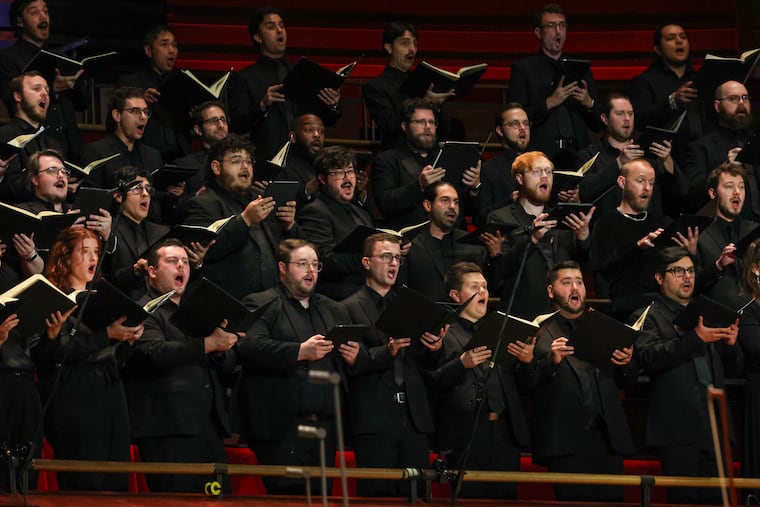
This life-and-death panorama echoing the 13th century, heard in numerous film soundtracks, ignited the Philadelphia Orchestra Friday and is likely to be one of the most popular concerts this season.
Pungent, lyrical, sexy, intoxicated, and with a constantly racing pulse, the 1937 Carmina Burana has composer Orff (1895-1982) seizing upon poems discovered in 1803 in a German Benedictine monastery — and doing so in the spirit of Stravinsky’s Rite of Spring. The piece often lacks respect because its effects are simple collages of lusty lyrics and basic rhythms. The piece was also a Nazi-era fixture.
Performances often suffer from “monster choir syndrome” — a lot of people making a lot of sound in which words and meaning get swamped. The Philadelphia Symphonic Choir, plus the Philadelphia Boys Choir, Philadelphia Girls Choir, and Commonwealth Youth Choir — all totally 150 — had ample volume but also precision.
In place of the reedy, vernacular sound heard on recordings made under Orff’s supervision, music and artistic director Yannick Nézet-Séguin favored a conversational articulation that wore better over the long run amid brutality, tenderness, and, of course, explosive fortissimos and delicate pianissimos. Extremes of despair, joy, wonder, cynicism, and alcohol all had equal time.
Vocal soloists outdid themselves. The already versatile baritone Will Liverman encompass tavern songs as well as more ethereal moments in upper-range head voice. Janai Brugger delivered particularly lovely coloratura singing in extolling her “sweeter one.” The hapless song of the swan — slowly being roasted to death — was characterized by Jonah Hoskins with oddball pathos. The whole package was thrilling, and not to be resisted.
The first half of the concert had the 2021 Gabriela Ortiz work Clara, a five-movement symphony characterizing an imaginary dialogue in the legendary marriage of Clara and Robert Schumann. The lives of this pianist-composer union were anything but easy — as suggested by the Clara’s agonized love for mentally ill Robert.
Two of the best moments were a single, by-itself note suggesting the electric but painful thread that bound the two together and, much later in the piece, a busy way-off-in-left-field treble-instrument solo, next to grave accompanying brass chords. Robert’s isolating madness next to Clara’s pained resignation? This is a major work. Not so major was Samuel Coleridge-Taylor’s Ballade in A minor, Op. 33 — a well-written, melodic orchestra work from 1899 that’s nice to hear once.
Repeat performances are 8 p.m. Saturday and 2 p.m. Sunday. Tickets: $80-$254. Information: www.philorch.org or 215-893-1999.