
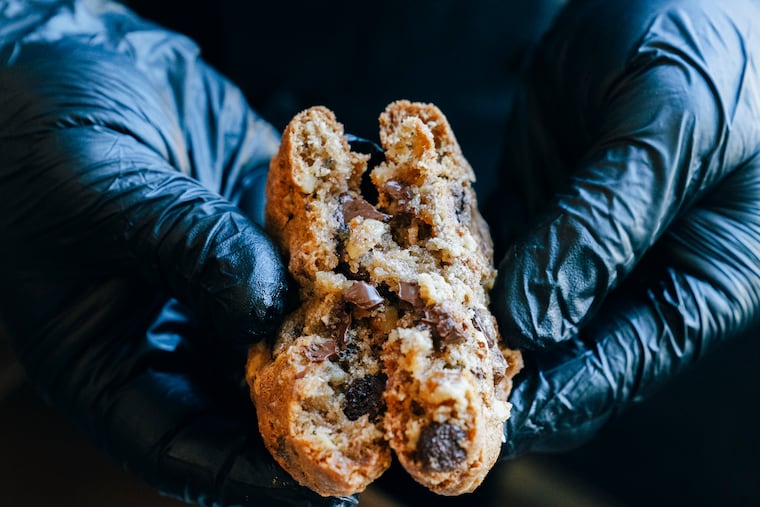
Lucas Spence did not see the cookie coming. He was surprised last year when the front-desk worker at the DoubleTree by Hilton he was checking into in Boston asked if his group liked cookies.
“Immediately in my head, I was like: ‘Yes, we do,’” said Spence, 23, a Chicago accountant who was traveling to see family. “I didn’t know this was a thing.”
But by the second day of his stay, after multiple swings by the front desk, he had amassed a stockpile of eight super-chocolatey, walnut-packed, warm-on-delivery sweets.
“The chocolate would melt in my mouth,” he said. “It was so good. I can remember the taste right now.”
Such is the power of the DoubleTree chocolate chip cookie, a marketing tool baked up 40 years ago that has become an iconic symbol in hospitality — and the heart of the hotel brand’s identity. Every year, the chain’s 700-plus hotels serve more than 20 million cookies.
The cookies became the first food baked in space as part of an experiment at the International Space Station in 2019, with one of the space sweets later landing at the National Air and Space Museum. During the early days of the coronavirus pandemic, Hilton released the famous recipe, revealing cinnamon, oats, and lemon juice as special ingredients.
All that is to say: The DoubleTree cookie is basically a celebrity.
Cookies are serious business
At the DoubleTree by Hilton McLean Tysons, outside Washington, D.C., there’s no escaping the treats, as if you’d even want to. Outside, a cookie-decorated van promises a “sweet ride.” The Wi-Fi password includes the word cookie. The front desk is equipped with a double-deck warmer full of freshly baked, individually wrapped specimens. Allergy-friendly versions are at hand.
There are squeezable stress-relief toy cookies for purchase. When work is being done in a room, signs ask guests to “pardon our crumbs.”
“It’s all about cookies here,” said Berat Kilavuz, the hotel’s director of rooms.
Same applies to all DoubleTrees, where cookies are part of the brand’s standard. There are locations in over five dozen countries. including Uzbekistan, which was added recently. Singapore and Azerbaijan are expected to be added this year. Every entry into a new country requires a supplier that can serve that area or make the recipe consistent with the rest of the chain, said Drew Iddings, global brand leader for DoubleTree by Hilton.
“People travel all over the world,” he said. “You don’t want it to be a completely different cookie experience, whether or not you’re in the United States or Japan or the Dominican [Republic].”
It’s an amenity the hotels take seriously. At the McLean location, hotel manager Soo Kim said a walk-in freezer failed earlier this year.
“First thing chef said: ‘I saved the cookie dough,’” Kim said.
The hotel orders cases of frozen dough — 150 cookies per case — from the brand’s vendor to store in tall stacks in the freezer.
“I can run out of anything except the cookie,” said executive chef Saf Sahraoui.
Every day, workers in the kitchen lay out the frozen pucks and bake dozens at a time, perhaps multiple times a day, starting in the morning, depending on the number of people expected to arrive. After cooling, each cookie goes into a little sleeve and gets delivered to the front desk’s warming drawers.
Kilavuz uses a formula to estimate how many they’ll actually need — which is generally more than one per guest: On weekdays, that amounts to about 1.25 cookies per arrival for the typical base of business travelers or groups. On weekends, when the crowds lean more toward families and tourists, it can be 2.5 cookies per arrival.
“A lot of guests don’t just stop at one,” Kim said.
A tasty history
Jim Smith, who was DoubleTree’s senior vice president of operations in 1985, had no idea he was creating something that would become a decades-long tradition when he encouraged general managers at a meeting to think about some special gesture the chain could dream up for guests.
A couple of weeks later, inspiration struck when he came across a tiny cookie spot in Laguna Beach, Calif. He said it was a branch of a San Francisco-based cookie company called Blue Chip Cookies.
“I broke it in half and I had a couple of bites, and that was it,” said Smith, 79, now a hospitality consultant. “I said, ‘Oh my gosh, it’s a chocolate chip cookie. Everybody’s mother and grandmother made them. Everybody loves chocolate chip cookies with a glass of milk.”
He returned to his office in Arizona with a pile of the cookies and asked the chef at the Scottsdale hotel to reverse-engineer the recipe. Once it was just right, the chain’s other chefs flew in to learn.
In early 1986, the cookies made their debut. At that point, they were placed on a plate in guest rooms as a way “to end the day with a special treat,” according to marketing material. Smith wanted to add milk, but couldn’t figure out a way to make it work without refrigerators. He settled for offering VIPs a bottle of milk on ice along with extra cookies.
Hotels quickly started offering boxes because so many people wanted to bring the desserts home. The chain moved the cookie distribution to the front desk in 1995. Hilton acquired the brand four years later.
“The idea was always that that cookie would be something that everybody, when they see it, they think of DoubleTree,” Smith said.
He’s also become linked with the tradition, jokingly referring to himself in messages as “the Cookie Man.”
He has been recognized by people who saw his photo, in which he wore a “big bow tie like Orville Redenbacher” on a note that accompanied the cookies in the early days. He still sometimes swings by a DoubleTree to buy cookies as gifts. Just recently, a friend mailed him a wrapper with a note: “Well, I had another one of your cookies.”
Cookie case study
The travel industry most of us experience isn’t exactly known for its freebies. Delta made headlines recently by eliminating snack and beverage service on its shortest flights. Southwest tossed free checked bags. American Airlines famously saved $40,000 a year by removing one olive from each passenger’s dinner salad in the 1980s.
Anna Abelson, a professor of tourism at New York University’s Jonathan M. Tisch Center of Hospitality, called the DoubleTree cookie “the art of hospitality at its best.”
“We do use DoubleTree cookie and its significance in a lot of examples and case studies in the classroom,” she said. “In my classes we talk a lot about travel sentiment, motivation, once they’re on the road, what we should do better as an industry to create that … emotional connection.”
Abelson said the cookies work so well “because of the welcoming aspect,” with their home-baked aroma and warm, sweet greeting.
On social media, people post videos of themselves stopping by hotels for cookies, even if they’re not guests. Some bemoan the presence of nutrition information on each cookie wrapper. Others share their first DoubleTree cookie experience.
But does a hotel chain need to be known by more than its check-in cookies?
Iddings, who joined the company in January, said his goal is to refresh and build the full-service brand — which positions itself as a “place of caring moments, comfortable spaces and trying to make you feel at home” — beyond chocolate chips.
“How do we round things out around it and identify what makes a DoubleTree a DoubleTree beyond the cookie?” he said.
But one thing is certain: The cookies aren’t going anywhere. Iddings said it would cost more to ditch the cookies than to keep providing them because they are so critical to meeting customers’ expectations.
“If we ever considered messing with the cookie, it would never get to the point of guests charging the castle because team members and owners would do it first,” he said. “It’s that important to them.”