
What often gets called cobblestones on old Philadelphia streets are actually Belgian blocks. But no, the neat rectangles cut so they can fit tightly together did not come from Belgium. They came from nearby quarries, often from the New Hope area.
Apart from the city’s architecture, Bucks County’s stones have also shaped the Pennsylvania Impressionism movement that flourished in the first half of the 20th century. New Hope, with its location on the Pennsylvania-New Jersey border, right by the Delaware River, was home to several artists who could afford to buy homes in the area, commute easily to Philadelphia to teach in art schools like the Pennsylvania Academy of the Fine Arts, and easily get to New York for shows and other networking opportunities.
“The land was pretty cheap at the time, and artists could move into an old industrial mill or buy a property for not a lot of money. They could also escape urban life and get out into the country. It was just a really beautiful landscape, so people wanted to live in that area,” said Laura Igoe, chief curator at Doylestown’s Michener Museum and curator of the museum’s ongoing “Abstractions of Nature: Quarries and Industry in Pennsylvania Impressionism” show.
The artists Edward Redfield and William Lathrop, Igoe said, were the first artists to settle in the area around 1900. Their works are a part of the show. Daniel Garber, who studied and taught at PAFA, soon followed them into the area and became one of the foremost artists living in New Hope. Then his students started moving to the area.
“It was kind of like this self-perpetuating colony in a way,” said Igoe, “There was a very active artistic community there at the time, and also a lot of quarries.”
Pennsylvania Impressionism by way of Europe
At the time, there was a new interest in abstraction and Postimpressionism coming from Europe. Cezanne, particularly, was a big influence on some of the New Hope artists who often traveled to Europe and painted in the style of Impressionists like Monet. The Philadelphia art collector Albert Barnes even collected Cezanne paintings where the artist paints abandoned quarries, including Bibémus Quarry (Carrière de Bibémus) (1895).
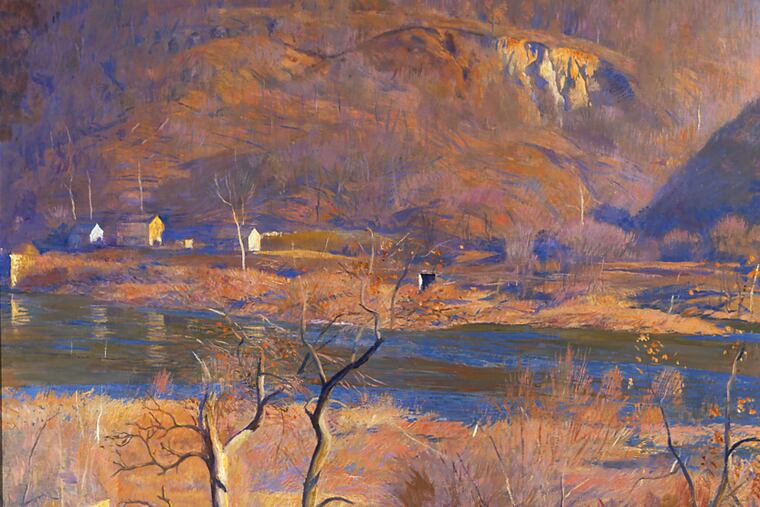
Like most Impressionists, the New Hope artists painted landscapes en plein air — outdoors, amid nature, directly drawing from subject matter. Naturally, the quarries that were a part of the landscape made it into the paintings and now form the focus of the exhibition.
“But while in Europe Impressionism was a much more avant-garde style, it became kind of the style of the academies in the United States,” said Igoe, “so this was what was taught at places like PAFA.”
“They emphasized capturing effects of light and atmosphere,” said Igoe, “really quick brushwork, quick application of paint.” Many of the artists, she said, were painting landscapes early in the morning or in the evening, painting sunrises and sunsets. “There’s frequently this shimmering sense of light in a lot of these Pennsylvania Impressionist paintings,” she said, “It is this really beautiful reflection of light off the stone that they’re trying to capture.”
Igoe considers 1900 to the 1930s as the peak of Pennsylvania Impressionism, with the 1915 Panama Pacific Exposition in San Francisco being a highlight. Many of the New Hope Impressionists exhibited their work in the show.
Redfield, notably, had a full room dedicated to his art; “which was an honor that was bestowed upon the likes of John Singer Sargent and Childe Hassam,” said Igoe. Many of the artists won medals at the show “and it led to them being proclaimed by some critics as the most American school of painting at the time,” said Igoe.
“They painted the landscape of the New Hope area, and they painted in this, what was considered at the time, bold … in this very masculine style. We might not think of Impressionism that way today, but it was considered a very national style for the United States.”
The artists continued to exhibit under the name of the New Hope Group, and their work was collected by museums across the country. Several women artists were members of the group. Together, they founded the Phillips Mill Community Association in 1929, which remains active as an exhibition venue.
“The Michener Art Museum was really founded to preserve the legacy of those artists. Especially in Bucks County, those artists have always been well known. But Michener was founded so more people could learn about these artists and preserve their legacy and collect their work,” Igoe said.
Why paint quarries?
The artists, Igoe said, weren’t always painting exact reproductions of the nature around them, so they had the option of omitting the quarries from their art. “But they frequently chose to include these quarries,” she said, “and that led me to this exhibition where I wanted to look a little more closely at these paintings and think about why artists were so drawn to this subject.”
Firstly, she thinks, the quarries added a drama to the landscape of New Hope that was attractive to the artists. Comparing quarries to the Grand Canyon, Garber said in an interview that they were “on a scale commensurate with the canvas,” said Igoe.
“So you can include these dramatic rock faces, but it doesn’t overpower the canvas in the way the Grand Canyon can. You can’t get the Grand Canyon on a canvas, but you can get a quarry,” said Igoe.
The way the light at different times of the day and year reflected off the stones also inspired the artists, as did the geometric forms of the rock face that often inspired the artists to play with abstraction.
“They were also interested in this human impact on the natural world, the way humans could excavate these rocks, from the landscape, I think was appealing to them,” said Igoe.
Show highlights
Many works in the show portray factories, smoke, and industrialization without much critical commentary, but Garber’s Harmonville (1925) shows a landscape near Conshohocken. To Igoe, it is “one of the artworks in the show that is the most critical of industry.” A sickly tree in the foreground of the print, she said, is perhaps Garber’s way of saying “that this industry can be really destructive to nature too.”
Other artists in the show include Letitia Maxwell Ely, the lone woman artist in the mix, who was one of Garber’s students. “I just wasn’t finding a lot of paintings of quarries by women artists. I am not sure if it’s because it’s perceived as a more masculine subject,” said Igoe. But Maxwell Ely’s work, she said, stands out in the way the artist paints in proximity to the quarries. Masters like Garber, Igoe said, took a distant view of the quarries, not usually engaging with the human labor at the quarries.
But Maxwell Ely, whose work was much smaller in scale, “brings you right into the quarries themselves in those little paintings, and she is more interested in the labor.” In works like Quarry (1914), there are no sweeping vistas, but a more zoomed-in perspective at life of those working in the quarries.
“There’s not a lot of work known by her that’s still available. She’s an artist that I wish we knew a little bit more about, but she didn’t leave a very large body of work behind,” said Igoe.
Among the other highlights of the show, according to Igoe, is a postcard-sized painting The Quarryman’s House by the artist George Lear. Another artist is Roy Nuse who lived by the Rushland quarry and painted that quarry many times throughout his life. “Nuse has this reputation as being somewhat of a homebody, he painted things close to his home,” said Igoe. “I just found it interesting that there was a quarry close to his home, and he painted it in all different seasons, in the winter and spring. And I think he really enjoyed the shapes that the quarry provided as well.”
Charles Rosen, another artist in the show, started his career being an Impressionist but moved onto more avant-garde European styles after moving to Woodstock, N.Y.
Pennsylvania Impressionism eventually dwindled as a movement around the 1940s as public interest shifted to more modern, abstract art forms. Some of the quarries depicted in the show remain active, some are overgrown, and some are part of protected land along the Delaware River.
Igoe’s colleagues have even picked up some rocks from nearby quarries that, with the art, will also be a part of the show.
So visitors can touch and feel the stones that they have walked over thousands of times. Stones that, with their jagged faces and smoothened ends, have witnessed artists’ curiosities and have gone on to outlive the hands that painted them.
“Abstractions of Nature: Quarries and Industry in Pennsylvania Impressionism” runs through Feb. 28, 2027. Michener Art Museum, 138 S. Pine Street, Doylestown, Pa. 18901. michenerartmuseum.org