
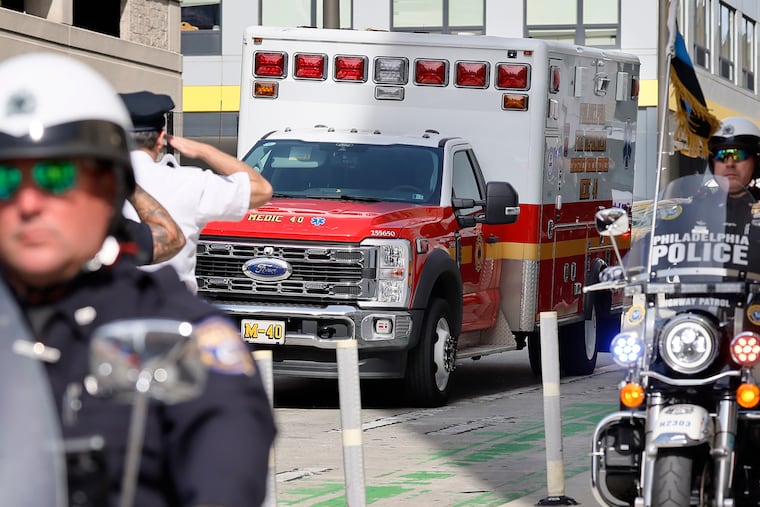
Eric Lewis, the city employee accused of ambushing Philadelphia police officers with a shotgun on Saturday and fatally shooting Officer Shane Seiber, had a criminal history that included a 2015 gun-related conviction and a homicide charge for which he was acquitted.
Despite that, the city hired Lewis in May 2024 to work a $47,000-per-year job with the water department as a trades helper. His hiring has raised questions about how a person with a criminal background who allegedly went on to shoot at police officers could have been employed by the city.
But according to officials in Mayor Cherelle L. Parker’s administration, the city was barred from considering Lewis’ most serious previous criminal allegations under its relatively strict laws that govern when and how employers can weigh an applicant’s criminal history.
That includes a homicide charge stemming from a 2019 killing for which Lewis was later acquitted. The murder case has become the subject of intense public scrutiny, with District Attorney Larry Krasner alleging that police botched the investigation.
Under local law, the city is prohibited from considering charges that did not result in a conviction while making hiring decisions.
The city also could not deny Lewis employment based on a 2015 conviction on misdemeanor charges of simple assault and carrying a firearm in public. That conviction, which resulted in a sentence of probation, took place more than seven years before Lewis was hired, putting it outside the window when the city could consider such a record in making hiring decisions.
Candi Jones, the city’s chief human resources officer, said in an interview Wednesday that a criminal record does not automatically disqualify someone from employment.
But Jones said the most recent crime Lewis is alleged to have perpetrated — killing Seiber and wounding another officer — is “abhorrent.”
“As an employer, the city’s focus is on supporting our employees and their families who are victims of this terrible crime, as we grieve together,” she said, adding: “The safety of city employees and the public is and will always be a fundamental priority.”
The city in 2011 first passed the Fair Chance Hiring Law, commonly known as the “ban the box” law, which required that most employers in Philadelphia remove questions on job applications about criminal backgrounds.
In 2016, the city strengthened the law to ban employers from asking job applicants about criminal history until after they made a conditional offer of employment. That amendment also limited employers from considering any criminal convictions more than seven years old.
Philadelphia City Council again amended the law last year to shorten the window for considering misdemeanor convictions to four years. That took effect well after Lewis was hired.
Proponents said prohibiting employment discrimination based on criminal history ensures job opportunities for the thousands of people in Philadelphia with conviction and arrest records. Critics have said the law places high burdens on private employers and poses safety risks.
Jones said the city stands by its practice.
“As an employer, we do engage in inclusive employment practices [and] we do provide employment opportunities to formerly incarcerated individuals,” she said.
Jones said Lewis went through the city’s typical hiring process for civil service employees, who make up the majority of the more than 29,000 members of the city workforce. The city’s website describes the job of trades helper as an entry-level position that involves assisting a more experienced worker with equipment maintenance and repairs.
According to Jones, Lewis submitted an application, was placed on an eligibility list for the job, participated in an interview, and was subject to a background check.
In making its hiring decision, the city likely would have been able to consider one low-level conviction that fell within the seven-year look-back window that was in place when Lewis applied.
Lewis was charged in July 2018 with simple assault and recklessly endangering another person after police said he punched a woman in the face, according to the affidavit of probable cause for his arrest.
He later pleaded guilty in municipal court to disorderly conduct, a third-degree misdemeanor, by engaging in fighting, according to court records. He was sentenced to one year of probation.
Jones said the city’s pre-employment screenings are designed to ensure that an applicant is reviewed on an individual basis.
She said the nature of convictions is considered, as well as their relevance to the position and the risk they pose. For example, she said, applicants for public safety jobs may receive more scrutiny, and child welfare laws dictate background check procedures for workers who interact with children.
In addition to being barred from considering older criminal convictions, employers are prohibited from inquiring about a job applicant’s previous arrests or charges that are no longer pending and did not result in a conviction.
» READ MORE: Krasner says ‘criminal’ police conduct tanked past murder case against man accused of killing Philly cop
In 2023, Lewis stood trial for murder in the 2019 shooting death of Christopher Williams.
That case has since drawn fresh scrutiny after The Inquirer reported that Lewis was acquitted by a judge who was so concerned about the weakness of the police investigation in the case that he contacted the department’s internal affairs bureau.
On Tuesday, Krasner accused police of mishandling the case, and he said one officer who dated Lewis’ sister gave fabricated information to investigators, something he characterized as potentially “criminal.”
Sgt. Eric Gripp, a police spokesperson, said the department was reviewing the case, but that its focus is on supporting the families of the officers involved in the shooting and those grieving the loss of Seiber.