
Growing up as a student in Catholic school, I remember occasionally asking adults why God permits human pain and suffering, even among innocent children. Years later, my nephew once approached me about a conversation that took place in his classroom. He asked a nun at his school why his friend was born with a disability that left the child unable to walk. She told my nephew God knew this boy would grow up to be a thief — or worse — and that God crippled him to avoid that fate.
I was aghast and told my nephew she was wrong. God would never do something like that. Yet, the difficulties in reconciling an all-good deity with the terrible ills inflicted upon humanity remain. Does God will these horrors, as the nun at my nephew’s school implied, or just permit them? Why are the innocent as susceptible to great suffering as are the guilty?
It is one of those truly profound theological conundrums that even a youngster can grasp. A childhood friend of mine carried the heavy leg braces and profound limp of a polio patient, and I often wondered why him and not me. He was one of the nicest kids I knew; it wasn’t right. What am I supposed to think of a God who could desire that?
Then I heard Pope Leo XIV as he presented me with a different picture of God. He was speaking to a gathering of young people in Spain last month, and what he said — which was much different from anything I had heard as a student in Catholic school — has stayed with me.
“We must not spiritualize pain, superficially attributing it to ‘God’s will’ or to some mysterious plan of his, because this risks minimizing that suffering, silencing it and hurting people,” he said. “God does not want suffering. He carries it with us and invites us to trust in him with perseverance.”
The pope went on, “With God, life is always reborn.”
On the other hand, he said, moments of darkness and suffering must never be silenced just “because certain cultural norms demand that we always be victorious and perfect.”
I am, shall I say, over 50, and like just about everyone my age, I have witnessed awful pain and suffering, sometimes among the youngest and most innocent. I have been told to “spiritualize” that pain, attribute it to “God’s will,” and just deal with it.
That never sat right with me, from playing with my classmate who had polio to this very day. Leo provided me with a new way to process human suffering.
First, God does not want suffering. When we say, “Oh, it’s God’s will,” we are actually making light of the suffering, shoving it away, minimizing it.
I had never thought of it that way. Saying “It’s God’s will” seemed to make it grander, divine, special.
In fact, the “God’s will” gambit only serves to distance me from what the other person is going through. I get to shake my head with immense pity, sigh deeply, and then go about my business.
What the pope made clear to me is that we are not called to label the suffering of another, wrap it up in brown paper, and send it off to heaven. No, we are called to accompany the sufferer, fully acknowledge their pain, and help in any way we can to ease their hardship.
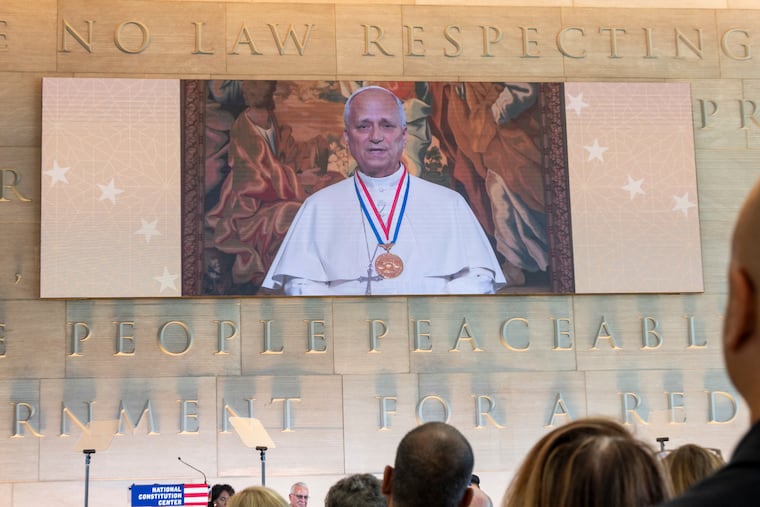
The pope seemed to refer to this duty again — in a broader way — when he accepted the Liberty Medal on Friday. “We are guardians and stewards of those entrusted to our care,” he said. “In this regard, the moral greatness of a nation is manifested, above all, in its capacity to support, protect and cherish the lives of all, especially the most vulnerable and those whose worth is questioned.”
We are born with fragile, mortal, material bodies. They will bruise, break, hurt, and die. That is a given: for my childhood friend, for my nephew’s disabled buddy, and for me.
We are likewise born with the enormous power to empathize, to touch the pain of another with patience and caring. That is not a given; that is a choice.
Jesus confronted hundreds of sufferers. He never said, “That’s God’s will; suck it up.” He reached out and, when possible, healed. His healing power is what is most often mentioned in the Gospels, but it may be the least understood.
I used to think Jesus’ healing gift was what separated him from us, what made him God and us just human beings. Pope Leo hinted that I have been all wrong about that.
We, too, are called to be healers. Our touch may not bring about a cure, only a connection. Suffering is not God’s will, but that connection definitely is. That connection is love.
Lonnie Barone is an author and executive leadership coach who teaches at the Wharton School of the University of Pennsylvania and the Fox School of Business at Temple University.