
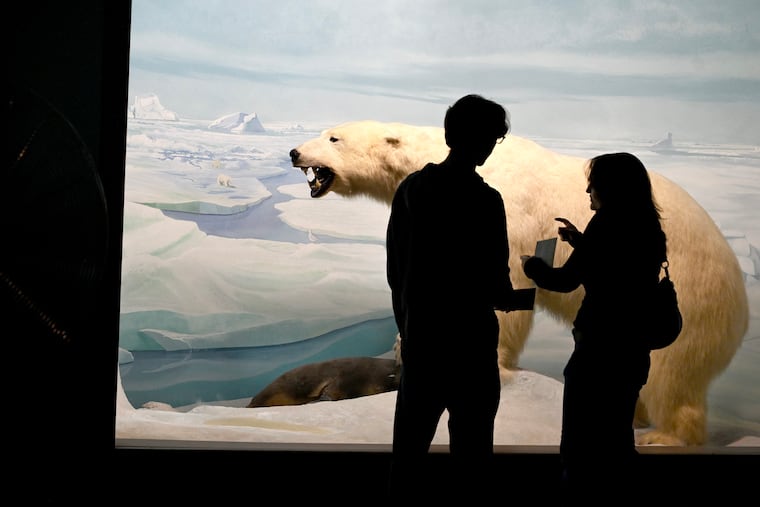
In the now-deserted halls of the Academy of Natural Sciences of Drexel University, three majestic gorillas quietly await their fate.
More than a century ago, the primates were prized scientific specimens captured by George Vanderbilt III — then a 19-year-old scion of the revered Vanderbilt family — on his 1934 African expedition for the Academy. Their carefully preserved pelts traveled some 6,000 miles from the Central African Republic to Philadelphia, where taxidermists prepared them for a new home in Logan Square: a habitat diorama.
The painstaking process required an artist to sculpt an anatomically accurate clay replica of each gorilla in a realistic pose, then create a plaster mold of the bodies, from which a hollow papier-mâché model was cast. The skins were then fitted, stitched, and glued onto the gorilla sculptures — but that was just one step of the diorama production. Other artist teams painted the curved background wall and made 6,000 wax and paper leaves by hand over the course of many months.
Each element was meticulously measured, studied, and imitated to recreate the lifelike scene as exactly as possible so the diorama, which opened in 1938, could transport viewers to the heart of the rainforest.
Today, in the wake of the 198-year-old museum’s abrupt closure due to financial hardships last month, the future of the gorillas — along with the tiger, polar bear, zebra, moose, and other taxidermied animals on view — remains uncertain. Reports that Drexel and Academy leaders are considering selling the building and moving its vast collections elsewhere have alarmed diorama specialists who worry the priceless treasures are endangered.
Unlike other parts of the Academy’s collection, the 32 dioramas currently on view are near-immovable historic artifacts. Any attempt to preserve them through potential relocation would require significant time and labor with a price tag in the millions.
“If they were going to be moved and preserved, and kept viable, that would be a good thing. Of course, it still would be the terrible loss of the building itself to the city and the presence of the very first natural history museum,” said Stephen Quinn, an expert diorama artist who spent decades creating and restoring exhibits at New York’s American Museum of Natural History. The expense to move and restore the dioramas would be high, but to Quinn, the alternative would be a greater loss.
“By losing the dioramas, you are abandoning what is really great historical and meaningful art.”
There has not been official word of what might happen next, but the museum has closed to the public during this period of limbo as leaders seek possible solutions.
“The building will continue to house the Academy’s collections, research activities and exhibit materials while Drexel and Academy leadership consider potential pathways forward,” Drexel spokesperson Britt Faulstick said in an email.
Window to the world
In the 1930s, the gorilla diorama was part of a wave of new installations at the Academy meant to revitalize its museum with new, cutting-edge taxidermy practices that provided a window into distant parts of the natural world.
It was a winning approach under Academy president Charles Cadwalader, whose diorama efforts boosted attendance numbers exponentially. Between 1929 and 1935, the number of annual visitors jumped from 40,000 to 181,000, according to A Glorious Enterprise: The Academy of Natural Sciences of Philadelphia and the Making of American Science by Robert McCracken Peck and Patricia Tyson Stroud.
Primarily made between the 1930s to 1960s, many of the Academy’s diorama scenes could not be readily replicated today (the western lowland gorillas, for example, are now a critically endangered species) and the cost to fund an expedition and create new ones from scratch would be exorbitant.
“You might think of the dioramas as art in the service of science. They’re so accurate and grounded in science that when people visit the museum, they feel as though they are encountering a real place with real creatures at a real location, [like] one of the earliest forms of virtual reality,” said Quinn, who lives in Ridgefield Park, N.J.
The retired artist, whom the New York Times once called “the da Vinci of dioramas,” cites the Academy as one of the early inspirations for his museum career. As a teen in the 1960s, he spent summers volunteering in their exhibits department, where his older brother, John Quinn, worked on developing dioramas, and he never forgot the “magical” experience collecting bamboo for the tiger display. He calls the current predicament at the Academy “a great tragedy” that could imperil the virtually irreplaceable dioramas — and deprive Philadelphians and tourists alike of the powerful opportunity to see wildlife up close.
“Anyone can sit with a laptop, press buttons, and encounter photographs of wildlife in their own home, but actually encountering an Alaskan moose, or a polar bear, or an African lion — that conveys so much more,” he said. “Museums that have maintained their dioramas have found that they do have a unique appeal and convey unique information to museum visitors … and, possibly, [a diorama] influences their views about nature and its importance.”
Preserving history
Restoration work is key to maintaining the Academy’s historical dioramas, most of which have remained untouched since they were unveiled. George Dante, a taxidermist who runs an eponymous studio in Woodland Park, N.J., says he has seen a “huge movement lately” with museums restoring and preserving their dioramas.
One notable example is the American Museum of Natural History’s $2.5 million restoration of its Hall of North American Mammals in 2011.
George Dante Studios (which counts Quinn as a trustee) led the 2018 restoration effort of the Academy’s gorilla and takin dioramas, which had become discolored and dusty over several decades behind the glass. The 18-month-long project involved updating the lights, deep cleaning every element inside, refreshing peeling background paint, reviving sagging branches, and recoloring faded taxidermy, which had to be transported off-site.
To restore both dioramas, the Academy’s bill was upward of $97,500 for labor, materials, transportation, and protective equipment, Dante said. The museum received external funding to cover the costs: The takin renovation was covered by the E. Rhodes and Leona B. Carpenter Foundation, while that of the gorilla was funded by Lucille Vanderbilt Pate (George Vanderbilt III’s daughter) and the Vandy Charitable Foundation.
At the time, the restoration was celebrated by museum leaders, who expressed the desire to fundraise so they could freshen up several more.
“The Academy’s dioramas are well known to generations of visitors,” then-president and CEO Scott Cooper said. “They are engrained in the fabric of Philadelphia, and they represent our rich history of scientific exploration and discovery.”
(He resigned when the closure was announced.)
A risky restoration
Given the hazardous chemicals inside the dioramas — arsenic was traditionally used on pelts as a pesticide — any handling of the taxidermy requires extensive protective gear, like Tyvek suits. (In 2023, the Delbridge Museum of Natural History in South Dakota closed because of concerns that its unsealed dioramas potentially exposed staff and visitors to arsenic.)
That is one of the primary complicating factors in the conversation about possibly relocating the diorama collection, as it would prove labor-intensive, expensive, and risky.
Still, that does not mean it’s an impossible task: In 2017, the Bell Museum in St. Paul, Minn., moved to a new building and relocated 10 dioramas in a major effort that involved cutting the exhibit walls to preserve the canvas paintings, which had been stuck to the walls with lead glue. The museum’s budget for the diorama move alone was reportedly $3 million.
If the Academy and Drexel move forward with a deal to sell the building, the intractable dioramas could be at risk. One source familiar with these conversations who requested anonymity because they were unauthorized to speak to the media told The Inquirer’s Peter Dobrin this month that a possible scenario could see the Academy split up and distributed in parts to other institutions.
“It’s very emotional. We love the museum. There are so many questions because we hear that they’re going to move the collection — I mean, if they don’t have the money now, how are they going to move 19 million specimens?” Dante said.
“Once we lose these, they’re gone forever … the monumental task of creating the dioramas — the foreground artists, the background painters, the taxidermists, everyone who collaborated — that will never be done again in history. I know it’s maybe foolish to make this analogy, but it’s like losing any other piece of artwork. If we had to move the Met, would we destroy its contents?”