
A coalition of politically powerful building trades unions will help finance the redevelopment of a dilapidated senior apartment complex in West Philadelphia, an arrangement the mayor on Tuesday framed as a first-of-its-kind approach to expanding the city’s affordable housing stock.
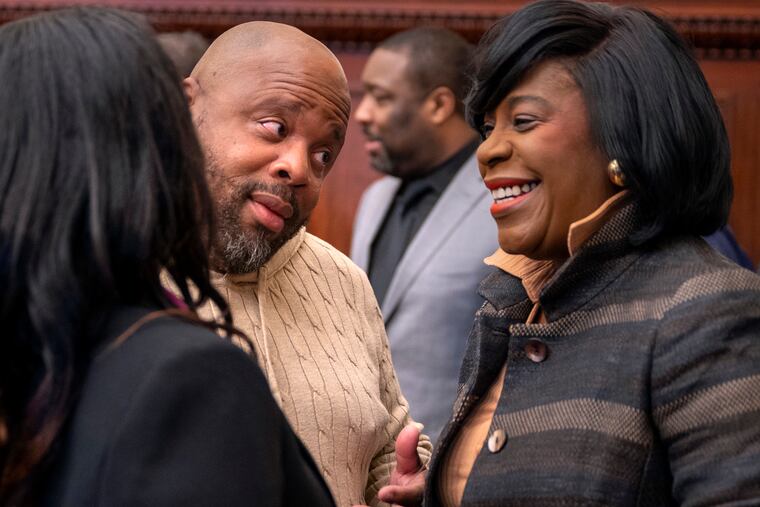
Mayor Cherelle L. Parker announced the plan alongside her longtime ally Ryan N. Boyer, the business manager of the Philadelphia Building & Construction Trades Council.
The pair said the conglomerate of dozens of trades unions will loan the Philadelphia Housing Authority $50 million to support the redevelopment of Brith Sholom House, a Wynnefield complex that was so neglected under its previous owners that tenants were forced to move out.
PHA President and CEO Kelvin Jeremiah said the trades’ investment comes in addition to the $99.6 million that the housing authority is spending on a gut rehabilitation of the apartment complex, bringing the total cost of the project to a staggering $150 million.
Under the terms of the deal, PHA will repay the building trades while the city guarantees the trades’ principal investment. Parker said the outcome will be 336 units of affordable housing for seniors on fixed incomes.
“This isn’t an investment for the building trades,” Boyer said. “It’s a down payment on our city’s future.”
Boyer, one of the most powerful non-elected political figures in the state, has been a longtime ally to Parker and much of City Council. The trades unions poured millions into Parker’s run for mayor in 2023, and have remained largely in lockstep with her. Boyer led the mayor’s transition team and has been a key voice on her signature housing plan, which stands to generate thousands of construction jobs.
Parker’s administration says the efforts at Brith Sholom are part of that plan, called Housing Opportunities Made Easy, or H.O.M.E. The mayor — who has promised to build, redevelop, and preserve more than 30,000 units of housing — is in the midst of continued negotiations with City Council over H.O.M.E.’s first-year budget.
Council in December advanced its own spending plan, which set income eligibility thresholds for two housing programs funded by H.O.M.E.’s bond proceeds. Parker wanted a higher threshold so middle-class residents could access the programs, while Council’s version aims to prioritize poorer Philadelphians.
» READ MORE: Philly Council votes against Mayor Parker’s vision for her signature housing plan, signaling a win for progressives
Council could vote on the spending plan as early as Thursday, when lawmakers return to session following their winter break.
Throughout the contentious negotiation process, Parker has said her administration is committed to affordable housing for lower-income Philadelphians. The collaboration with PHA to remake Brith Sholom, she said, is part of that effort.
Brith Sholom fell into disrepair over years under its previous owners, the New Jersey-based Puretz family. A 2024 Inquirer investigation found that members of the family became one of the nation’s largest affordable housing purveyors by buying up old buildings, saddling them with debt, and then defaulting on loans.
At Brith Sholom, the Puretz family profited while defaulting on a $36 million mortgage and amassing dozens of code violations. Residents — who organized to save their homes — complained of deteriorating infrastructure, threats of utility shut-offs, squatters, and severe pest infestations.
In a bid to preserve the building and reutilize it in part as subsidized housing, PHA acquired Brith Sholom House in August of 2024 for $24 million.
In addition to the price of the acquisition, Jeremiah estimated that the cost of rehabilitating the building would be an additional $30 to $40 million. PHA said that the remaining 111 elderly residents in the 360-unit building would be able to remain in place.
But three months later, Jeremiah informed the dismayed tenants that Brith Sholom was in such ragged shape that they would have to be moved out in order to repair the building. Some units were so badly damaged that PHA could not repair them, and the available unit count dropped to 335.
“The conditions are worse than we anticipated,” Jeremiah said at the time. “The disrepair, in a word, is astonishing.”
Jeremiah also said at the time that a gut rehabilitation of the building would take 18 months. That would mean the building could be inhabited again by May of this year — but with the financing phase ongoing, that timeline could be in question.
This is a developing story and will be updated.