
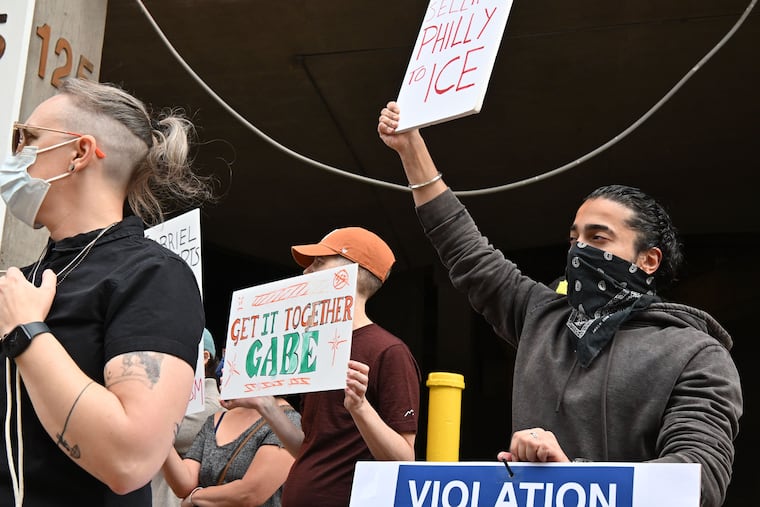
About two dozen No ICE Philly activists gathered Saturday outside a parking garage in Old City, demanding the Philadelphia Parking Authority end an arrangement with Immigration and Customs Enforcement.
At issue are 16 parking passes at the federally owned garage on Second Street, which is managed by the PPA. The group sang protest songs, held signs, and passed out informational flyers that resembled oversized PPA parking tickets.
“Who doesn’t know what these things look like, you know?” said one activist handing out flyers.
Group organizer Jay Bergen said the rally is meant to pressure the PPA — and to let people know that ICE is using the parking garage.
“It’s scary that you could be parking downtown, and unbeknownst to you, parking next to an ICE agent,” Bergen said.
Bergen, a 34-year old pastor at the Germantown Mennonite Church, pointed to public records showing a $53,520 contract that allows “for parking of government vehicles for ICE Homeland Security investigations” at the garage.
That contract was set to expire at the end of September, but another one, beginning in October and running through at least next September, gives Department of Homeland Security “16 leased parking spaces,” records show. ICE is part of DHS.
PPA spokesperson Martin O’Rourke declined to comment on the contracts.
Bergen said the group opposes ICE for “kidnappings” of immigrants and others, including people who have lived legally in the community for decades. One recent example is a 30-year-old nurse from Delaware County, who was arrested while taking her son to Disneyland.
Bergen said most people detained by ICE did nothing wrong. Some had minor lapses in paperwork or had been convicted of summary or misdemeanor crimes.
“Their goal is terror. It’s not public safety in any meaningful way,” Bergen said.
The local ICE field office did not respond to a request for comment Saturday.
At the rally, protester Akarsh Balaji said that the amount of money PPA makes on the contracts is “less than what they spend every year on salt to de-ice the streets.”
Balaji said he’s seen ICE harass his Puerto Rican neighbors in West Kensington. Puerto Ricans are Americans — so is Balaji, who is of Indian ethnicity — but that doesn’t seem to matter, he said.
“Nobody should have to live in fear, or be told that they’re harmful to society,” Balaji said.
Balaji said he got involved with the group in February after feeling a need to do something, “and be part of a movement that is so much bigger than I was.”
No ICE Philly has been active since ICE ramped up activities under the Trump administration last year. In January, protesters blocked vehicle access to a Center City garage used by ICE. In March, nearly a dozen protesters were arrested while blocking the garage.
“We want to make it as difficult as possible for ICE to do its job,” Bergen said.
In Philly, ICE has faced obstacles from residents and elected officials. In April, the city adopted some of the nation’s most aggressive polices aimed at restricting ICE. The legislation took effect in July but the federal Department of Justice sued the city over some of its directives.
Bergen said ICE has changed its tactics since early this year, when its Operation Metro Surge in Minnesota — and the killings, captured on video, of U.S. citizens Renee Nicole Good and Alex Pretti — led to overwhelming public opposition to the agency.
“But the fear has not gone down. I heard this week about someone whose mother is afraid to go to doctor’s appointments, because she’s afraid ICE might grab her,” Bergen said.