
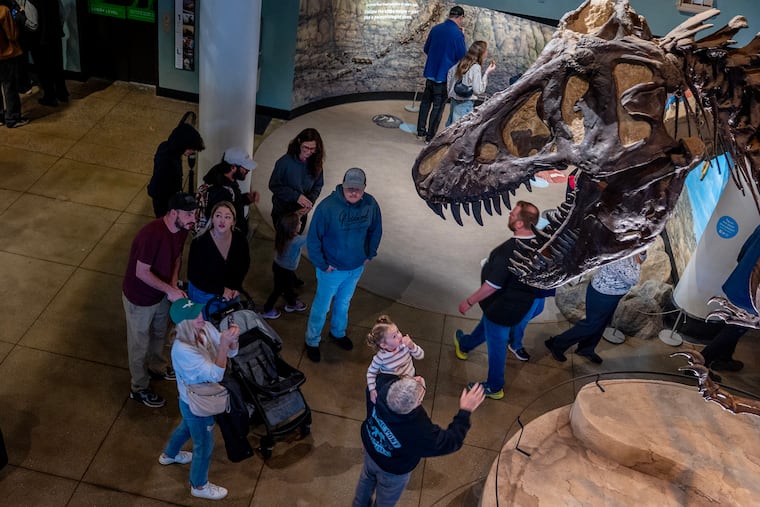
The Academy of Natural Sciences opened in 1828 when John Quincy Adams was president.
It survived the Civil War, the Great Depression, two world wars, Philadelphia’s near bankruptcy, and the COVID-19 pandemic.
So, the decision by the leadership of the Academy and Drexel University to close the oldest natural history museum in the Americas on short notice is beyond disappointing.
This is one of the city’s cultural crown jewels, housing more than 19 million scientific specimens, including fossils, plants, and animals, supporting global research on biodiversity and environmental science.
Generations of grade school students in the Philadelphia area experience their first formative contact with science and history during field trips that have launched untold careers in pathbreaking fields.
To be sure, the museum has faced declining attendance and budgetary strain since the pandemic and is in need of a refresh. But its finances do not appear to be dire. Its 2025 tax filings show $25.8 million in revenue and $23.8 million in expenses.
» READ MORE: The Art of the Steal | Editorial
The bigger problem is that the 150-year-old building on the Benjamin Franklin Parkway faces roughly $150 million in deferred maintenance costs, according to people familiar with the matter.
While that may seem daunting, it is not insurmountable. Twenty years ago, city leaders raised $68 million in 45 days to keep Thomas Eakins’ iconic painting, “The Gross Clinic,” from being sold to an ownership group made up of the National Gallery of Art in Washington and an Arkansas museum.
The William Penn Foundation attempted its own Hail Mary pass to the Academy late last week when it offered to underwrite the costs to operate the museum for at least a year. That seems like some welcome breathing room until a long-term solution is found.
But Drexel said in a statement that it had not received a formal proposal from the foundation. At the very least, it seems like a generous offer that warrants further discussion.
Instead, the museum opted to close the doors to the public on Sunday.
David L. Cohen, the former Comcast executive and ambassador, has been designated by Gov. Josh Shapiro and Mayor Cherelle L. Parker to serve as their agent to find a solution to keep the Academy going.
» READ MORE: President Trump tried to stop the press and ended up muzzling himself | Editorial
In an interview with the Editorial Board, Cohen said solutions have been found to preserve the research and education operations but an agreement on a plan for the museum had yet to be reached.
Cohen is a prolific fundraiser who once served as former Mayor Ed Rendell’s right-hand man through the city’s near bankruptcy in the 1990s. He has the gravitas and clout to strike a grand bargain.
But it is disappointing to hear that a working proposal already calls for relocating the museum and selling the building. The city has spent decades transforming the Benjamin Franklin Parkway into the museum mile, including the addition of the Calder and Barnes museums. Moving the natural history museum — and its millions of artifacts — should be the last option, not the first.
Philadelphia has stepped up at other times of civic crisis.
As governor, Rendell led a controversial effort — that included raising tens of millions of dollars mainly from foundations, along with state funding — to bring the Barnes museum to Center City.
Surely, Philadelphia’s business, political, and nonprofit leaders can come together to find a solution to keep the Academy of Natural Sciences in its iconic location for generations to come.