
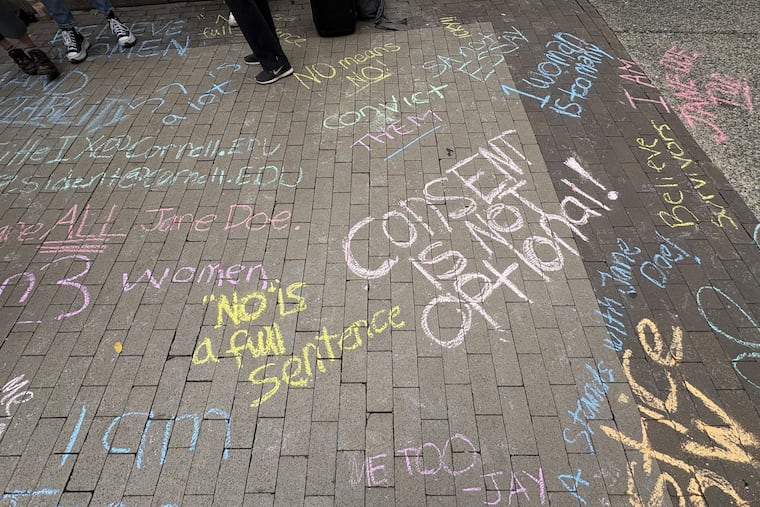
Dozens galvanized on Saturday morning in Center City to decry rampant sexual abuse on college campuses and support Jane Doe, the former Cornell University student who said she was gang-raped at a fraternity house in 2024.
The Cornell allegations have recaptured the spotlight after the woman, identified only as Jane Doe, recently filed a lawsuit, roiling the Ivy League school, and renewing the national debate about colleges’ handling of sexual assaults and campus safety.
In recent weeks, those conversations have reverberated across social media, in private chats and group texts nationwide, on prime-time broadcasts, and, now, 300 miles away, in Rittenhouse Square.
On Saturday, the group of mostly young women protesters — many of whom said they had experienced sexual violence — held up signs and scribbled messages in sidewalk chalk, sharing stories of their own survival while expressing their frustration, exasperation, and collective grief. Scores of passersby, there for the weekly Rittenhouse Farmers’ Market, paused to listen or watch.
“I want people to be angry,” said organizer Delaney Brannon. “I want to make people who are afraid to talk about [sexual assault] uncomfortable because we need to talk about it.”
Brannon, 26, said she has felt sick, on edge, and “in fight or flight” mode hearing about developments in the Cornell case this week.
“There’s something about this specific case that’s so deeply disturbing and unnerving,” she said.
» READ MORE: How a Cornell student went from shame to seeking justice
The latest in the Cornell rape investigation
In September, Jane Doe sued the university, the fraternity, and seven men she alleged were involved, as well as others, claiming she was plied with alcohol and drugs and repeatedly assaulted. One of the men sent a crude Snapchat message inviting other fraternity brothers to join in, according to a screenshot included in the lawsuit.
Campus police and administrators and the local prosecutor are also under scrutiny for their handling of the 2024 case, including their failure to pursue criminal charges against the accused men despite Jane Doe’s unequivocal assertion to police that she had been raped.
At the time, Cornell launched its own investigation that resulted in some of the students being expelled or suspended, while others were ordered to write essays, according to the lawsuit. Cornell doesn’t deny that the essays were part of the punishment for some of the men but has declined to give details on how each were sanctioned.
The criminal investigation was reopened this week and is being led by New York’s attorney general.
» READ MORE: A timeline of the Cornell University assault case
Many at Saturday’s demonstration called the allegations — and Cornell’s response — shocking and horrifying but said they were “not surprised.” The refrain “I am Jane Doe” has become a rallying cry on social media in solidarity with Jane Doe, while also illustrating the pervasiveness of sexual violence. According to a World Health Organization report, one in three women worldwide have experienced physical or sexual violence in their lifetimes.
“This problem is not isolated — it is everywhere,” said Ray Epstein, a consent and prevention specialist who founded Student Activists Against Sexual Assault (SAASA) while a student at Temple University.
“I guarantee you even if you don’t think that you know a Jane Doe in your life, you do — you absolutely do,” she said. “It is everywhere.”
The group also voiced dismay at officials’ initial response and the lack of consequences.
“No one is held accountable — universities don’t do anything,” said Jacqueline Hill, a Temple student and SAASA’s marketing director. “When they know they can get away with it, they’re going to keep doing it.”
To Hill and others, “actual accountability” is the only effective deterrent. Attendee AJ McCormick, 26, added: “Silence is how systems like this survive.”
» READ MORE: N.Y. governor says Cornell rape accuser was ‘failed’ by people obligated to protect her
Jo Buyske, a third-generation Cornellian woman, said drinking and Greek Life was central to the school’s culture when she was a student. Seeing Jane Doe’s allegations, she’s “sure that exact thing happened while I was there.”
“I’m horrified, I’m embarrassed,” Buyske, 66, said of her alma mater, asking, “Where are the grownups? The university is the grownup in absentia.”
Brannon, the organizer, was surprised at Saturday’s showing, saying she expected to be — and was willing to be — standing alone. For some, the turnout was encouraging but bittersweet.
“I’m so sorry we all relate,” Brannon said.
Epstein added, “I hope we can find some form of hope in how many people are rallying now.”
“Isn’t it kind of moving?”
The Associated Press contributed to this report.