
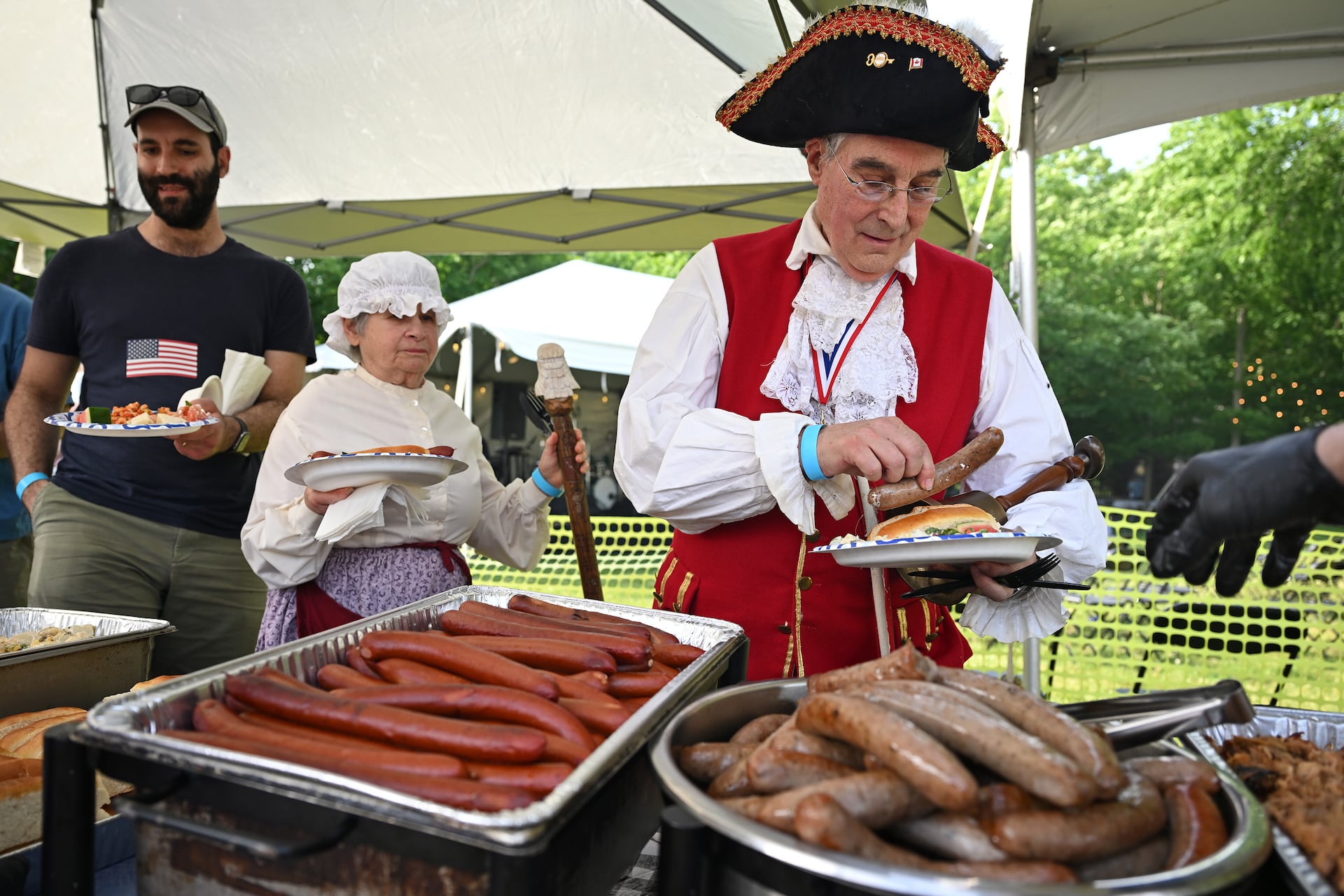
Groups like the Daughters of the American Revolution, the Mayflower Society, and the Sons of the American Revolution offer fraternity and provide community. Known as lineage societies, they also preserve history and educate the public, making personal connections to important events in our national story.
This weekend, the Descendants of the Signers of the Declaration of Independence (DSDI) gathered in Philadelphia as they do every July Fourth. This year’s Semiquincentennial events kept them from meeting in the room in Independence Hall where their direct ancestors met as America was born. But their children still participated in the annual symbolic tapping of the Liberty Bell ceremony.
Everyone knows about Thomas Jefferson, John Hancock, and the Adams cousins. But few know much about the other 52 delegates to the Second Continental Congress. These men all had interesting lives, and we hardly know them — especially our signers from Delaware, New Jersey, and Pennsylvania (well, except for Ben).
GEORGE ROSS, PENNSYLVANIA
George Ross studied law with his half brother John and was admitted to the Pennsylvania Bar when he was 20, establishing his own practice in Lancaster.
Like several founders, he started out as a Tory, representing the British Crown as a prosecutor before gradually concluding that colonial rights could not be protected within the existing system. The brother later married Elizabeth Griscom, known to us as seamstress Betsy Ross.
Stacie Pagano grew up in Lancaster County, where her grandmother told her she was descended from Ross. She rode on a float dressed as Betsy Ross in a 1988 parade celebrating the 200th anniversary of the town of Columbia, but never gave it much thought.
It was while she was in her 20s and met her husband Richard, who is a member of the Carpenters Company — where the First Continental Congress met — that they started to explore her ancestry.
As a DSDI member, she coordinates the annual ceremonial tapping of the Liberty Bell by junior descendants. Her 11-year-old daughter Theodora was one of the kids who tapped the bell 13 times on July Fourth for the 13 original colonies.
JOHN HART, NEW JERSEY
John Hart was a farmer, unlike most signers, who were lawyers, merchants, or wealthy intellectuals, but he earned a reputation for integrity rather than brilliance or eloquence. Fellow signer Benjamin Rush described him as having no formal education but possessing exceptional judgment and virtue.
Descendant Greg Munro’s sister in-law was into genealogy, and she was tracking her husband’s family. When he was in his 30s, she said, ”You know what, Greg, you’re related to John Hart.” Munro said, “Who was John Hart?“
Decades later when he retired, it gave him something to do. Munro’s first step was joining the Descendants of the Signers of the Declaration of Independence, something he thought would be easy. His brother’s wife had already documented his family tree, and the organization told him he had to document every step back to maybe three, four generations. From there, the DSDI had records that go back to Hart, who had 13 children.
But Munro’s birth certificate did not have his father’s name on it. Once he got all the right papers together, he was admitted and is now spreading the word.
He recently wrote and helped produce a documentary on his ancestor’s life, and worked to reprint a Hart biography originally published for the Bicentennial.
After Hart signed the Declaration, he became a wanted rebel leader. When British troops occupied parts of New Jersey in late 1776, he fled his home while it was looted, spending months separated from his family and sleeping wherever he could.
In June 1778, Hart invited George Washington and roughly 12,000 Continental soldiers to camp on his New Jersey farm — right at the height of growing season. When the troops left, they fought and won the Battle of Monmouth.
FRANCIS HOPKINSON, NEW JERSEY
Sally Hopkinson is a descendant of Francis Hopkinson, something she learned when she was in the fifth grade. “My name appeared in a history book, and I was like, why is my name here?”
Her father was actually the DSDI’s treasurer for years, until he died. “I had no idea back then. I didn’t know anything about this.”
Later on, though, she really got into genealogy and started questioning her grandmother. “And then I found all this stuff when finally it came on line after 2000.” But the most information came from her dad’s papers. “I found he had this treasure trove in his filing cabinet. Wow. Everything I was trying to figure out.”
Francis Hopkinson’s father died when he was 14, but his mother, determined to ensure that her son had a good education. enrolled him in the brand new College of Philadelphia (later the University of Pennsylvania) when he was 16, making him a member of UPenn’s first class of students.
Many historians now believe Hopkinson — not Betsy Ross — was the principal designer of the original Stars and Stripes. He submitted a bill to Congress seeking payment — “a Quarter Cask of the public Wine” — rather than cash as compensation. He never received it.
He also was an accomplished organist and a harpsichordist, and, as early as 1759, he had composed the song “My Days Have Been So Wondrous Free,” considered the earliest surviving American secular composition.
On Sunday, July 5, Hopkinson and descendants of New Jersey’s four other signers are scheduled to throw out the ceremonial first pitches and participate in an on-field reading of the Declaration at TD Bank Ballpark in Bridgewater. The New York Yankees’ Double-A affiliate there — the Somerset Patriots — is temporarily rebranding as the Somerset Semiquincentennials to commemorate America’s 250th anniversary. The players will wear red-and-blue pinstriped jerseys with the original signers’ signatures written in gold on the sleeves.
GEORGE READ, DELAWARE
Richard Rodney Cooch, a retired Delaware Superior Court judge and direct descendant of signer George Read, lives across the street from Immanuel Episcopal Church on the Green in New Castle, his ancestor’s final resting place.
His mother’s family has lived in New Castle since the church’s first rector, Rev. George Ross, came from Scotland in 1703. His son, George Ross, later moved to Philadelphia and signed the Declaration as a delegate from Pennsylvania. Read and Ross were brothers-in-law. Cooch is also related to Delaware’s two another signers; through marriage to Thomas McKean, and through a cousin, to Caesar Rodney.
He is the eighth and final generation of his family to have lived at the family’s namesake property south of Newark. It was the site of the state’s only Revolutionary War battlefield — Cooch’s Bridge — a week before the Battle of Brandywine in September, 1777.
George Read initially thought independence was a mistake and hoped reconciliation with Britain was still possible. He voted against independence but after the measure passed, he signed, supporting the new nation. He was also one of only six men who signed both the Declaration and the U.S. Constitution. At the Constitutional Convention, Read wanted a stronger national government and even suggested eliminating state boundaries altogether.
JOHN MORTON, PENNSYLVANIA
John Morton is also an important figure in Finnish American history, as his family roots go back to the Finns who lived in New Sweden, the colony of the Swedish Empire settled in the mid-1600s along the lower Delaware River.
Generations of Mortons have lived in Delaware and Chester Counties since, including descendant Rick Morton, who says of his lineage: “It was so well known in the family that it’s almost like I came out of the womb with the knowledge.”
He remembers as a kid placing wreaths with his sister at the Old Swedish Burial Ground in Chester and getting their picture in the Delaware County Daily Times.
Both of his sons have participated in the annual DSDI ceremonial tapping of the Liberty Bell by young descendants on Independence Day. His oldest son, Sketch, was named after John Morton’s son Sketchley.
The Pennsylvania delegation in the Second Continental Congress was deeply divided and Morton was the “swing vote” for independence.
It is said his deciding vote is why the Commonwealth is nicknamed the “Keystone State” as without Pennsylvania, the Declaration might not have been adopted.
Morton died before the Revolutionary War ended — the first signer to die — even before the new nation was fully established. As a result, he left fewer writings and had less opportunity to shape the country’s early growth.
GEORGE CLYMER, PENNSYLVANIA
George Clymer, orphaned before his first birthday, was raised by a wealthy uncle. Although that uncle helped found Philadelphia College, which later became the University of Pennsylvania, Clymer received little formal schooling and was largely self-educated. Through reading and his uncle’s training for a career in business and commerce, he became a successful merchant and statesman.
In 1773, George Clymer led efforts that pressured British-appointed tea agents in Philadelphia to resign. As a result, Philadelphia avoided the kind of confrontation that later erupted at the Boston Tea Party.
Before independence became mainstream, Clymer was already arguing that the colonies should separate completely from Britain. His views put him in frequent conflict with the more cautious Quaker-led powers of Pennsylvania who initially hoped for reconciliation.
Brett Clayton Johnson grew up not knowing he was a descendant. When he found out from his grandparents, he wondered why there was nothing about Clymer in any of his history books in school.
Johnson visited Philadelphia once with those grandparents, but he was too young to really appreciate what those men did. “It was brave,” he says. “Every freedom we have is because of those guys in the room,” adding “I now know and it is the proudest thing of my life.”
BEN FRANKLIN, PENNSYLVANIA
Benjamin Franklin is one of the most recognizable figures in American history, and much is known about him because he left behind such a detailed record of his life.
Even before he arrived in Philadelphia as a teenager, Franklin was already a “best-selling” humor writer, known for the witty and satirical letters he secretly submitted to his older brother’s Boston newspaper, the New-England Courant under the pseudonym Silence Dogood, pretending to be a middle-aged widow.
Growing up in South Philadelphia, Sarah Miller heard the stories passed down for generations. “All the parents would tell the kids we were related to Benjamin Franklin,” she says, “but then no one really looked into it. It was kind of like, Is that true? Is it just a story?”
It was her mother, who was not a direct descendant but was really into ancestry, who started looking into it. “She used to drag me to the National Archives [then in the Robert N.C. Nix Federal Building — the old U.S. Post Office at Ninth and Market Streets] when I was in high school to search through their microfiche,” she recalls.
During a recent visit to Constitution Center’s Signers’ Hall — Franklin was one of six who signed both documents — and seeing his life-size statue, Miller said it seems like it was a long time ago, “but it really wasn’t. We all still live in the same area.” It really puts the Declaration of Independence in perspective she says. “It’s really only a few generations back. America is still very young.”
CAESAR RODNEY, DELAWARE
When the U.S. Mint produced the statehood quarters from 1999 through 2008, it issued the coins in the order that the states ratified the U.S. Constitution or joined the Union. Delaware was honored on the first coin, and it shows a man on a galloping horse. People assumed it was Paul Revere, as he is the most famous Revolutionary War horseman.
That man was Caesar Rodney.
At home in Delaware recuperating from painful facial cancer, Rodney left on a stormy night, riding the 80 miles from Dover to Philadelphia on horseback to cast Delaware’s tiebreaking vote for independence on July 2, 1776.
Rodney served Delaware as a judge, sheriff, military officer, legislator, and governor but was also a plantation owner who relied on enslaved labor. In 2020, amid nationwide Black Lives Matter protests, his equestrian statue was removed from the park that is named for him in downtown Wilmington. It remained in storage until President Donald Trump had it installed in May 2026 in Freedom Plaza in Washington.
GEORGE TAYLOR, PENNSYLVANIA
George Taylor arrived in America as an indentured servant to an ironmaster near Philadelphia. Working off the debt involved manual labor in iron production, making him one of the most working-class signers.
He worked his way up into management and when the forge’s owner died he married the widow and took over running the ironworks.
His furnaces produced castings, and stoves, including Franklin stoves. In August 1775, Taylor secured a contract from Pennsylvania for cannonballs and later made grape shot, bar shot and cannons for the Continental Army.
When several Pennsylvania delegates chose not to vote in favor of the Independence on July 4, the Assembly chose five replacements: George Taylor, George Ross, George Clymer, Benjamin Rush, and James Smith, all of whom signed the Declaration of Independence when the engrossed copy of the document was ready on August 2, 1776.
GEORGE WILSON, PENNSYLVANIA
As a young man in Scotland James Wilson was studying for a life in the church. But as it was the time of the Scottish Enlightenment, he entertained much broader interests, including classical governments and philosophy, and in 1765 sailed to America for more opportunities.
He arrived in New York during the Stamp Tax dispute, and ended up in Philadelphia where he found employment teaching Latin at the College of Philadelphia, the school that later became the University of Pennsylvania. He also prepared to be a lawyer and passed the Bar a few years later.
His writings – while still in his 20s – on the legal relationship between the British Parliament, the Colonies, and the King foreshadowed the content of the Declaration of Independence two years later. Constitutional scholars often rank him among the most influential thinkers at the Constitutional Convention.
ABRAHAM CLARK, NEW JERSEY
Abraham Clark was born into a farming family, but his father considered him not made for manual labor, so he had his son trained in surveying, Not content, Clark taught himself law and set up a practice, earning a reputation as “the poor man’s councilor” because of his willingness to defend those who could not afford a lawyer’s fee. His contemporaries said he was “limited in his circumstances, moderate in his desires, and unambitious of wealth.” He refused to wear a wig or ruffles on his shirts.
He consistently argued that the new nation should protect ordinary farmers and working people.
THOMAS MCKEAN, DELAWARE
McKean voted to approve the Declaration of Independence in July 1776, but he left Philadelphia before the document was signed, to rejoin the fight against the British.
Historians believe he was the last person to sign the Declaration, either in early 1777 or as late as 1781.
One of his daughters married a prominent Spanish diplomat and her descendant — a great-grandson — was born in Europe, growing up to serve as the prime minister of Spain in 1847.
BENJAMIN RUSH, PENNSYVANIA
Benjamin Rush opened a medical practice in Philadelphia in 1769 and was appointed professor of chemistry at the College of Philadelphia (now the University of Pennsylvania). He wrote the first American textbook on chemistry. He supported the patriot cause and recommended the title “Common Sense” to his friend Thomas Paine.
On January, 1776, Rush married the daughter of his good friend Richard Stockton of Princeton. The minister that married them was John Witherspoon whom he had helped bring to America ten years earlier. Six months later they would all sign the Declaration of Independence.
JOHN WITHERSPOON, NEW JERSEY
Before becoming an American patriot, John Witherspoon was a well-known Presbyterian minister in Scotland. He didn’t move to America until he was 45 years old, when he accepted the presidency of the College of New Jersey (now Princeton University).
The college sent Benjamin Rush and Richard Stockton (also later signers of the Declaration of Independence) to Scotland to recruit Witherspoon for the position.
One of his students was James Madison, often called the “Father of the Constitution.” Historians generally agree that Witherspoon’s teachings on moral philosophy, liberty, and government had a major influence on Madison’s political thinking.
ROBERT MORRIS, PENNSYLVANIA
Historians often call Robert Morris the “Financier of the Revolution” because he used his business connections and personal credit to obtain supplies and loans for the war effort.
During the war he purchased the house at 6th and Market Streets in Philadelphia and later volunteered it to serve as the presidential residence while Philadelphia was temporarily the nation’s capital. George Washington lived there on the site now known as the Presidents’ House, a memorial to the nine enslaved Africans who also lived there.
After the Revolution, Morris speculated heavily in land in New York and the nation’s new capital, Washington, D.C. During the financial panic of the 1790s, he couldn’t pay his debts and was taken to Prune Street debtors’ prison where he remained for over three years. His friend Senator John Marshall helped pass a bankruptcy law and Morris was released, but he was never able to restart his career.
JAMES SMITH, PENNSYLVANIA
Smith was elected to the Continental Congress on July 20, 1776 – more than two weeks after the Declaration was adopted. Like many other delegates who were serving in their state governments or in the military he later signed the engrossed copy in August.
A fire destroyed his office and his personal and professional records simply disappeared. That is one reason he is much less well known than figures such as Thomas Jefferson or Benjamin Franklin.
RICHARD STOCKTON, NEW JERSEY
On July 1, 1776, Richard Stockton and fellow New Jersey delegate John Witherspoon traveled to Philadelphia from Princeton during a storm. They were late and caught only the end of a speech John Adams was giving. They asked Adams to repeat what they had missed. He at first refused, but then rose to the occasion and gave a stirring speech in favor of independence. Stockton later declared Adams “the Atlas of the hour, the man to whom the country is most indebted for the great measure of independency.”
After signing the Declaration, Stockton was captured on a trip for Congress to Fort Ticonderoga. He was dragged from his bed, put in irons, and sent to New York’s notorious Provost Jail, where reports describe starvation, freezing conditions, and severe mistreatment. He was released after five weeks, his health ruined. When he returned to his home he found it plundered of its books and furniture by the British army and his horses, cattle, hogs, sheep, and grain had all been taken.
His wife, Annis Boudinot Stockton, was a published poet and one of the more influential female voices in revolutionary New Jersey. She corresponded with leading figures of the time including George Washington.
The signers’ biographical material was aggregated primarily from websites of the Descendants of the Signers of the Declaration of Independence, the National Constitution Center, and the University of Pennsylvania Libraries. Their descendants were interviewed and photographed in June, 2026.