
This week’s edition of Shackamaxon asks why City Council won’t hold Sheriff Bilal accountable, explores the Philadelphia Police Department’s continued inaction on traffic safety, offers a compromise for student SEPTA fares, and provides an update on historic preservation.
Council’s choice
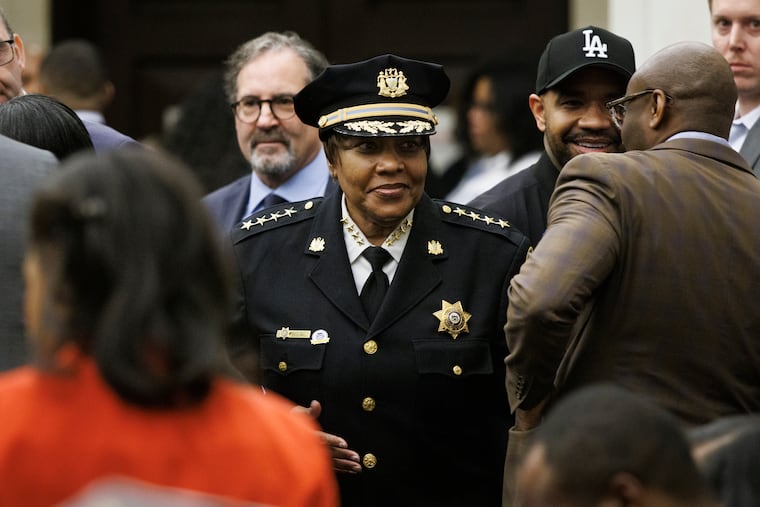
Philadelphia Sheriff Rochelle Bilal continues to embarrass the city. Most recently, she reneged on her agreement to accept court-appointed oversight of her office, while a top deputy announced that roughly $20 million worth of taxpayer dollars had been hiding in the department’s couch cushions.
All of this comes just months after Inquirer reporting showed that Bilal had misled City Council during her budget hearing, claiming deed processing was moving full steam ahead despite significant evidence that things were stuck.
Given these circumstances, you might think Council would act, hold fact-finding hearings, and even consider abolishing the office. Instead, their focus is on something completely different, namely Starbucks workers’ unionization effort. Council wants everyone to know it supports boycotting the coffee chain until a contract agreement is reached.
It is one thing for members to signal their support for organized labor, but Council could have done so by signing a letter. Instead, where people get their coffee became the biggest issue of the day during last week’s Council hearing, which included an anti-Starbucks rally. The Seattle-based chain itself is no longer thriving. The company just closed 250 stores nationwide, including three in the Philadelphia area.
This level of attention was particularly galling when paired with Council’s inaction over Bilal, which is an issue they can actually do something about. Instead, the city’s lawmakers have been virtually silent.
Beating up on big out-of-town corporations is easy; fixing systemic issues in city government is hard. It is clear what the current crop of Council members prefers to do.
Stalled stops
In August, after a Philadelphia police officer left a struggling man to die in the street, I joined others in criticizing the department’s decision to deprioritize traffic enforcement. Unfortunately, it doesn’t seem like anything has changed. When a cyclist was struck by a hit-and-run driver near Jefferson Einstein Hospital on North Broad Street on Sunday, police apparently failed to arrive at all. I wish I could say I was surprised, but this inaction is par for the course.
Walk or drive here long enough, and you’ll find multiple examples of motorists executing blatantly illegal maneuvers on the city’s streets, only for the police who witness it to do nothing at all. The numbers confirm it: Traffic citations have decreased by 90% since 2000.
Policing experts I’ve talked to suggest this strategy is a kind of risk avoidance. In an era when cops fear potential “social media moments,” doubling or tripling the number of stops could double or triple the number of bad headlines police brass are forced to explain.
It is safer, from a public relations standpoint, to simply respond to calls rather than engage in “proactive policing.” This, however, is the wrong mindset. What’s needed is for police to do their jobs, including traffic stops, with poise and professionalism.
Beyond the impact on traffic safety, there’s also evidence that traffic enforcement helps to reduce other forms of crime. Policing experts pointed to the U.S. Department of Justice’s “Data-Driven Approaches to Crime and Traffic Safety” program, which is built on the idea that “traffic law enforcement not only prevents accident fatalities and injuries, but also provides an opportunity to identify fugitives, stolen merchandise, illegal weapons, and stolen cars … the more vehicle stops an agency conducts, the more likely it is to identify persons wanted by the police.”
Earned privilege
On Tuesday, City Council’s transportation committee held a hearing to explore expanding free student access to SEPTA’s TransPass+, which currently does not work after 8 p.m. or on weekends. There was widespread agreement that something should be done.
While we had to pay for our school tokens back when I attended Central, they were similarly restrictive. Paying full price to get home from work or engage in weekend extracurricular activities is a pain when the only people interested in hiring you pay just $7 an hour. Expanding access could help get more students to broaden their horizons, which would enrich both them and the city.
There were, however, two major concerns noted before Council. One is how to pay for this expanded access, which could cost tens of millions of dollars. The other is the behavior of some students. Councilmember Curtis Jones Jr. mentioned the crowds that have mobbed Dilworth Plaza, while others brought up the inexplicable failure of many students to tap their fare cards on their way to and from school, which reduces SEPTA’s ability to get reimbursed by the state.
Councilmember Anthony Phillips, citing his own experience working with young people, suggested limiting the expansion to only students who are enrolled in extracurricular activities, while Jones suggested turning off the benefit for students who have misbehaved. Although these ideas are well-intentioned, they also sound like a headache to administer.
There may be a way to overcome these obstacles, in part by tying them together. A key part of growing up is earning privileges. In that spirit, SEPTA and the school district could extend transit access if students start tapping their cards at an acceptable rate. This would cut down on turnstile jumping, offer some of the accountability Jones and Phillips were looking for, and create a pathway to expanded access.
Historic ruling
Last week, I wrote that Common Pleas Court Judge Christopher Hall seemed skeptical of the case for the Washington Square West Historic District. That observation was confirmed by this week’s decision, which once again revoked the Philadelphia Historical Commission’s decision to create the city’s largest and most extensive preservation zone.
I share the Preservation Alliance’s appreciation for great architecture and our city’s history. At the same time, the revocation of this district should not come as a surprise. As Hall’s order notes, 85% of residents opposed the designation during the commission’s hearing, and in many cases, properties were included simply due to their location, with no other justification listed.
It turns out that infringing on homeowners’ ability to renovate their own property according to their own wishes requires more than good intentions.