
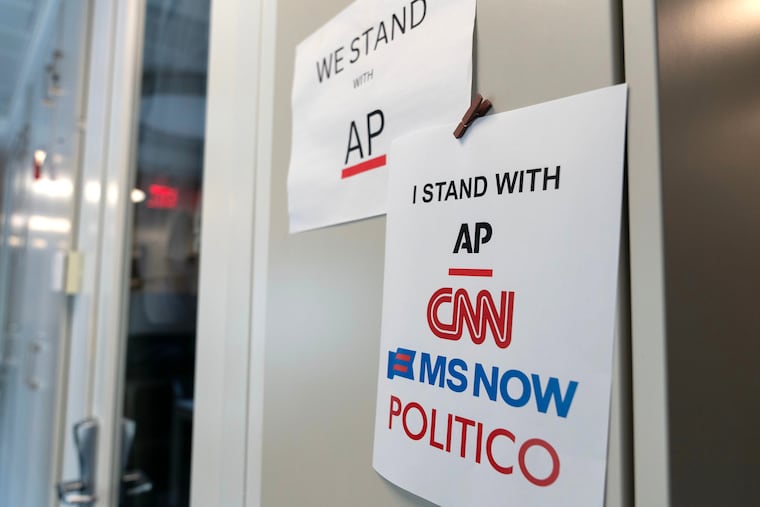
Pressed recently on President Donald Trump’s expulsion of three news organizations from the White House, U.S. Sen. John Barrasso (R., Wyo.) shrugged it off as indistinguishable from Trump’s own past suspension from social media platforms, saying, “So it goes both ways.”
Huh? The senator is either remarkably ignorant of the Constitution from which he derives his power, or shameless enough to pretend to be.
What Barrasso didn’t appear to understand is that the First Amendment, like the rest of the Bill of Rights, doesn’t go both ways: It protects us from the government, not vice versa. Specifically, it guards the expression of citizens and publishers against state censorship and interference. Government officials can neither dictate what Facebook posts nor punish CNN for what it airs. If the First Amendment doesn’t mean news organizations can report on the government freely without being barred from public buildings and events as a result, it doesn’t mean anything.
» READ MORE: Pennsylvania’s shameful contribution to President Trump’s immigration crackdown | Editorial
Trump’s latest trampling of the Constitution is in that sense too clear to be muddied by senatorial sophistry. He expressly denied CNN, Politico, and MS NOW entry to the White House based on the content of their reports, in particular their failure to sufficiently glorify him. This is the essence of what the First Amendment prohibits.
It’s far from Trump’s first or most consequential authoritarian challenge to the country’s long-protected freedoms of expression and the press. Since his first term, he has derided legitimate journalism as “fake news,” encouraged violence against reporters, and called the press the “enemy of the people,” echoing Josef Stalin and other despots. In his second administration, he has graduated to leveraging the power of the federal government against the media, using the Federal Communications Commission (FCC) to try to force late-night host Jimmy Kimmel off the air; wielding government power over mergers and more to reward corporations that rein in independent journalism; and menacing journalists and their employers with lawsuits, investigations, and arrests.
» READ MORE: Should Larry Krasner still lead the Philadelphia District Attorney’s Office? | Editorial
But the ban may be Trump’s most glaring violation of constitutional press protections to date. As the affected organizations noted in a lawsuit filed in federal court this week, the policy “could not be a more direct assault on the First Amendment.” The president himself called it a “ban on the free press” and attributed it to the organizations’ “negative” coverage.
The courts have blocked his earlier attempts to exclude individual reporters as well as a parallel Pentagon policy instituted by his defense secretary. Even the Trump-friendly U.S. Supreme Court could be hard-pressed to justify this one.
In addition to laying the groundwork for his next legal defeat, the president’s lockout gave the fractious press corps rare cause for collective action. With other networks declining to provide pooled camera coverage in solidarity with the banned organizations, the lack of competent recording at a ribbon-cutting for a new White House helipad this week ensured an idling chopper drowned out Trump’s remarks — not that very many people missed them.
It was the sort of pseudo-news event that only raised more questions about the value of broadcasting much of what the president says. Journalists who direct their attention elsewhere are bound to transcribe that much less fake news.