
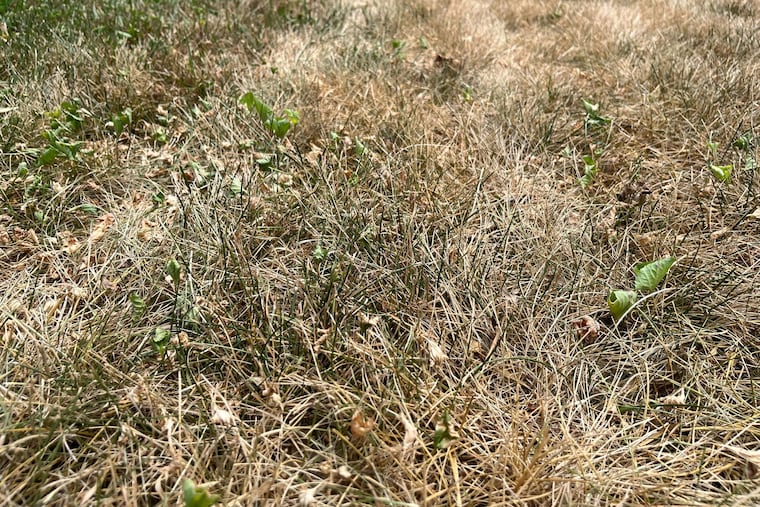
Unless rainforest levels of precipitation soon fall, New Jersey appears headed into a summer marked by voluntary conservation measures and browned lawns.
Last week, Gov. Mikie Sherrill urged residents to voluntarily cut back on water use at a time it typically surges for lawns, gardens, and pools.
Residents of the state are living amid a prolonged drought warning — the third of four levels of dryness monitored by officials. Parts of South Jersey have been under a drought warning since the fall of 2024. If dryness continues, the governor could declare a drought emergency, the highest level, and order mandatory restrictions.
David Robinson, the state climatologist, said that the state has been at roughly 75% of normal rainfall for 24 months.
“That’s the worst level in 20 years,” Robinson said.
Parts of South Jersey have fared worse than other parts of the state, he noted.
Much of South Jersey is listed as “extremely dry,” according to the state Department of Environmental Protection’s monitoring of data from the National Weather Service’s Middle Atlantic River Forecast Center.
Camden County has a rain deficit approaching 10 inches over the past 365 days — the most in the state.
Officials are monitoring the continued dry spell with lingering fears of wildfires that have raced through woods during the drought. Despite Wednesday’s damp weather, fire danger was high across the state, according to the DEP.
Robinson said he can’t forecast whether there will be a large rain or two that break the spell, but noted that the National Weather Service’s Climate Prediction Center says odds are that an El Niño will emerge soon and last through the end of the year.
“Generally, when you have an El Niño in the tropical Pacific, you have a weak hurricane season in the Atlantic basin,” Robinson said.
That suggests we might not see dousing rains in summer and fall from tropical storms, Robinson said. But he noted that’s unpredictable and that the state can come out of drought quickly if it hits a period like last May, one of the wettest of that month on record. It pulled much of the state out of drought.
Regardless, Robinson noted that the typical wet weather New Jersey relies on to restore drained water supplies over the winter and spring has not materialized.
How dry is it?
Here are current 90-day and 365-day rain deficits for key South Jersey counties.
In establishing whether a region is in drought, New Jersey considers multiple indicators such as precipitation, the status of water supply, stream flow, ground water levels, and reservoir storage. Each is weighted according to its importance to a region.
Typically, reservoirs are a more significant factor in the Northeast and serve as a critical water supply source there. Southern New Jersey relies mostly on massive underground aquifers.
Data show that the DEP’s Southwest drought region of Burlington, Camden, Gloucester, and Salem Counties are among the driest on average the past 90 days.
Much of Pennsylvania is also dry with 20 counties in a drought watch including Bucks, Delaware, and Philadelphia. Chester County is in the more severe drought warning stage of the state’s similar four-tier monitoring system, with drought emergency as the highest.
State geologist Steven Domber believes the drought could continue.
“The indicators that we track closely are showing persistently dry conditions,” Bomber said. “New Jersey is experiencing a chronic water supply drought, the scale of which we haven’t seen in more than twenty years.”
He urged residents to cut back on water use.
How you can help
Below are some water conservation tips from the DEP regarding lawns and gardens (for a more comprehensive list, visit NJDEP’s website):
-
Water grass sparingly given that most lawns only need one inch of water a week, which often comes from rainfall and dew.
-
Use a rain barrel connected to a downspout to water plants and flowers.
-
Consider drip irrigation, which uses 30% to 50% less water than sprinklers.
-
Plant fine-leaf fescues, which tend to be more drought-tolerant than other grasses.
-
Mulch around plants to reduce evaporation and weeds.
-
Replace lawns with native plant beds that require less water.
-
Water plants early morning or evening to reduce evaporation.
-
Water the root zone of plants instead of the foliage.
-
Water deeply and less frequently for a healthier root system.
-
Use water from dehumidifiers to water plants.
-
Raise lawnmower blades to at least 3 inches to promote deeper grassroots which hold water better.
-
Don’t over-fertilize lawns, which causes them to need more water to survive.
-
Sweep driveways, sidewalks, and steps, rather than using a hose.
“It is extremely important that all residents and businesses remain mindful of conserving water use going into the late spring and early summer, when demand normally increases,” the governor said.