
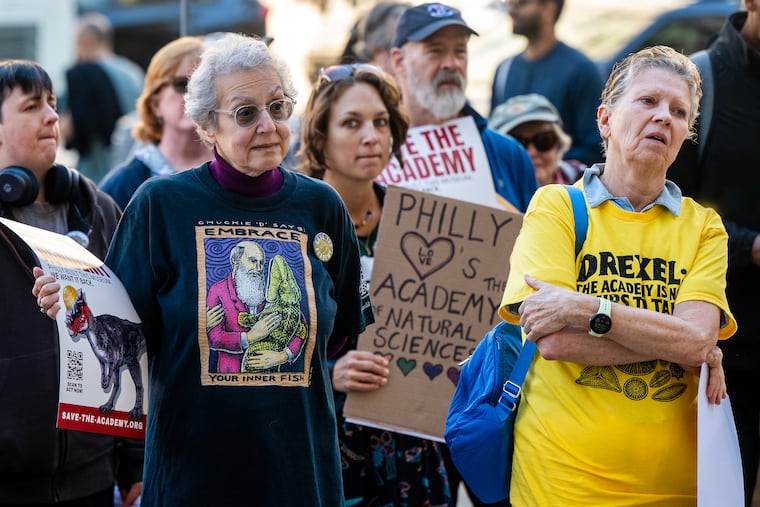
The sudden closing of the museum of the Academy of Natural Sciences of Drexel University was driven, in part, by a budget deficit, various leaders have said in the almost-two months since the decision was made to shutter the nearly two-century-old museum.
How big is that deficit? Two very different figures were presented in a City Council hearing this week focusing on the closure of the Academy’s museum.
» READ MORE: Six concerns raised over the future of the Academy of Natural Sciences in City Council’s hearing
“Last year, the Academy’s public programs cost $7.7 million but brought in only $3 million in revenue,” resulting in a $4.4 million deficit, said Melissa Richman, Drexel’s executive director of operations, who testified Monday about the university’s support of the Academy over the years.
But with that number, Richman was referring to the total amount listed on the Academy’s tax return that went to “public education” — which encompasses not just the museum itself, but also its educational programs.
In fact, looking at the deficit for just the museum, in fiscal year 2025, the shortfall came to less than $1 million, according to testimony from Monday from Academy board chairperson Suzanne Biemiller. Academy financial documents obtained by The Inquirer showed estimated expenses of $3.66 million and revenue of $2.7 million, resulting in a $960,000 deficit.
» READ MORE: City Council grills Drexel representatives for closing Academy of Natural Sciences museum
Nonprofit experts contacted by The Inquirer said that’s a relatively small gap to cover.“ Given their donors, their legacy in the community, and the loss to the city, a raise of the amount would be something they could do on a ‘Friday afternoon,’” said arts consultant Nancy Burd.
The William Penn Foundation has offered to cover the amount Drexel has been contributing toward the museum for about a year while a long-term solution could be studied. Drexel has neither accepted nor rejected the offer, and while the university has said it is open to discussions with the foundation, no talks have happened, a foundation spokesperson said.
Among the programs Drexel is counting in its larger deficit number quoted by Richman: a collaboration with Drexel’s Robert and Penny Fox Historic Costume Collection for an exhibition called “The Ecology of Fashion;” support for the Watershed, a climate resilience hub in Germantown in partnership with Mural Arts and the Philadelphia Water Dept.; the Academy education department’s programs for lifelong learning and lessons for students at Friends Select School; and work with Mantua Civic Association, Sloan Street Community Garden, and Lankenau and Olney high schools.
Drexel spokesperson Niki Gianakaris confirmed that the $7.7 million budget number cited in testimony “encompasses a full range of public activities, rather than the operation of the museum’s galleries alone.”
“The differing financial figures presented at the recent City Council hearing underscore the importance of understanding the full cost of the Academy’s public programming,” said Gianakaris, who added that the “operational imbalance, coupled with capital needs” contributed to the “difficult decision” to close the museum.
“The museum can certainly be operated independent of community-located programs,” said Academy spokesperson Christine Reimert. “In fact, Drexel’s public education figures also include the 50-year-old Women in Natural Sciences high school program, which was consistently fully funded but was spun off as a separate organization in the spring of 2026 at Drexel’s insistence. All of this supports the need to have an independent financial analysis and feasibility study completed so that decisions can be made based on a single set of accurate numbers.”
Still, more than one City Council member at Monday’s hearing sounded astonished by the relatively small amount it would take to fund a reopening of the museum to five days per week. When asked that question by councilmembers, Biemiller, the Academy chairperson, again cited the figures from fiscal year 2025 — $3.6 million in costs, offset by $2.7 million in revenues.
Said Councilmember Jeffrey Young, Jr.: “We have a $7 billion budget [for the entire city] and we contribute millions of dollars to other cultural institutions in the city. I think that’s something that was very, very doable,” said Young.