
Andre Martin was close to hurting somebody.
The 51-year-old South Philadelphia man, incarcerated in his youth, recalled when a jailhouse conflict between him and another young man nearly became violent.
But before a tragedy occurred, an ex-gang member serving as a counselor in the facility de-escalated the situation, Martin said, and later empathized with his inner turmoil.
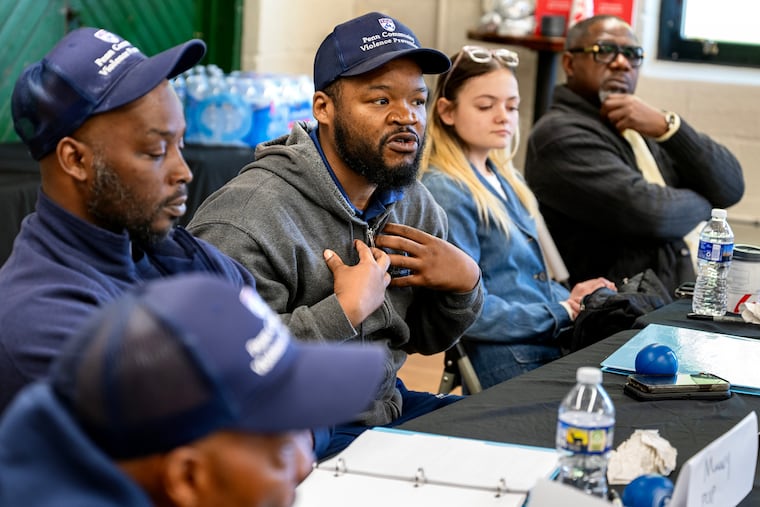
“It changed my life, and I became the man I am today,” Martin, an outreach worker with Penn Community Violence Prevention, told a room of his peers in Northwest Philadelphia last week.
They had gathered at an East Germantown coworking space for the launch of the Peacekeepers Institute, a new eight-week training program launched by city’s Office of Public Safety with the goal of unifying and training those who work in Philadelphia’s patchwork of community violence intervention organizations.
Around 25 members from groups like the Pennsylvania Anti-Drug/Anti-Violence Network (PAAN) and Kensington’s Cure Violence shared stories and best practices in a field that, until recently, had flourished nationwide.
Community violence intervention programs, aided by hundreds of millions in federal funding during former President Joe Biden’s administration, work to reduce gun violence by deploying “credible messengers” to engage with those most at risk — offering conflict mediation, social support, and public services in an effort to avert crime without involving law enforcement.
Donald Trump’s return to the White House has seen much of those investments eliminated. The president shuttered the Office of Gun Violence Prevention, and has shifted funding for such programs to law enforcement agencies.
In Philadelphia, those moves have created uncertainty for grassroots organizations like the New Kensington Community Development Corporation, which last year lost a $1.5 million federal grant to expand its street outreach work.
Since 2021, the Public Safety Office has awarded around $60 million to such groups.
To mark the opening session, Adam Geer, the city’s Public Safety director, told attendees Mayor Cherelle L. Parker’s administration would not abandon these programs.
“This is work we value as a city, this is work our communities value,” Geer told The Inquirer after his remarks.
Geer said more cohorts of Philadelphia-based outreach workers are expected to enter the institute later this year. Trainings will focus on conflict de-escalation, overdose prevention, and personal wellness, among other topics. Speaking to the purpose behind the program, Geer said:
“I want them to charge their batteries, I want them to learn how to be even more effective than they already have been.”
The program arrives at a relatively positive moment for crime in Philadelphia.
The murder rate has fallen precipitously since its pandemic high, hitting a low not seen since the 1960s. There have been just 34 homicides in the city in 2026, according to police. In April 2021, there were 53 murders alone.
A variety of factors explain the drop, and the city’s community violence intervention groups say they have contributed.
They point to independent studies, such as one published by the University of Pennsylvania in 2022, that found a single interaction with a credible messenger reduced gun violence among at-risk participants by around 36%.
At the Peacekeepers Institute, speakers stressed that despite a decline in murders, now was not the time for antiviolence groups to ease up on their responsibilities.
George Mosee, the executive director of PAAN, reminded attendees that Philadelphia has long been considered a pioneer in the field.
Antiviolence work in the city dates back to the 1970s, Mosee said, evolving during the devastating introduction of crack of the 1980s and expanding during the modern day gun violence epidemic.
“Now is the time to make sure that the work solidifies the progress, so that the problem doesn’t come back,” he said of the recent drop in crime.
Given those trends, Mosee warned attendees they could perhaps expect city leaders to begin considering whether funding for community violence intervention was still necessary.
“When you start to succeed, they try to take the money away from you,” he said. Geer, for his part, told attendees they had the Parker administration’s full support.
On the other hand, Mosee added, one of the most challenging parts of antiviolence work is proving to others that the programs make an impact.
He said it was difficult to quantify a murder or violent crime that didn’t occur because an outreach worker offered someone support or intervened in a conflict.
That echoes persistent criticisms of major investments into progressive alternatives to policing.
Large-scale studies on the effectiveness of community violence intervention programs are limited when compared with those that study the impact of law enforcement. And researchers that do study antiviolence programs remain divided on whether they should be directly credited for reducing crime.
Peacekeepers Institute attendees, however, say they have clearly seen the salutary impact of their work.
They spoke of teens encouraged to put down firearms, of retaliatory gang killings averted.
“I know we have changed people just by being in their presence,” said Martin, the outreach worker from Penn. “You can’t ever say that what we’re doing, because it’s not on paper, isn’t making a difference.”