
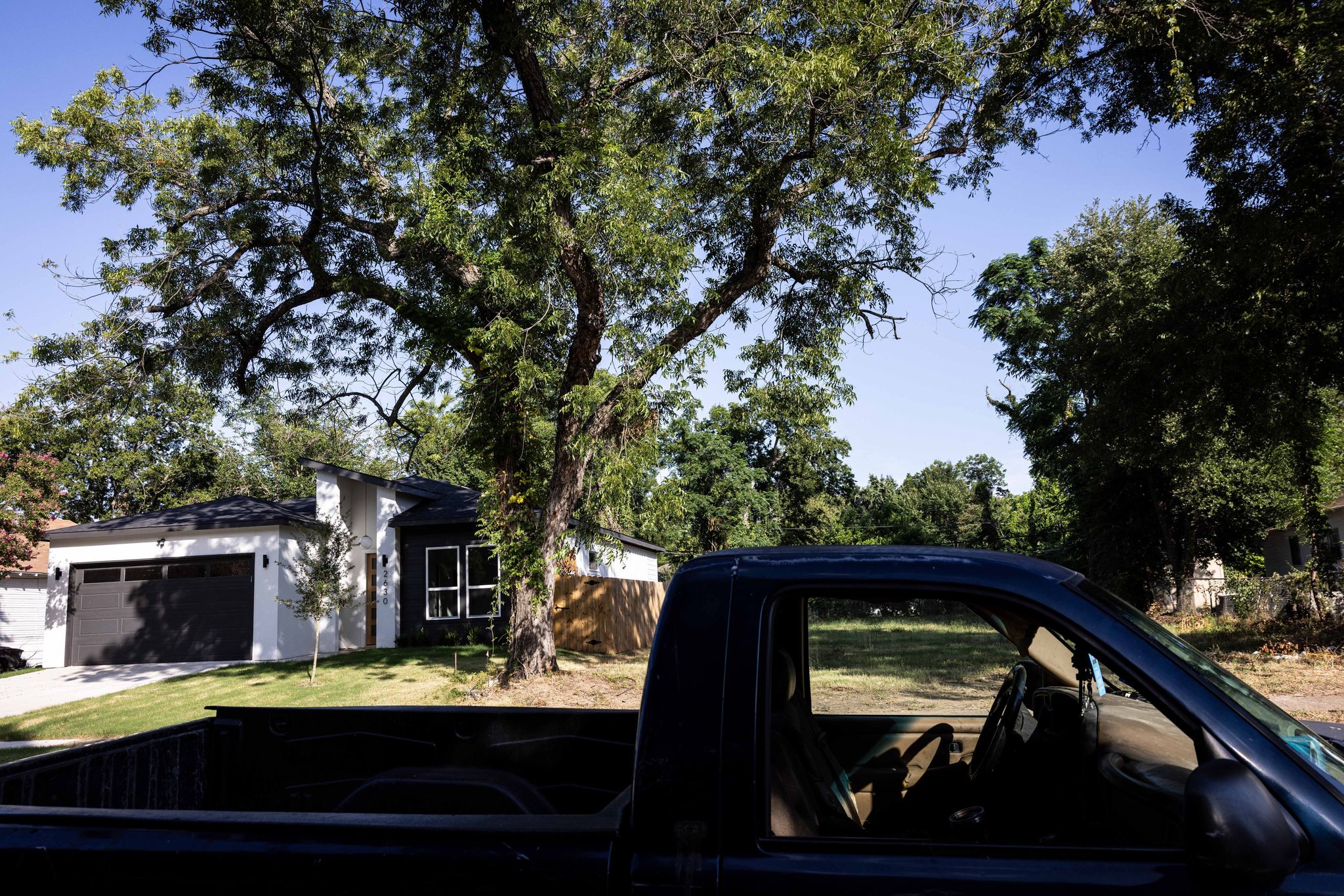
When one South Dallas neighborhood came up at City Hall, Theresa Garrett shut her eyes and prayed.
As the Landmark Commission voted unanimously Monday to continue the yearslong historic designation process for Queen City, tears streamed down her face. Garrett showed up to carry the baton for the neighborhood where generations of her family have lived, hoping historic protections will have a positive impact.
“There is greatness in Queen City, and right now we are already embarked upon it,” Garrett said. “We just need some more time.”
The process to consider a historic district for the area started in 2024 as contemporary homes filled lots amid historic dwellings. For two years, there’s been a moratorium, but the area is so large that more time is needed to complete the process, city staff said. If a historic district is ultimately granted, it will help implement a long-term community vision of welcoming needed development while guarding the area’s history.
Related: South Dallas, Fair Park area zoning to be considered by City Council after plan commission vote
Eva Jones, longtime president of the Queen City Neighborhood Association, called the process an “exhausting effort,” where advocates work to keep the community engaged as more than 1,000 properties are documented.
“What I ran into today is: the residents work,” Jones told commissioners, as a small group waited to speak Monday afternoon. “We do have support for this initiative.”
Home to unique architecture and African American history, Queen City has seen national recognition but not a local designation, meaning it doesn’t have protection under Dallas’ development rules. The new district would provide preservation criteria specific to the area.
“Queen City is more than just a collection of homes and streets,” said Jessica Jolly with the neighborhood association.
“It is a living testament to the history, resilience, culture, and contributions of generations of African American families in Dallas,” Jolly told commissioners. “For decades, this neighborhood has represented community, pride, faith, and perseverance.”
Three commissioners found there is enough of the neighborhood’s historic character, with its narrow streets and Craftsman-influenced homes, that it should be locally protected, according to city documents.
The area contains two separate national register districts. The nationally recognized structures reflect “early phases of residential development and architectural patterns,” documents show. On Romine Avenue, the area got recognition for its concentration of “Tudor Revival-style” homes, adding cultural distinction to the neighborhood.
However, these areas are a small portion of the neighborhood and aren’t protected locally. Inside the proposed district, roughly two-thirds of the more than 1,000 properties could contribute to a future district, documents show.
Related: With FIFA Fan Fest set to hit Fair Park, will South Dallas businesses be involved?
The ratio of contributing structures is “unusually high,” city staff emphasized in a statement. This means there’s a need to carefully document, and that takes time. The decision on Monday to continue the work helps prevent demolition and alteration as the area is evaluated.
A tentative timeline shows the change could be adopted by the City Council in February. Documents show the adoption, if it comes to be, would follow drafts of preservation criteria and several reviews, along with a Landmark Commission hearing in January.
Communities like this neighborhood have been “dismantled,” said Shaní Dixon to the commissioners, but so much of Queen City remains intact even after a highway tore through the area in the ’50s.
“It’s imperative that it be protected on a local level,” she added.
This reporting is part of the Future of North Texas, a community-funded journalism initiative supported by the Commit Partnership, Communities Foundation of Texas, The Dallas Foundation, the Dallas Mavericks, the Dallas Regional Chamber, Deedie Rose, Lisa and Charles Siegel, the McCune-Losinger Family Fund, The Meadows Foundation, the Perot Foundation, the United Way of Metropolitan Dallas and the University of Texas at Dallas. The News retains full editorial control of this coverage.