
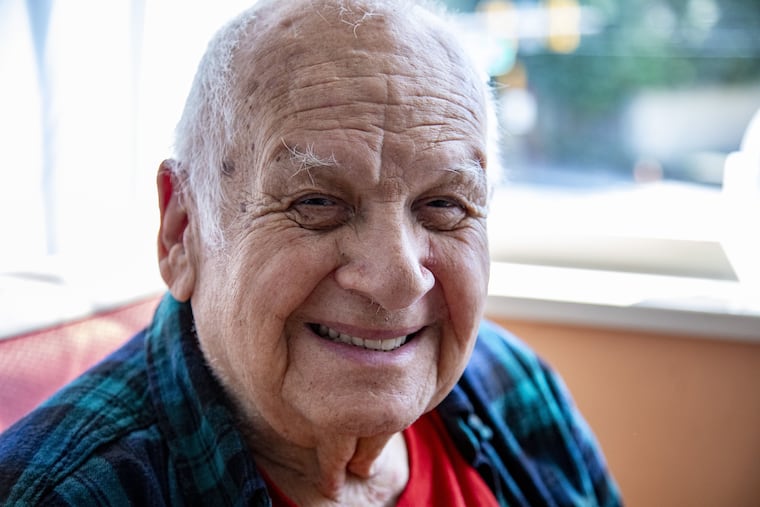
People told me about a great street messiah, so I set out to find him.
The homeless men simply called him Zave, short for Xavier de la Huerta.
In the 1980s, he ran St. Joseph’s Shelter for homeless men where Front Street meets Kensington Avenue, beneath the rumble of the Market-Frankford El. He was a Franciscan friar assigned to nearby St. Francis Inn, the soup kitchen that survives on donations and still serves meals each day to homeless people, those who are unemployed, people battling substance use, struggling seniors, poor children, and anyone else with nowhere to turn.
The Franciscans have both priests and brothers, such as Zave, with the order saying it is dedicated to serving God where they are most needed. Guests don’t shuffle through a buffet line carrying plastic trays; instead, they sit at tables while volunteers deliver meals, restoring a measure of dignity of which they may have known very little.
The neighborhood itself foreshadowed what has made Kensington known today beyond its borders, through YouTube videos focused on exploiting images of poverty and the opioid crisis for clicks.
Once called “The Workshop of the World,” Kensington was one of America’s great manufacturing neighborhoods, home to textile mills, carpet factories, and the John B. Stetson Hat Co., which employed 5,000 people before it closed in 1971.
As factories evaporated, jobs vanished, families left. Investment in the neighborhood dried up and poverty settled over streets lined with crumbling rowhouses and inoperable, abandoned cars.
Before meeting Zave in 1989, I imagined him as a stern schoolmaster. The homeless men called him the “Mayor of Front Street,” and spoke of him with such reverence that I pictured a towering authority figure in a black cassock with half-glasses sliding to the edge of his nose.
I had been talking with the men on the corner when a crowd suddenly gathered around a little man about 5-foot-5 wearing a bright red knit cap with a white pom-pom. The huddle of people trailed him like pigeons chasing breadcrumbs.
“Who’s that?” I asked.
“That’s Zave,” they said.
I crossed the street, finding someone who seemed half my size, barrel-chested with a gleeful, disarming smile. He unlocked the shelter, empty during the afternoon before residents returned for the evening.
The building that housed St. Joseph’s Shelter was a narrow rowhouse that had once been Joe’s Bar, its name still preserved on the tile floor. Eight army barracks beds lined one wall. A small sitting room served as the heart of the house, where the men argued, laughed, mourned, and tried to help one another survive substance use and life on the streets.
I asked Zave what inspired him to dedicate his life to homeless men. Surely this had been his calling. He laughed.
“This is my assignment,” he said. “It’s where the Franciscans sent me.”
I later visited his sister, who lived near my Maryland home. She described her brother as a gentleman with innate kindness. When he stayed overnight at her home the first time, he asked her to replace the bed in the guest room because it was too comfortable. He rarely watched television because he lived upstairs at the shelter among the men, so he enjoyed viewing the old shows on his sister’s box.
She also told me a childhood story about a faithful dog who waited for young Zave at the school bus stop every afternoon. Neighbors were amazed at the canine’s devotion, but eventually learned the source.
On the walk home, Zave stopped at the butcher shop to collect discarded bones and carried them home for the waiting pup.
One homeless man who had spent a decade on Philadelphia’s streets described Zave to me in the most glowing terms.
“Brother Xavier, he’s like a saint,” he said. “He’s good people. Very good people. He’d take the coat off his back to give it to somebody. I feel like it’s Christmas whenever I see him; that’s the glow he has. I don’t know how somebody so little can do so much.”
One of the men I met at the shelter eventually entered drug treatment, moved into a halfway house, found sobriety, and rented an apartment. Another quiet soul Zave saved.
When I visited Zave again, he looked exhausted.
“What happened?” I asked.
“I broke one of my own rules,” he said.
He had agreed to hold one resident’s money so the man wouldn’t spend it on drugs.
“At 2 o’clock this morning,” Zave said, “he came pounding on the door demanding it back.”
There was no complaint in his voice, just another day.
Last year, Zave, now 90, celebrated 60 years as a Franciscan brother and now lives quietly in his order’s retirement home, the St. Lawrence Friary in Beacon, N.Y. He retired in 2016 after suffering a stroke, completing 37 years of Front Street duty.
Thirty years of newspaper reporting for major newspapers has introduced me to presidents, governors, celebrities, athletes, and thousands of fascinating people. Few taught me more about the meaning of a life than the little friar in the red knit cap.
Muhammad Ali once said, “The service you do for others on this earth is the rent you pay for your room in heaven.”
Zave’s heavenly home is paid off.
Gerard Shields is a Kensington native and author of “The Front Row: Recording American History from Reagan to Trump.”