
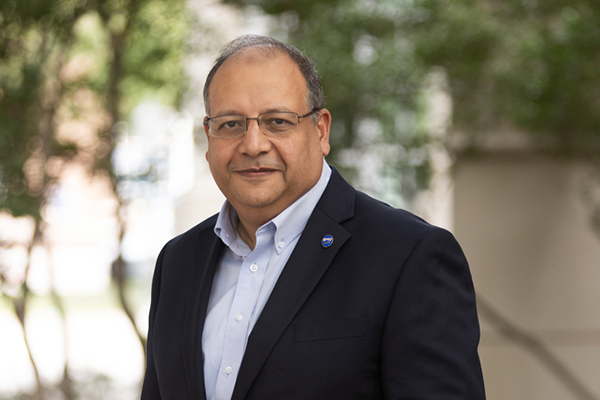
Khaled Abdelghany describes autonomous vehicles as a “big elephant” coming to North Texas roads. Yet the SMU civil and environmental engineering professor does not expect them to account for more than about 10% of traffic by 2045 unless the technology advances significantly and gains wider public acceptance.
But Abdelghany says the effects could extend beyond traffic, reshaping where people live and work, how lower-income residents get around and how passengers connect to public transportation.
The study was partially funded by the North Central Texas Council of Governments and published in the Journal of Urban Technology. This conversation with Abdelghany has been condensed and edited for clarity.
How could autonomous vehicles reduce D–FW congestion without adding highway lanes?
Abdelghany: The main short-term benefit is making better use of the lanes we already have. Vehicles driven by robots could coordinate their speeds and movements. We call this speed harmonization. You can think of a platoon of vehicles moving together like a train at a steady speed.
Today, drivers travel at different speeds and have different reaction times. That creates instability and what we call flow breakdown. Sometimes traffic slows to a crawl, drivers assume there must be a crash ahead and then find nothing. The slowdown was caused by instability in the traffic.
Related: Uber launches robotaxis in Dallas
Connected vehicles could communicate with each other, agree on a speed and keep traffic flowing more steadily. That could increase how many vehicles a highway can accommodate without adding more concrete.
You expect autonomous vehicles to represent only about 10% of traffic by 2045. Why did the study examine scenarios reaching 100% adoption?
Abdelghany: In one experiment with 100% adoption, the model estimated a 33% reduction in total daily traffic delay. Delay means the additional time spent traveling under congested conditions compared with free-flow conditions, such as driving the same route at 2 a.m.
That is why we examined different adoption rates. Even at 25%, the model found benefits, although mixing autonomous vehicles with human-driven vehicles creates another challenge. One idea under consideration is establishing dedicated technology lanes, similar to HOV lanes, to separate the two types of traffic.
How could autonomous vehicles increase the number of miles traveled while reducing congestion?
Abdelghany: People may become more willing to travel longer distances because they will no longer have to concentrate on driving. The vehicle could become an office, game room or another place where passengers do something useful. Someone working in downtown Dallas, for example, may become more willing to live in a distant suburb.
Related: Survey says Americans don’t trust self-driving cars
That could also change where businesses locate. If workers move farther out, employers and services may follow them. Over several decades, autonomous vehicles, remote work and digital connectivity could reshape where people live and work across the region.
Could robotaxis make transportation more affordable, or could they deepen existing mobility gaps?
Abdelghany: The future transportation system could include large fleets of robotaxis operated by competing companies. Instead of owning and maintaining a car, someone could request a vehicle through an app. Competition among those companies could make transportation more affordable.
But there is also an equity concern. The vehicles could concentrate in parts of the region where demand and profitability are highest. Someone in one area may receive a vehicle in two minutes, while someone in southern Dallas waits much longer because fewer vehicles are available. Prices may improve while the quality and reliability of service remain unequal.
Robotaxis could also help solve public transportation’s first- and last-mile problem by taking passengers to and from rail stations. That would require public agencies and private transportation companies to coordinate their services.
What is the biggest misconception readers should avoid when interpreting the study?
Abdelghany:
The 33% reduction is not a promise. It is the model’s estimate under a particular set of assumptions. As we learn more about autonomous vehicles and how communities adopt them, those assumptions and estimates will need to be updated. This study describes possible futures, not a fixed forecast.
This reporting is part of the Future of North Texas, a community-funded journalism initiative supported by the Commit Partnership, Communities Foundation of Texas, The Dallas Foundation, the Dallas Mavericks, the Dallas Regional Chamber, Deedie Rose, Lisa and Charles Siegel, the McCune-Losinger Family Fund, The Meadows Foundation, the Perot Foundation, the United Way of Metropolitan Dallas and the University of Texas at Dallas. The News retains full editorial control of this coverage.