
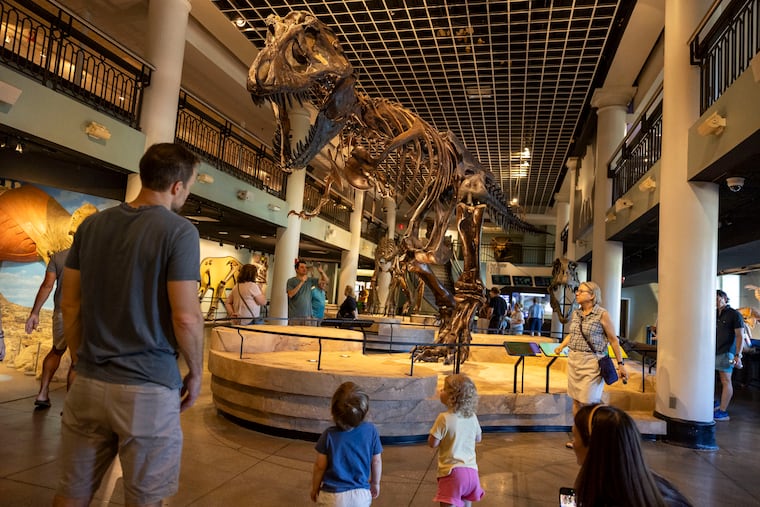
The line at the 19th Street entrance of the Academy of Natural Sciences of Drexel University zigzagged outside of the institution’s sliding doors on Friday morning.
Dozens of parents pushing two-seat strollers cleared paths along the sidewalk in front of the museum at 19th and Benjamin Franklin Parkway. They were all looking for a spot in the line that stretched to the corner of Cherry Street.
Small children climbed onto the building’s brick-covered grooves for a peek inside the museum as they inched closer to the museum’s doors, which opened at 10 a.m.
Inside, the museum was filled with visitors snapping selfies and taking family photos in front of full-scale dinosaur displays. Children sprinted across the mezzanine floor and rolled up their sleeves for the “big-dig” fossil exhibit. Others stopped by for close encounters with turtles and other live animals, while some frolicked alongside prehistoric creatures using virtual reality.
Staff members eagerly welcomed the growing crowd, with one commenting that the attendance reminded her of pre-pandemic times.
That post-pandemic drop in visitors, along with added financial pressures linked to Drexel’s budget deficit, are the reason the museum — which opened to the public in 1828 — plans to cease operations at the end of the business day Sept. 30.
Bella Vista resident Reiss Clauson-Wolf said he brought along his 2-year-old son to experience the same “wonder” he encountered as a 4-year-old visiting the museum.
The Dinosaur Hall and old-school dioramas of bison, bears, and tigers are core memories of his childhood, and he’s sad knowing his son and others won’t be able to experience it much longer.
“It’s such a joy. It’s really sad when an institution like this closes, ” Clauson-Wolf said.
The museum’s last day with regular hours for the public will be Sept. 27.
Chris Bodenhamer, 39, said he didn’t know about the impending closure until he came into the museum on Friday morning. He had traveled from Miami to visit friends in the city and stopped by the museum to check out the new exhibit, “Botany of Nations,” which features historical items linked to Native American nations and explorers Lewis and Clark.
But upon hearing the news, Bodenhamer, who often visited the museum on his frequent trips to Philly, said he was devastated.
“It’s such a special place. You don’t get all of this stuff in one area. What can you do that’s better than this to replace it?,” he said.
After hearing the news, Lancaster resident Dana Krooeck was determined to bring her two nephews to the museum before it closed. She enjoyed watching them walk the halls and engage with the exhibitions they encountered.
“They’re very hands-on, and they’re learning different stuff you don’t get a chance to learn about anywhere else,” Krooeck said.
Like Krooeck, her nephews Ethan Miegel, 10, and Benjamin Elmer, 8, said their favorite part was roaming through Dinosaur Hall.
“Everything here is awesome,” Elmer said.
“It’s an awesome museum. Why would they close it? I’m going to miss it,” said Miegel.
A rally aimed at saving the museum is planned for Tuesday at 10 a.m. in front of the Academy building at 1900 Benjamin Franklin Parkway. It is being organized by Skype A Scientist founder Sarah McAnulty, a squid biologist whose nonprofit focuses on science education, as well as Philly Science Action and Green Philly.
“We have the responsibility to make sure Drexel and other decision makers know that this isn’t something we are going to take lying down,” said McAnulty.
McAnulty said she grew up in the Philadelphia area and went to the Academy frequently. It’s important not just to the city but the entire country, she said, noting its fame as the first natural history museum in the United States.
“It’s unconscionable to close the museum down to the public,” she said. “It’s the responsibility of the stewards of that museum, the Academy board, and Drexel to do whatever it takes to preserve both the collections and the public facing museum.”
In a social media post announcing the rally, organizers called on Drexel to find a way to keep the museum open.
“At a time when climate change and science continue to be under attack, Philadelphia cannot afford to lose another institution that connects people to the natural world,” the post said. “This is an institution Philadelphia can’t afford to lose.”
“We recognize that this is an emotional time for many who care about the academy,” Drexel said in a statement in response to the announcement of the rally.
The decision to close the museum, the school said, was “not made lightly” and will “protect the collections and scientific mission at the heart of the Academy and represents an important step toward addressing the Academy’s financial challenges.”
“The Academy’s Board and Drexel leadership are committed to developing a sustainable long-term model that preserves the Academy’s scientific research enterprise and creates new, meaningful opportunities for continued public engagement and display of these natural history collections and the scientific discoveries they make possible,” the statement said.
Back at the museum, Mackenzie Guillaume, 19, said the museum’s closing is also a loss for artists, who like her, visit the museum to clear “artist’s block.”
“This is one of my favorite places to come, draw stuff, and show people,” she said.
The second-year student at the Moore College of Art & Design said the full-scale replicas of animals inspire her art. The sketches she has done at the museum incorporate the details of the animals and the small “stories” embedded inside the museum’s encasings.
Guillaume said the closure felt like part of a broader trend. “I feel like I’m watching everything get stripped away. From UArts to [defaced] murals and now this,” she said.
The closure of the museum doesn’t affect the rest of the Academy, which builds and maintains the collections and conducts research, all housed inside the Parkway structure. Though not part of the new terms of the deal between Drexel and the Academy, officials said, the goal is to relocate the museum’s collections and sell the 1876 building, owned by the Academy.
Mitchell Hirsch, a Spring House resident and retired scientist, brought his son and two grandchildren into the city to visit the museum.
“This is the only dinosaur museum in all of Philadelphia, and I think its loss will be a serious one,” he said.
Speaking over the din of the noisy museum, filled with children shouting with excitement, he said that the increased attendance was evidence of the institution’s impact, and hopes it signals a brighter future for the Academy museum.
“These institutions enrich all of our lives,” he said.