
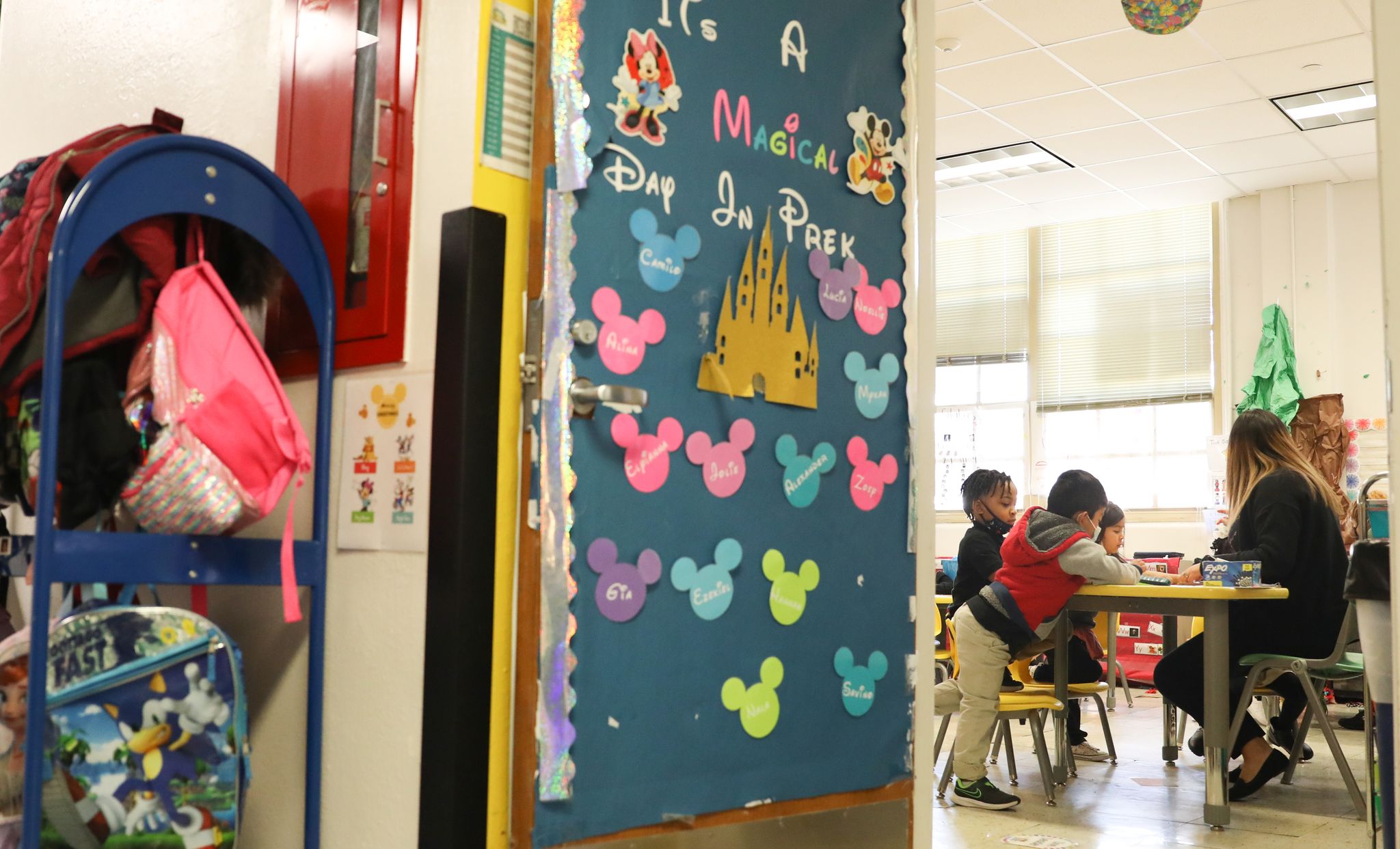
By Texas’ own estimation, almost half of its children entering kindergarten are not ready for school.
Kindergartners stream into their elementary schools from all sorts of backgrounds. Some previously spent the day at home with a parent or guardian. Others were enrolled in a public pre-kindergarten or a private preschool or daycare.
There’s a patchwork of systems that apply to some early learning providers but not others that might give us a snapshot of the quality. But by and large, it’s hard for everyone from parents to policymakers to gauge the success of early childhood programs because there isn’t a uniform tracking system to evaluate how well they prepare children for school.
A continuous improvement system is one of 10 benchmarks for quality pre-K programs, according to Rutgers University’s National Institute for Early Education Research, or NIEER. Texas fell short on that benchmark and seven others, per a recent report by the think tank.
To us, the lack of a transparent and uniform accountability system for state-funded pre-K is the biggest deficiency. Data show that Texas students who entered school ready for kindergarten standards were more likely to be proficient in reading by the time they were in third grade, according to the Commit Partnership, a North Texas nonprofit that advocates for better education outcomes. Early childhood programs are critical to laying the foundation for academic success, and we need better tools to tell us whether pre-K programs are delivering.
Texas has a spaghetti bowl of a regulatory scheme for early learning programs. Health and Human Services issues licensing to childcare providers based on health, safety and operational requirements. Public school pre-K programs have to meet certain standards under state law, such as limits on class size. They also assess students during the year and report their results to the Texas Education Agency.
But state-funded early childhood programs go beyond public school. The Texas Workforce Commission provides childcare scholarships to certain low-income families. Providers that accept subsidies are required to participate in the commission’s Texas Rising Star rating system. Through the program, providers receive coaching and other assistance.
However, that kind of feedback system doesn’t exist across all early learning programs, though some school districts adopt their own. NIEER has previously recognized Dallas ISD for having its own pre-K quality improvement system.
We are proud to have vision and accountability in our backyard. But every Texas family that enrolls their child in a state-funded pre-K should feel confident that their student will get a quality education.
Gov. Greg Abbott’s task force on early childhood governance is charged with figuring out how to improve the quality and oversight of Texas programs. It’s a tall order, given the complexities involved, but neighbors including Mississippi, Alabama and Georgia have figured it out. We can, too.
Have thoughts about this? Send a letter to the editor using our letters form or email letters@dallasnews.com. Letters should be no more than 200 words and include the first and last name of the writer and city of residence.