
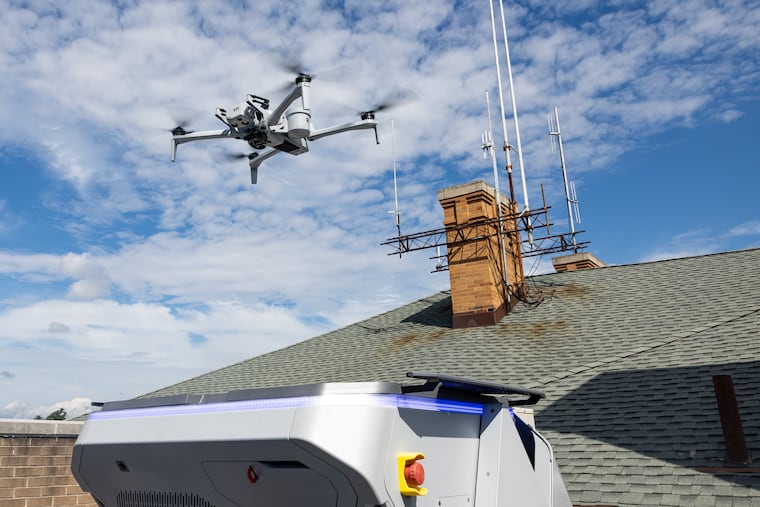
When Upper Darby Police received notice that a car thief out of Maryland was making his way through the township in June, they responded immediately. A high-speed chase ensued, but the department quickly broke it off, fearful of the risk it presented.
They didn’t want the driver to harm himself or bystanders, Upper Darby Police Superintendent Tim Bernhardt said.
Minutes later, officers caught up to David Graham, with the stolen Nissan Maxima, on a side street where he had attempted to blend in as the car’s owner, doing repairs on the vehicle.
Graham’s arrest on receiving stolen property, fleeing police, and related charges was calm and straightforward, and the case is pending trial, Bernhardt said. That resolution came because his officers were able to keep an eye on Graham, tracking his movements from 400 feet above.
Upper Darby is the latest police department in the Philadelphia region to adopt drone technology, using it to supplement their patrol and surveillance capabilities. Bernhardt and other local officials tout the new technology as a way of de-escalating arrests.
“That police officer in a marked car with lights and sirens going, the adrenaline is going, we no longer need that,” Bernhardt said. “And on the opposite end of that, the suspect, they don’t hear or see the police coming, and we take them into custody without that fight, without that resistance, without that fleeing.”
But experts say the adoption of drones by police, often done with little community input, has raised concerns about the potential for departments to overstep privacy boundaries in the name of civil service.
Bernhardt is adamant that his officers have no interest in spying on people.
“We’re not surveilling people that shouldn’t be surveilled,” he said. “We’re using this as a another tool in our tool belt, and it’s allowing us to apply our resources better.”
On the other side of Philadelphia, Bensalem Township police have applied drones in a novel way: using them as virtual first responders to certain crimes, including reports of retail theft from big-box stores that are easy targets for thieves.
Director of Public Safety William McVey said since the department started using drones in 2024 to track alleged thieves, following them as they attempt to escape, retail theft has decreased by 29%.
And the closure rate of retail cases has jumped to 75% in that same period — three out of every four reported thefts end in an arrest, he said.
McVey cited one recent case, when a thief who stole from a Target in the township fled on foot, was tracked via drone and was arrested nearby, even after changing his clothes in an attempt to hide from police.
McVey said the drones are part of the department’s Bensalem Secure Theft Reduction Taskforce, which also includes an information-sharing system that connects retailers commonly hit by thieves directly with his officers, allowing them to respond faster when the thefts occur.
“If it was your store, if it was your business, you would want us doing it,” McVey said, responding to criticism he sometimes hears about focusing on something as seemingly minor as retail theft.
“And what most people don’t realize is the people on this list are committing other crimes as well,” he said. “They’re not just going and stealing one time and done, usually they escalate as they go along their criminal ways.“
Other municipalities in the region are taking notice. In September, Lower Merion Police Department leaders asked the township for $375,000 to fund a “first responder” drone program that would automatically dispatch a drone to the scene of certain 911 calls, including burglaries and missing-persons reports. Council members were split in their reactions, with some voicing concern over increasing surveillance. No decision has been made.
Andrew Guthrie Ferguson, a scholar of police tactics and author of Your Data Will Be Used Against You: Policing in the Age of Self-Surveillance, said the debate about drones is happening throughout the country as the technology becomes cheaper and easier to use.
“I think it feels both practical and dystopian at the same time,” he said. “On one hand you can understand why chiefs want this, but on the other hand, the idea that someone steals some toothpaste and is followed by a drone just feels like a different police world than we’re used to living in.”
Ferguson said too often departments implement new technology policies without input from community leaders, and only begin putting limits on the technology when residents, or officials, learn about them after the fact.
“We sort of defer either to a company selling it or a chief adopting it and not having kind of the democratic back and forth about ‘OK, we’re trading up some privacy and autonomy and security for police’s ability to find a person in the stolen car,’” he said. “Are we OK with that?”
In Philadelphia, those concerns have only recently been addressed by City Council, two years after the city’s police department began using drones to respond to emergency calls in a handful of districts.
Philadelphia Police have a fleet of 21 drones that have been deployed more than 8,000 times since they were put online in 2024, an Inquirer investigation found earlier this year. Unlike other large cities, like Boston and Los Angeles, there is no independent oversight of police drones in Philadelphia.
The department has said drone footage was the primary source of evidence in at least 15 arrests, but declined to divulge any information about those cases, including even the names of the arrested individuals.
City Councilmember Rue Landau has expressed concerns about the lack of transparency, and has said she wants Council and independent experts to have more input in how the devices are used.
In response to The Inquirer’s reporting, and pressure from Landau and other council members, the police department agreed in April to compile an annual report on its drone usage.
Across the city line, in Bensalem, McVey welcomes that level of scrutiny for his drone operators.
“It’s about getting eyes to an area where a cop can’t get immediately. We’re not using it to go fly over people’s houses,” he said. “And if anyone ever suspected that, they should reach out to the police department, because everything we do is categorized and documented.”
Staff writer David Gambacorta contributed to this article.