
Any Collingswood resident over the last 18 years can remember the fight to legalize backyard chickens. Or the second attempt. Or the third.
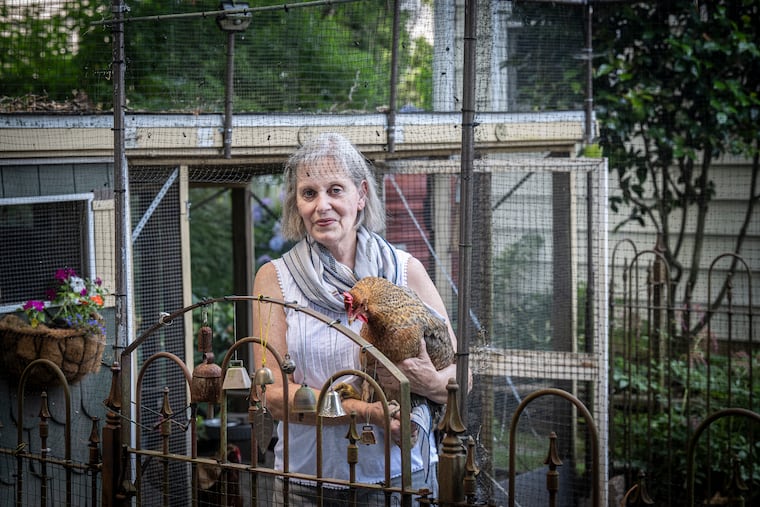
Gwenne Baile, 77, knows the efforts well. A Haddon Township resident and the unofficial “Chicken Lady of South Jersey,” Baile initially became interested when she saw Martha Stewart showing off her chickens on TV. After retiring in 2009 from a long career as an ob-gyn nurse, Baile decided she needed a hobby.
“I started looking into it,” Baile said, “but it was illegal here.”
Since then, Baile said, she has played some part in changing the ordinances in 35 municipalities across South Jersey, including in her hometown. She keeps a list of places with pro-chicken zoning rules, including the 19 municipalities in Camden County that allow them. Baile now has five hens, taken in as fosters, including those injured by predators or forced from owners whose municipalities do not allow coops.
One hen with arthritis lives indoors. Baile calls her a “mini me” since she hates the heat, doesn’t like exercise, and has golden feathers that match Baile’s hair.
Baile and a small group of hopeful Collingswood residents have frequented Collingswood Borough Board of Commissioners meetings in recent months. At its last working meeting on June 17, the group handed over proposed language that they hope the board will use in a future ordinance supporting backyard chickens, informed by Baile’s years of advocacy.
The last major push for residential hens fizzled out in 2019 after several Collingswood residents spent more than a year regularly attending meetings to champion an ordinance that never saw the light of day.
But this time feels different, Baile said, and some locals and officials agree.
Dan DiVito, 42, has lived in Collingswood for six years and owns Front Yard Food, a business that teaches people how to grow their own crops and helps design the backyard infrastructure to do it. If Collingswood passes an ordinance, DiVito said, he will get chickens himself and join the new Backyard Chicken Advisory Board — a five-member commission that would oversee the initiative and investigate complaints.
“Chickens are a no-brainer,” DiVito said. “It’s a pet that makes you breakfast.”
‘A change and an opportunity’
Collingswood did not always ban chickens.
But in 2008, Collingswood’s three-person board of commissioners — made up of a mayor, deputy mayor, and a commissioner — adopted measures prohibiting residents from keeping or breeding a long list of livestock and fowl, including chickens.
Local news records from 2008 do not give a clear explanation why the rules were adopted, other than comment from then-Mayor Jim Maley that the board wanted to “head off a problem before it presents itself.”
The maximum penalty for violating the ordinance is a $500 fine.
Repeated attempts to end the ban have been unsuccessful, even as neighboring municipalities passed ordinances to allow chickens. Some residents voiced concerns about the smell or the noise, or about Collingswood properties being too small to house chicken coops. Collingswood Chicken Uprising, the local Facebook group for the chicken resistance, was created 16 years ago and is up to 234 members.
Enjoyed this story?
Get more South Jersey news on your homepage with one click.
But a recent political shift in Collingswood has meant hope for some local chicken advocates.
Maley’s 28-year tenure as mayor ended last May, when two progressive challengers joined Maley to win seats on the board of commissioners.
Daniela Solano-Ward became the first female and Latina mayor of Collingswood in 2025, and Deputy Mayor Amy Henderson Riley became one of only a handful of women to serve on the board in the borough’s history. That shuffling was one factor that brought on the chicken resurgence.
“Advocates and community members saw that this was a change and an opportunity to try this out with the new team and see what could happen,” Henderson Riley said.
Maley, who has said that he would not want chickens living next door or support a backyard chicken pilot program, would be one of three votes if an ordinance makes it to the floor. It takes only a majority to pass.
Passing an ordinance takes time. There must be two separate readings of the proposal, and time must be given for residents to comment. The next commissioners meeting is not until July 15, and Henderson Riley said Tuesday that she was unsure whether the proposal drafted by Collingswood residents would make it to the agenda.
But with an organized, citizen-led group, Henderson Riley said, she suspects this is the most favorable effort thus far. Plus, with concerns like the cost of living and gas prices, she said, there are bigger things to worry about than banning chickens.
“Let the chicken people have their thing,” she said.
Maley and Solano-Ward did not respond to requests for comment.
What advocates are proposing
Every municipality’s backyard chicken ordinance is slightly different. Most have strict requirements, including that coops are predator-proof, set a certain distance from other properties, and kept dry and clean.
Collingswood residents’ pitch to the commissioners would ban roosters, forbid residents from selling their eggs, and require completion of an online course teaching applicants how to care for hens. Collingswood could have only 30 households with hens at a time (of the 6,900 estimated housing units the U.S. Census Bureau estimates are in Collingswood), and new licensees would be capped at four chickens.
Chicken owners would have to pay $10 fees annually to renew their licenses. The Backyard Chicken Advisory Board would investigate complaints and help relocate chickens that are no longer wanted, since the advocates are calling for a ban on slaughtering hens.
Any violations could result in a fine of up to $1,250 or imprisonment of up to 90 days, a more severe punishment than the current ordinance gives for keeping chickens.
Henderson Riley, who has a doctorate in public health, took the three-hour backyard chicken course to learn more about the potential process residents would have to go through to get a coop.
She passed, but not without a bunch of red markings and a reality check that owning chickens takes time, money, and energy that she does not have. Henderson Riley said she thinks the long list of requirements, along with the difficulty of raising hens, will dissuade the vast majority of people from partaking in the hobby.
“It’s not like the hens are going to take over Collingswood.”
Words of wisdom
Lynn Parker, 52, has 10 hens in her backyard in Stratford Township, Camden County. When Stratford passed its ordinance allowing chickens in 2023 (an effort Baile helped with), Parker was the first person in line for a chicken permit.
She now chairs the township’s Hen Advisory Commission, which inspects new coops and educates residents. Fourteen homes in Stratford have chickens now, Parker said, and there have been no complaints.
Her advice to people who want to change their municipality’s chicken law is simple.
“Even if you get a no, do it again,” Parker said.
Suzanne Passante, 71 and Baile’s neighbor, chairs Haddon Township’s Backyard Chicken Advisory Board. She has four chickens and averages a dozen eggs per week.
It took time to educate residents about the benefits of hens and to quell misconceptions, like chickens attracting rats, but she said complaints have been nonexistent in recent years.
“Now, after 11 years, people don’t even think about it,” Passante said.