
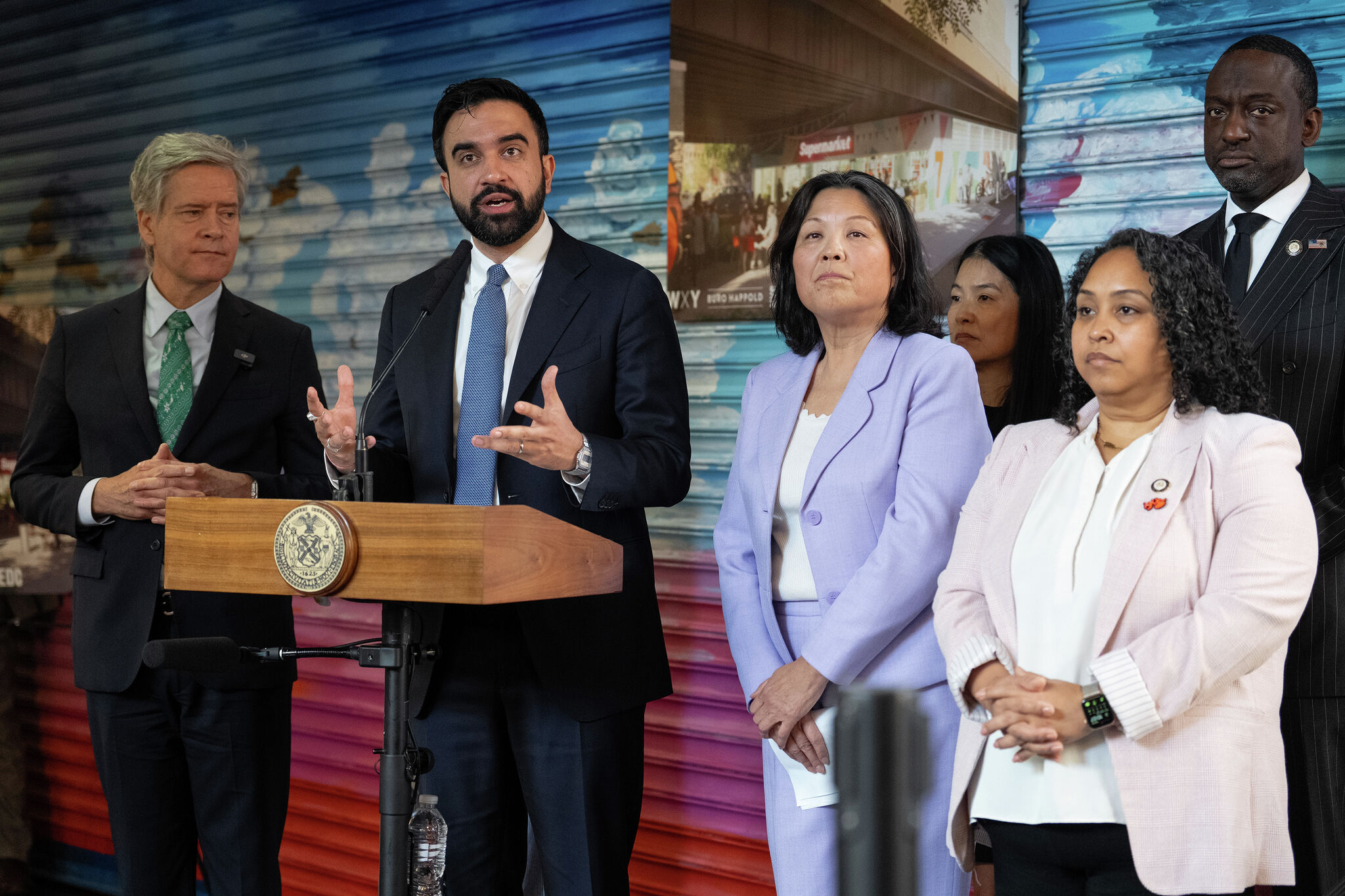
Watching the news about Mamdani-Marts in New York got me wondering: What would a grocery store with a city of Dallas brand look like?
Well, to match the rest of our built environment, 75% of the parking lot would be randomly cordoned off with cement blocks, 15% would be occupied by the cardboard houses of blue-inked methamphetamine users, and the other 10% would be a helipad just for Park Cities people. Inside, the shelving would be falling apart while a furious argument ensued in the storeroom about how to preserve the historic vision of the store’s designer.
In the Big Apple, markets have always been unique. Among the most viral concepts from America’s Meme Mayor Zohran Mamdani is the idea of government-owned grocery stores. Mamdani is set to put his post-Soviet vision into practice in New York, where the combination of food inflation and food deserts has made the metropolis almost unlivable for people near the poverty line. If food inflation accelerates again (the U.S. Department of Agriculture has warned food prices could rise by as much as 5.6% in 2026), Mamdani-Marts might become a serious consideration for us here in Dallas.
Earlier in 2026, it felt like prices were finally leveling off at the grocery store after a half-decade of checkout terror. Just when it was safe to get back to Kroger, the Strait of Hormuz closed. A decent dollop of the world’s fertilizer feedstock traverses the strait, and prices responded. Remember that faint feeling you got when inflation was near 9% and the checkout person asked you “cash or card?” (You wanted to ask, “Is there a bank loan option?”) Economists call that feeling “consumer sentiment,” and it’s coming back to those levels soon.
In Mamdani’s vision, private companies will operate the store as a conventional supermarket. Rather than getting directly into the grocery business, the city will act as the store’s landlord and also subsidize a core group of staple foods such as eggs and bread. La Marqueta was chosen as the flagship location because the site is within 10-minute walk of roughly 65,000 New Yorkers.
Proponents of the stores argue that only the government’s thumb on the scales can make the bulk sale of nutritious food economically viable in a big city. There’s a reason all the big-box and club-membership stores are in places like Plano, not Brooklyn. Grocery giants can’t justify the premiums for adequate real estate and infrastructure, and that has led to “supermarket redlining” in the inner city. Meanwhile, the nation faces an urban malnutrition crisis.
To those who decry government interference in private grocery enterprises, proponents point out that the federal government has operated similar concessions for years at the popular commissaries on military bases, selling Navy Beans for cost plus a 5% surcharge.
New York has always been on the leading edge of imaginative economic store structures, with some version of popular cooperative groceries such as today’s Park Slope Food Co-op tracing back to the early 1900s.
Dallas has its own history of experiments in food economics: Bonton Farms in South Dallas, the Corner Market on Greenville Avenue and others.
Even more creatively, one South Dallas storefront made news last month when police arrested a man who goes by Zillionaire JJ for selling cocaine and methamphetamines right over the counter like they were carrots.
That’s what I call thinking outside the big box.
Dallas has always welcomed zillionaires to its commercial life; can it welcome socialists?
Have thoughts about this?