
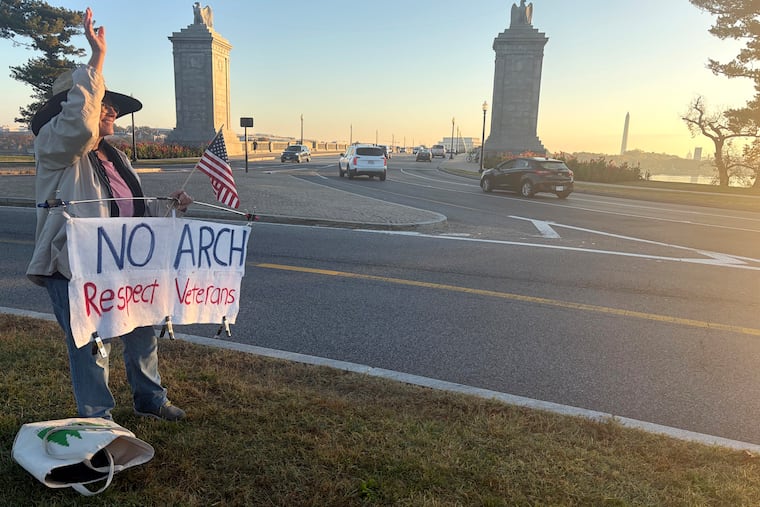
The District of Columbia government and the commonwealth of Virginia sued Saturday to block construction of President Donald Trump’s planned triumphal arch, calling it a “flagrantly unlawful” project that will forever change the landscape of the nation’s capital.
The lawsuit is the latest attempt to stop the 250-foot-tall arch, which Trump hopes to build near Arlington National Cemetery and says will commemorate the nation’s 250th birthday. The administration would like to begin construction as soon as next week.
The two jurisdictions are asking a federal judge to halt the plan and argue that they have “indisputable standing” to bring their lawsuit because the towering arch would have tangible, negative effects on the region — an argument that distinguishes their lawsuit from others that have tried to stop Trump’s construction projects.
D.C. Attorney General Brian Schwalb (D) said the arch construction would cause “serious, immediate, and irreparable harm to the District and its residents,” while Virginia Attorney General Jay Jones (D) said “Trump’s illegal vanity project” would be an affront to Arlington National Cemetery and the “extraordinary sacrifices it represents.”
“The Commonwealth has a solemn duty and a profound interest in preserving the dignity of this sacred place,” Jones said in a statement. “We will vigorously litigate to protect its sanctity and honor the legacy of those who made the ultimate sacrifice.”
The arch already faces legal peril. In a separate case brought by three Vietnam War veterans and a historic preservationist, a federal judge on Friday signaled she might block it.
Spokespeople for the Interior Department, which is managing the project, and the White House did not immediately respond to questions about the new lawsuit.
The administration has acknowledged that the arch will unavoidably harm local historic sites by altering views, and that it will divert traffic and create loud noise during years of planned construction, among other disruptions. Officials have said that those harms are not significant enough to halt what the administration has deemed a “high-priority project.”
The Trump administration has also tried to defend the arch and the president’s other construction projects by claiming that litigants lack standing — the legal grounds to sue — because they cannot show that they would be directly harmed. That argument swayed the Supreme Court this summer in a case about Trump’s White House ballroom. The justices ruled 5-4 that a historic preservationist likely could not prove that she would be harmed by the project — and cleared the way for Trump to keep building.
D.C. and Virginia say harms to the region would be irreversible if Trump’s project proceeds. In their court filing, the jurisdictions argue that the arch would harm the region’s security and emergency preparedness, disrupt traffic, degrade the environment, and run afoul of the Height Act, which caps building heights at 130 feet in D.C. — a defining feature of the city’s architecture intended to preserve views of the Washington Monument and the U.S. Capitol. The arch would be nearly double that height.
They also say the arch is illegal because Congress has not authorized it, and because the National Park Service failed to follow laws requiring “appropriate consultation before undertaking a project that would transform the District’s physical landscape and upend its historic plan.”
The Trump administration has said construction could begin by Thursday if the National Capital Planning Commission — a federal review panel that oversees major projects in the region — approves the arch proposal at its meeting that day and the Interior Department greenlights construction.
Lawyers for D.C. and Virginia argue that if the court fails to act now, the administration could swiftly shift to a new argument — as officials did last year with Trump’s ballroom — that once construction on project begins, it will be too late to stop.
“The court should not allow this cynical gambit to succeed,” they wrote in the filing.
D.C. Council Chairman Phil Mendelson (D), who is a member of the National Capital Planning Commission, said in a statement that the commission is being asked to move forward “without the information, consultation, and approvals required by law.”
“Congress established a process for approving memorials in Washington for good reason. What we commemorate, where we commemorate it, and how a memorial fits into Washington’s historic landscape are important decisions that deserve careful consideration,” Mendelson said. “The proposed Arch has not gone through that process.”
Trump has said he hopes to build the arch on Memorial Circle, a traffic roundabout near the south end of Arlington Memorial Bridge and tucked inside Washington’s boundaries. Administration officials have laid out a plan to work 20 hours per day, year-round, for several years to construct the arch.
The speed and scope of the president’s project — a planned five-level “concrete structure clad in granite,” as federal officials have described it — have alarmed historic preservationists, architects, parks advocates, and local groups that say its effects on the region would be irrevocable.
The arch would permanently disrupt historic architectural designs by competing with the Washington Monument, local officials argue. It would also obstruct the sight line between the Lincoln Memorial and Arlington House, a memorial to Robert E. Lee. The historic preservation officers from both jurisdictions have raised concerns about a lack of review required by law.
But the arch would also cause other logistical headaches, D.C. and Virginia officials say, such as year-round construction for two to three years that would temporarily and permanently change traffic patterns on a busy artery — with potentially serious implications.
They note the arch construction could hamper emergency vehicles at the foot of a bridge that is a designated evacuation route.
“The construction-related closures of the Circle, new pedestrian crossings, and additional pedestrian and vehicular traffic after construction is finished will all complicate evacuations from and emergency response in the District,” they write.
And in a highly restricted airspace, the towering height of the proposed arch would “pose risks to air safety,” which will require local officials to spend significant resources adjusting emergency preparedness plans, D.C. and Virginia officials say.
D.C. leaders have not previously sued to block Trump’s construction projects, including the ballroom, the changes to the East Potomac golf course, and other projects that have drawn complaints.
In a hearing Friday in the separate lawsuit seeking to block the arch, U.S. District Judge Tanya S. Chutkan independently raised questions about how the arch would affect traffic patterns and other potential disruptions to the region. An administration lawyer told the judge that he was not prepared to talk about traffic patterns because that issue was not germane to that case.
Chutkan questioned what harm would be caused by waiting several months vs. beginning construction as soon as next week.
“What is the rush to put this arch up?” she asked.