
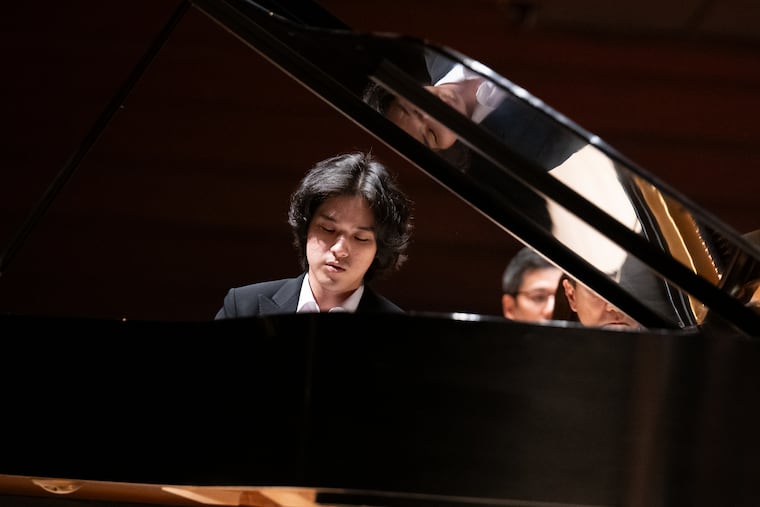
Stars aren’t simply aligned for the Philadelphia Orchestra so much as they’re positioned — purposefully, artfully and precisely — for satisfying Kimmel Center concerts this weekend and near-perfect programming for the 2026 Asia Tour and China Residency (Nov. 5-15).
Of course, all tours have anything-can-happen circumstances.
Pianist Yunchan Lim is the key figure here, having won the 2022 Van Cliburn Competition with Rachmaninoff’s Piano Concerto No. 3 — Everest-like repertoire to which he is returning, first in these Kimmel concerts and on the South Korea leg of the tour.
Marin Alsop, who conducted Lim’s competition win, leads the tour — with the Philadelphia Orchestra, whose famous history includes recording the concerto with the composer himself in 1940.
For the dashing, 22-year-old South Korean Lim — whose Carnegie Hall concerts are consistent sellouts and whose recordings are award magnets — the tour could be an epic homecoming.
(Haochen Zhang, 36, the Van Cliburn winner in 2009, will have his own homecoming on the Far East tour’s China dates, but is sensibly playing Rachmaninoff’s shorter, wittier and more scintillating Rhapsody on a Theme of Paganini.)
Lim doesn’t just play extremely well; he deeply internalizes the music and convincingly projects that to audiences hungry for renewal. But maybe not always.
A social media flurry this week expressed burnout concerns over his schedule — originally four of the tour concerts, but now up to five, shoring up tickets sales. But are five consecutive Rachmaninoff performances healthy?
His Instagram reply: “I understand well what it means to worry about back-to-back performances … This decision was made with full consideration of my condition and what I can handle.”
From a stamina standpoint, Yuja Wang has upended any such guidelines by playing all the composer’s concertos in one concert, in 2023.
At the Thursday and Friday Philadelphia concert, Lim encored a five-minute version of the concerto’s maximum-velocity third movement. Undeniably thrilling.
Yet Lim isn’t yet a candidate for the pantheon of great pianists. And it may be a while.
On the plus sides, the first movement of the Rachmaninoff on Friday didn’t leap from one sensational moment to another, but created a long line of musical thought. The second-movement piano entrance — my idea of a musical nervous breakdown — summoned remarkable intensity. As in Lim’s 2022 live recording from the Cliburn Competition, the final movement had Lim in a virtuosity overdrive. But his middleweight sonority — good for creating a filigree delicacy — felt downright shallow.
This music has its share of dark corners, and they were only somewhat explored. Also, constant expanding and contracting tempos became predictable and were more about effect than expression.
Friday’s concert was dedicated to the memory of the great pianist Ruth Slenczynska (1925-2026), one of the very few pupils of Rachmaninoff. Do all roads lead to Rachmaninoff around here?
The rest of that Kimmel concert, however, was not overshadowed.
In Stravinsky’s Firebird suite — a natural choice since the Philadelphia Orchestra isn’t hired to be demure — principal guest conductor Alsop all but had a thought balloon saying “Keep Stravinsky shocking.”
Symphony in One Movement by West Chester-born, Curtis Institute-educated Samuel Barber (1910-1981) is core repertoire for Alsop and nobody does it better. Many conductors zero in on Barber’s more lyrical gifts. But as a master craftsman, Barber is most effective when heard as a fully-realized orchestral package.
And Friday’s package had an especially well-played slow-movement oboe solo by Peter Smith. Though inspired by Sibelius, the symphony is as dense as Mahler, not quite so worldly, and, in sum, unlike anything in the standard repertoire.
“Yunchan Lim Plays Rachmaninoff” repeats Oct. 31, 2 p.m., Marian Anderson Hall, 300 S Broad St., Phila. Tickets: $85-254. philorch.ensembleartsphilly.org