
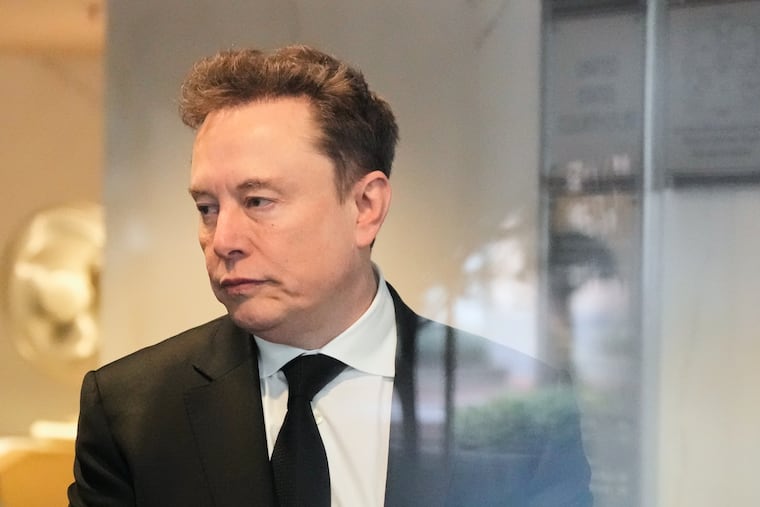
OAKLAND, Calif. — Elon Musk, the Tesla CEO, world’s richest man, and OpenAI cofounder, took the stand Tuesday in a high-stakes trial revolving around a bitter feud between himself and former friends Sam Altman and Greg Brockman that could reshape the future development of artificial intelligence.
The bickering billionaires’ appearances at the Oakland, Calif., federal courthouse foreshadow the start of a legal drama that is expected to brim with intrigue and potentially embarrassing details about the two tech moguls. Musk filed the lawsuit against Altman and Brockman along with Microsoft over its investments in OpenAI in 2024.
“Fundamentally, I think they’re going to try to make this lawsuit … very complicated, but it’s actually very simple,” Musk said. “Which is that it’s not OK to steal a charity.”
The jury was selected Monday and the trial is scheduled to take three weeks.
Opening arguments began with Musk’s attorney, Steven Molo, who quoted OpenAI’s mission statement when it was created as a nonprofit for the benefit of humanity as a whole and not constrained by the need to generate financial enrichment for anyone.
Altman and his top lieutenant Brockman, aided by Microsoft, “stole a charity,” Molo said, “a charity whose mission was the safe, open development of artificial intelligence.”
In the lawsuit, Musk accuses Altman and Brockman of double-crossing him by straying from the San Francisco company’s founding mission to be a steward of a revolutionary technology. He is seeking damages, funding for the altruistic efforts of OpenAI’s charitable arm, and Altman’s ouster from OpenAI’s board.
OpenAI has brushed off Musk’s allegations as an unfounded case of sour grapes that’s aimed at undercutting its rapid growth and bolstering Musk’s own xAI, which he launched in 2023 as a competitor.
In his opening statement, OpenAI lawyer William Savitt told jurors, “We are here because Mr. Musk didn’t get his way with OpenAI.”
Savitt said Musk used his promises to provide funding to bully OpenAI founding members and tried to take control of OpenAI and merge it with Tesla. In fact, he said, Musk wanted to form a for-profit company and own more than 50% of it. In the middle of discussions about OpenAI’s future, he added, Musk pulled the plug on $5 million quarterly donations he was making.
There is no record, Savitt said, of promises made to Musk that OpenAI was going to remain a nonprofit forever, or open-source everything. What Musk ultimately cared about, he said, was not OpenAI’s nonprofit status but winning the AI race with Google.
Molo said the case is not about Musk, but rather Altman, Brockman, and Microsoft.
By 2017, about two years after OpenAI’s founding, it became clear that OpenAI would need more money, and Molo said the founders eventually settled on the idea of creating a for-profit arm of OpenAI that would support the nonprofit. Terms were capped for investors so they “couldn’t make infinite profit.”
Microsoft initially invested $2 billion in OpenAI. Then, in 2022, news spread that OpenAI had done a deal with Microsoft and “this was a horse of a completely different color,” he said. It was a “gamechanger,” Molo said, that violated “every commitment” OpenAI made not just to Musk but to the world. It was no longer open source, it became a for-profit company for the benefit of the defendants, and Microsoft was going to have control, through licensing, of much of its intellectual property, Molo said.
Musk was the first to testify.
Molo asked Musk about his views on AI. Musk said he expects AI to be “smarter than any human” as soon as next year. Musk said a longstanding concern about AI is the question of what happens when computers become much smarter than humans. Comparing it to having a “very smart child,” Musk said when the child grows up “you can’t control that child,” but you can instill values such as honesty, integrity, and being good.
Musk recounted his version of OpenAI’s founding, which he said essentially happened because of a discussion he had with Google co-founder Larry Page, who called him a “specieist” for elevating the survival of humanity over that of AI.
The kinship between Musk and Altman was forged in 2015 when they agreed to build AI in a more responsible and safer way than the profit-driven companies controlled by Google’s Page and Sergey Brin and Facebook founder Mark Zuckerberg, according to evidence submitted ahead of the trial.
At that time, Musk said, Google had all the money, all the computers and all the talent for AI. “There was no counterbalance.”
Musk recalled there was discussion early on about alternative sources for funding OpenAI beyond donations, and he wasn’t opposed to it having a for-profit arm, but “the tail shouldn’t wag the dog.” There would be a profit limit, and once artificial general intelligence, or AGI, was “figured out,” the for-profit would cease to exist.
Musk is expected to continue testifying Wednesday.
Altman, OpenAI’s CEO, is also expected to testify, along with Microsoft CEO Satya Nadella, one of the technology leaders who helped fund the late 2022 release of ChatGPT, the chatbot that unleashed the current AI boom that has propelled the stock market to record heights.
Altman’s court appearance likely made him unavailable to attend an Amazon event across San Francisco Bay on Tuesday at which both companies announced an expanded partnership.
“I wish I could be there with you in person today,” Altman told attendees of Amazon’s event in San Francisco via a prerecorded video message. “My schedule got taken away from me today.”