
Whitney Biennial curators travel the length and breadth of the country, paying visits to artists in their studios, surveying their work, and picking creators whose work they think represents the present climate of artmaking in the country. Together, they bring a once-every-two-years expansive exhibition at New York’s the Whitney Museum of American Art, often regarded as the most prestigious and faithful register of American art.
Past Biennial curators — the 2024 edition was curated by Institute of Contemporary Art’s former associate curator, Meg Onli — have embarked on these travels separately, but on the country’s 250th year and the Biennial’s 82nd, Whitney curators Marcela Guerrero and Drew Sawyer traveled together.
“We wanted to just listen to artists and see where they were at, see what they were thinking about, how they were processing recent events,” said Guerrero. They traveled for a bit over a year, nationally and internationally, and visited more than 300 artists.
“The idea of relationality and how do we relate in different ways” at political and interpersonal levels, is a theme that eventually emerged from their survey, Guerrero said.
While some curators have traveled as far as Hawaii in the past, Guerrero and Sawyer’s short travel to Philadelphia in the winter of 2024 proved equally fruitful.
“Philly was such a productive trip and very coherent in terms of what we were hearing from artists on gentrification, displacement, and the cost of living,” Guerrero said.
Artists in Philadelphia, Sawyer noticed, “seem to be particularly preoccupied with ideas of infrastructure” and there exists a strong sense of connection between them. Several of the city’s artist are graduates of the MFA programs at the University of Pennsylvania and University of the Arts, being taught by the same professors like Michelle Lopez (whose work is included in this year’s Biennial) and Sharon Hayes (whose work was a part of the 2024 Biennial).
Performance artists Maia Chao and Jonathan González, both of whose works are part of the Biennial, live in West Philadelphia and are friends and collaborators. Emilio Martinez Pope attended Penn and studied with Lopez, and was particularly interested in the idea of infrastructure from the perspective of the labor of public sector employees to help build and maintain our social and civic architectures.
“A kind of certain institutional critique, I would say, was common” among Philadelphia artists, said Sawyer.
“One of my biggest takeaways is the real vibrancy of the artistic scene in Philadelphia,” he said.
Here are the Philadelphia artists whose works appear in the Biennial.
Maia Chao
‘Scores for the Museum Visitor,’ ‘Being Moved’
Maia Chao’s performance art emerges from studying social behavior. Where some might see the mundane walk from home to work, she sees choreography, a rhythm, and an interaction of the body with its surroundings.
Her Biennial performance piece Being Moved takes inspiration from how museum visitors interact with the art. “It reframes the focus from the art itself to the visitors’ experience,” she said. The title refers to both “this potential to be moved by an artwork,” but also “of the ways that the institution makes us move, makes us move our bodies, and makes us behave in the presence of extremely valuable assets.”
That tension of the push and pull of a museum — where its mission might seem inviting and welcoming but once inside, rules around how to behave, what to touch abound — is at the center of Chao’s piece.
When visiting the Biennial beyond Chao’s performance schedule, visitors see Scores for the Museum Visitor as a set of prompts, an invitation to create “micro performances” of their own.
Among the scores are: “Identify another museum visitor. From afar, copy their movements as closely as possible.” “While holding a museum brochure, clasp your hands behind your back. Drop the brochure.” “Find a bench. Take a seat. Imagine the artworks slowly falling to the floor.”
“These are invitations to kind of transgress the rules, [for] engaging with the artwork, or interpreting and encountering an artwork,” the West Philly-based artist said.
Chao first caught the curators’ attention with Agents of Deterioration (2024), a performance piece commissioned by the Hirshhorn Museum & Sculpture Garden. Sawyer was drawn in by Chao’s “legacy of institutional critique through affective registers.”
“There’s a real kind of commitment to the institution, even as Maia is critiquing it, which we felt was important in this moment where there’s, from many different directions, an eroding of faith in institutions. We were really interested in the way she both critiques and pushes institutions to do better,” he said.
Michelle Lopez
‘Pandemonium’
Pandemonium is a fully Philadelphia piece of art. It was made in collaboration with the Moore College of Art and Design and the Franklin Institute, supported by the Pew Center for Arts & Heritage and the University of Pennsylvania, filmed at Northeast Philadelphia’s RAIR (Recycled Artist in Residency), premiered at the Fels Planetarium and the Galleries at Moore, and was inspired by artist Michelle Lopez’s earlier work exhibited at the ICA.
“Philadelphia is just a really supportive environment for artists,” said Lopez, who is an associate professor of fine arts at Penn’s Weitzman School of Design where she leads the sculpture program. “I could not have made that work in New York.”
The video project, as Lopez says, came from a desire to “situate the viewer in the eye of a storm so that they could feel, on a somatic level, what it was like to have their environment really collapse around them.”
At the Whitney Museum, Pandemonium plays on a domed screen on the ceiling of the gallery and demands the viewer sits below it and looks up. What they witness is things moving around with a violent force against the sky — debris, newspapers, packaging, clothes, clothing (including Lopez’ own and her son’s old underwear), and other markers of extreme human consumption.
In order to make this mayhem happen, Lopez, who is trained in sculpture, built a tornado machine using a robotic contraption, industrial fans, and leaf blowers. Together they created a simulation of a tornado at RAIR which was then filmed and eventually screened in the Fels Planetarium.
“A lot of the work imagistically, came from seeing images of tornadoes and hurricanes wiping out towns. I was really interested in the way nature could collapse culture,” said Lopez, who lives in South Philadelphia.
While a Whitney gallery is nowhere close to the grandeur and wonder of the Fels Planetarium, the 360-format video manages to suck in a viewer who feels almost weightless as the feeling of being thrown around by the forces of nature is simulated.
When the curators visited Philadelphia for studio visits, “top on our list was Michelle Lopez,” said Sawyer. “We were aware that she had been working on this major moving image project that departed from what she’s most well known for, which is sculpture. So we were really excited to meet with her, especially because her work had not been a part of the Biennial before.”
Emilio Martínez Poppe
‘Civic Views’
Like Lopez’s Pandemonium, artist Emilio Martínez Poppe’s Civic Views is an artwork that is only possible because the city of Philadelphia exists. Several Philadelphians have already seen artist Martínez Poppe’s work when it was on view last year at the City Hall Courtyard.
Martínez Poppe was then studying city planning and working toward an MFA in visual art from Penn when he was mulling over the future of city planning graduate students who’d go on to join the public service workforce.
It was in conversation with professors that he found out that the oldest surviving daguerreotype in the country, which is stored in the Pennsylvania Historical Society, was taken by Joseph Saxon, who was a public sector employee working for the U.S. Mint.
“That was shot out of the U.S. Mint, where the Widener Building is today. He’s following Daguerre’s technological recipe he uses it to photograph what he sees through the window. Unlike Daguerre, who sold eyeglasses, Saxton was a public sector employee who was doing something he was not hired to do,” said Martínez Poppe. “He was hired to work on the newly-nationalized currency and he was tinkering with this invention in his office, and that view is one of the only real entry points that we have into his position at his job there, which is interesting.”
Inspired, Martínez Poppe visited municipal buildings all across Philadelphia and photographed views from the inside out so he could document what city workers see from their windows. Alongside, he conducted “dozens of long form, anonymized interviews” with city workers across more than 20 agencies.
“I would ask them, what was your perspective of city government before working here, who taught you about the value of public sector work? Often, so many people would tell me it was their mothers.”
Civic Views is a result of those conversations — a coming together of anonymized interview snippets and photographs displayed in a scaffolding-like structure in the middle of a Whitney gallery. “It’s the scaffolding that dissolves the authoritative center, even in the Whitney Biennial,” said Martínez Poppe.
Since his exhibition in Philadelphia, there have been a municipal workers’s strike, threats of a SEPTA strike, President Donald Trump’s DOGE cuts have resulted in thousands of public sector employees being laid off in the city.
“The public sector is vulnerable to radical change, for better or worse. With my work, I want to say that it’s time to seize the means, seize our technology to create the world that belongs to us,” the artist, who now works for the New York City Mayor’s office as a civic arts programs coordinator, said.
“We need to assume that responsibility. That’s why the project centers the voices of workers and how their positions shape their views. But also how their views shape the structures that we are living in and living through.”
On the curators’ Philadelphia visit, Guerrero recalled seeing Civic Views and people of the city interacting with it. “It was very touching,” she said. Her favorite part about the work is that it uses “the tropes of the camera, of the interview, of bureaucracy, but then upends it completely.”
“You see how important the job of a public servant is,” she said, “and how you know they’re in kind a double bind because they’re the face of the government and also they receive the same services they provide … their kids are in the public school system, they depend on the Department of Sanitation.”
She finds this complexity “beautifully translated” in Civic Views. “You can really put yourself in the shoes of the person who’s speaking and feel the care that really goes into this type of work that should not be overlooked.”
Jonathan González
‘magic hour — golden time’
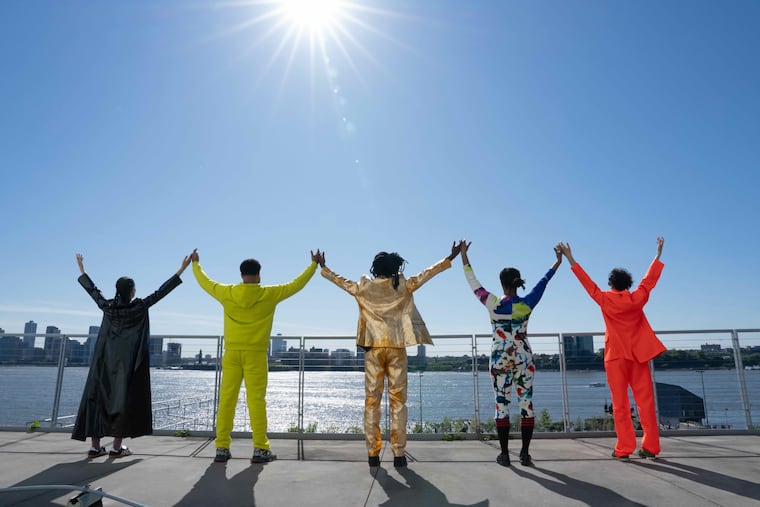
Like Chao, Jonathan González’s work also sees a two-pronged approach with performance and photography. Three Super 8 photographs, A, B, and C mark the locations, across the museum, of the three-hour long performance piece presented by González and their co-artists.
“Each photograph shares with the performers how to perform the work,” said González, who also lives in West Philadelphia. magic hour-golden time, they said, “is a double leaning. magic hour comes from the usage in broadcast television when you have the highest viewership. And golden hour is that moment of the sunset. And so the piece is merging this experience of looking out and also being seen over three hours.”
From three terraces around the museum, the performers follow the sun’s movement for three hours. In the first hour, the performers “embody the architecture that surrounds the museum” that make up the city’s skyline. The second hour, they said, “is a procedure of call and response … the dancers dance with every dance you’ve ever danced, and take information from one another as dancers, as well as from the pedestrians.”
The final hour, González said, is performed on an inaccessible terrace. “It can only be viewed from across the street, you cannot see it from the museum. It’s called the ‘Endless Bow,’ and it’s 60 minutes of bowing to the sun and bowing to the world and bowing to the performance.”
Philadelphia, the University of the Arts alumni said, gives them “the capacity to slow down to hear these voices, and have dreams, visions come to you.” The city allows them the time to spend time in the studio with friends like Chao and inspires them to “collaborating not toward a particular product or aim, but much of the time experimentation.”
“Just the fertile nature of Philly as a historical Black geography has been really important for me to really situate the questions of time and what happens to a city at the late stage of industrialization, and to really think critically about what a group can do, what mutuality is,” they said.
“Certain artists just stay in your mind, and you want to come back and see what they are working on,” said Guerrero recalling her first tryst with González’s work. “The work felt so mature. There’s this notion of how, through improvisation, you can be attuned to your surroundings. In the case of their performance, they make these other effective strategies [for attunement] that don’t always rely on the senses, and that is something that is very present in the show.”
The Whitney Biennial 2026 is on view through Aug. 23 and on partial view, which will include all the Philadelphia artists’ static works, through Oct. 12. The Whitney Museum of American Art, 99 Gansevoort St, New York. whitney.org