
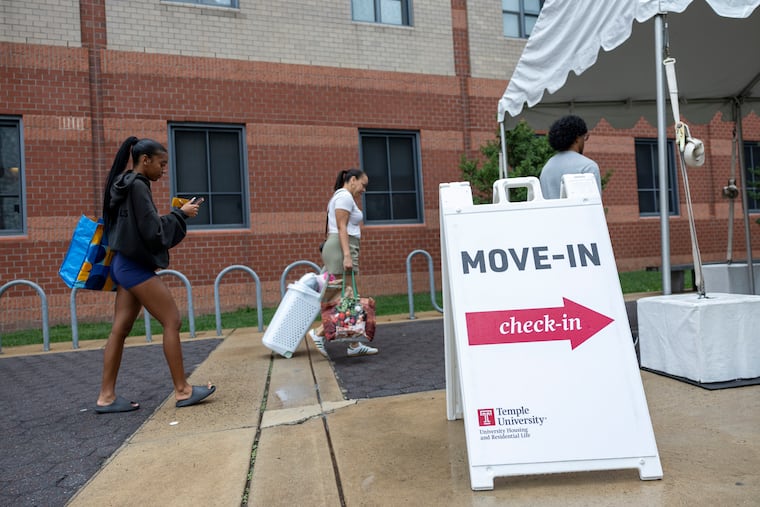
Remember all those big feelings you had on move-in day as a college freshman? After a long summer, you probably arrived on campus ready to tackle dorm life fortified with new flip-flops, towels, and a duvet. Today held great promise — the start of a new you.
My daughter recently enrolled at Temple University. Her move-in day was scheduled for the final week in August. I was proud, and she was excited. Yet, on our drive to campus, we discovered that something was wrong. She was somehow assigned to an all-male floor. How could this be?
We contacted residence life and chatted with a well-meaning student who told us there was nothing she could do. Could we speak with her supervisor? Yes — another caring individual informed us that her hands were tied and that no other dorm rooms were available. How could this be possible? It was her first day of college.
My daughter is transgender and autistic. Temple University assigned her to a male dorm section despite us working closely with intake counselors and disability resources to ensure a smooth and safe move to a gender-inclusive setting. Somehow, a form was missed that coordinates between the office that ensures students with special needs have the necessary supports and the residence halls that house our students.
We pulled up to her assigned dorm in a packed car for drop-off only to learn my daughter could not be accommodated.
We drove home and unpacked the car. She moved back into her bedroom. It was devastating. There was a lot of crying.
The following day, we were contacted by another staff member who informed us they had found a room for my daughter in a female suite. However, the floor was not gender-inclusive.
My daughter would have to roll the dice and not disclose her gender identity.
We asked what the contingency plan was if her roommates rejected her. There was no plan.
We thanked the staff member and declined the offer. I sought assistance from many university administrators (president, provost, dean, heads of the disability resource center), none of whom responded.
Fail.
Full disclosure, I support the mission of Temple University as an alum, a donor, and tenured full professor in the College of Public Health. I am writing today not as a representative of the university, but as a concerned parent and member of the Philadelphia community.
» READ MORE: Trans students and faculty are under attack. Higher education must respond. | Opinion
I am saddened (but not surprised) by how our move-in transpired.
My daughter was collateral damage in an ongoing war for ever-higher enrollment numbers and was let down by an on-campus support system that has been weakened by extreme budget cuts.
Like many American universities, student tuition dollars are integral to Temple’s survival. Student retention and enrollment are both down. The university is facing a well-publicized $200 million annual budget shortfall.
Faculty, librarians, and support staff have been thinned to the breaking point. For example, many of my faculty colleagues in the College of Public Health recently learned that our salaries were to be cut by approximately 20%.
This scenario is not unique to our institution. Indeed, a common cycle is at play.
Tuition revenues fall in tandem with reduced enrollment and poor student retention. These deficits cause financial distress for the university. So administrators relax admissions and increase tuition in anticipation of a financial “sugar rush” that comes with more paying customers and a higher tuition rate.
But many newly accepted students require complex psychosocial and educational supports, and those supports are now largely to be shouldered by a depleted faculty.
Administrators cast instructors as friendly and approachable. Although this is a well-intentioned strategy, the teacher-student relationship is not based on casual friendship.
As instructors, we are compelled to use a boilerplate syllabus template that addresses students using first-person language as if we are addressing them personally:
Feel free to visit us during “drop-in” hours and discuss “anything you need to talk about.”
That could mean anything from personal relationships, dating, intimate partner violence, parental neglect, trauma, financial insecurity, and concerns about immigration policies and enforcement (e.g., Will I be safe here?). Most of my faculty colleagues are not trained as clinical psychologists. Nor do we have sufficient expertise — or in-class support staff — to help students with complex learning disabilities in the context of large (and growing) classroom settings.
When vulnerable students fail and/or withdraw, administration often attributes retention and enrollment dips to faculty — as justification for deeper cuts to classroom instruction and increases to a vast administrative framework.
This cycle is continually baffling to us as teachers, because many of our institution’s most damaging reputational failures have originated in the boardroom rather than the classroom.
I believe in Temple University and in its founder’s vision of a high-quality public education where students from all walks of life benefit from world-class scholars. The university has enriched my own life by providing the training I needed to thrive as a neuroscientist and clinical translational dementia researcher. My colleagues care deeply about the success and well-being of our students.
Yet, many of us fear the university is losing its way.
Unrelenting pressure for new revenue streams, expansion into costly real estate ventures, and lack of reinvestment in teaching and research are eroding the foundation of what makes us so special.
My family experienced these failures up close on my daughter’s first day of college — when we learned there was no place for her here.
Any educational system that fails its vulnerable students and families this badly needs oversight and reform. I hope we find it.
Jamie Reilly is a professor in Temple University’s department of communication sciences and disorders.