
President Donald Trump’s sprawling family business empire has become increasingly intertwined with the boom in artificial intelligence, at the same time that he has resisted calls to slow the development of the technology, a Washington Post analysis of his financial disclosures and corporate announcements found.
Several factors play into Trump’s push for rapid AI development: He has surrounded himself with technology executives and investors who have advocated for the government to accelerate AI development, including venture capitalist David Sacks, Nvidia chief executive Jensen Huang, and Meta chief executive Mark Zuckerberg. The president fears ceding an economic and technological advantage to China. And he has celebrated the stock market’s record highs, which are heavily tied to the performance of AI-related firms.
But Trump also has a personal financial stake in industries benefiting from the AI build-out, creating potential conflicts of interest as his administration makes decisions that could affect the value of those investments. Unlike his recent predecessors, Trump has not placed his assets in a blind trust, and he has continued to buy and sell stocks while in office.
“No president since we’ve had this regime of conflict-of-interest statutes has ever conducted their finances this way,” said Don Fox, a former acting director of the Office of Government Ethics in the Obama administration. “His predecessors in the post-Watergate era wanted the American people — whether they agreed with them or not — to believe the president was doing what was in the best interest of his country.”
White House spokesperson Davis Ingle said in a statement that there are “no conflicts of interest.” Trump’s investments are “made entirely by independent managers,” he said.
“All holdings are maintained in discretionary accounts and invested through computer-based model portfolios that automatically replicate recognized indexes, such as the Schwab 1000,” Ingle said in a statement. “Neither President Trump nor any member of his family has any ability to direct, influence, or provide input regarding how the portfolio is invested or when investments are bought or sold.”
The Trump family’s expanding web of investments illustrates how Trump’s personal wealth and his family’s increasingly technology-focused ventures overlap with one of the most consequential policy debates confronting his administration: how aggressively the government should respond to rapid advances in artificial intelligence.
Trump’s investment accounts have disclosed nearly 30,000 securities transactions since he returned to the White House, including many purchases and sales of shares in companies supplying the chips, servers, and energy infrastructure underpinning the AI boom.
Trump has purchased shares in companies including Dell Technologies, Micron Technology, and GE Vernova, government filings show. Those companies’ profits are tied to the enormous spending on computing and electricity infrastructure needed to develop and operate advanced AI systems.
On Monday, shares of all three companies fell amid a broader sell-off in AI-related stocks after prominent technology leaders warned about the risks of racing ahead with increasingly powerful AI systems.
It is not known whether Trump still owns the shares he bought in any of those companies since he does not have to disclose trades in real time. He has also disclosed buying technology stocks whose share prices went up Monday.
At the same time, businesses controlled by or tied to Trump’s family are striking deals that would give them greater exposure to the AI economy. Trump Media & Technology Group, the parent company of Truth Social, has announced a merger with a nuclear fusion company that plans to develop power plants as electricity demand surges, in large part because of the rapid expansion of AI data centers.
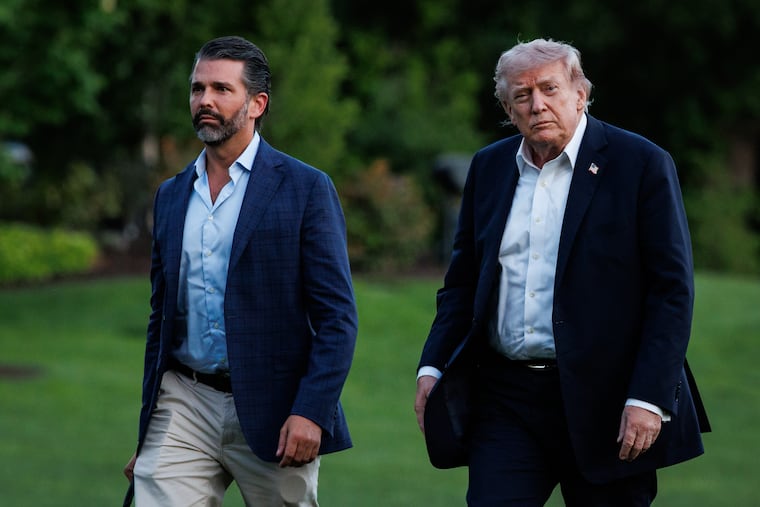
Trump’s sons Donald Trump Jr. and Eric Trump are investors in a number of AI and data center ventures, primarily through the investment firms 1789 Capital and American Ventures. Trump Jr. is a partner at 1789 Capital, a Florida-based venture capital firm that announced it had closed a $1.2 billion fund that will focus on real estate ventures, including deals aimed at digital infrastructure like data centers.
In a statement, a 1789 spokesperson said Donald Trump Jr. was operating as a private citizen and not in a government capacity.
A growing number of lawmakers, researchers, and technology executives have called for safeguards around increasingly powerful AI systems, with those calls mounting after Anthropic CEO Dario Amodei, OpenAI CEO Sam Altman, and xAI founder Elon Musk warned that the pace of AI development could outstrip the ability of leading labs to control the technology.
(The Post has a content partnership with OpenAI, which makes ChatGPT.)
Trump recently offered a number of responses to concerns about out-of-control AI. Days ago, he posted that the only necessary guardrail for AI was “a STRONG AND SMART (High IQ!) PRESIDENT.” On Saturday in a Truth Social post, Trump suggested policing ”BAD” aspects of the industry through enforcement of existing laws and a new, scantily described “AI Force.”
The clash comes as AI is emerging as a political issue ahead of the midterm elections. Multiple polls show a majority of Americans are concerned about the pace of AI development and opposed to the construction of data centers.
Trump’s stock holdings
The past volatile week in the stock market illustrated how Trump’s wealth could be affected by AI news developments that he has influence over.
After some prominent AI industry leaders spent the weekend advocating for slowing AI advancements over their fears of an AI doomsday, technology stocks dropped sharply Monday even as Trump spent the day ridiculing AI fears as a “hoax.”
Investors, worried that an AI slowdown could hit profits of AI-related companies, sold off stocks of many companies connected to the mammoth, trillion-dollar construction of AI data centers across the country.
Trump’s financial disclosures this year show that he had bought stock of several of the losers in Monday’s stock market decline, including computer chipmakers Broadcom and Texas Instruments and the data center equipment companies Credo Technology and Super Micro Computer.
Trump has attributed his income of more than $2 billion in 2025 to the highs in financial markets.
“You know why I’m profiting, because the stock market’s going up,” Trump told reporters in July after his financial disclosures were released. “Everybody’s profiting. … Thank you, President Trump.”
U.S. stocks have been on a tear for most of the four years since the public launch of ChatGPT kicked off an AI surge. Stocks related to AI are responsible for about two-thirds of the increase in the S&P 500 index this year, according to calculations by Matt Orton, chief market strategist at the investment firm Raymond James Investment Management.
The AI-related market gains have made wealthier, stock-owning Americans richer and spurred them to spend more money, which has boosted overall U.S. economic growth, economists say.
Trump’s family businesses
Since Trump’s first term, his family businesses have evolved from real estate and reality TV to encompass a wide range of technologies at the center of Washington’s regulatory debate.
As Trump Media and Technology Group (TMTG) prepares for its merger with the nuclear fusion company TAE Technologies, its subsidiary Truth Social is also investing in AI-related products.
TMTG interim CEO Kevin McGurn told CNBC in August that it was going into the “AI world” by licensing access to Truth Social posts to AI labs. AI companies are eager to vacuum up social media posts so they can feed them into AI algorithms in an effort to train those models to mimic human speech patterns.
TMTG would provide data through TruthAPI, the controversial tool that provides companies and investors with access to posts from the president and others. The tool allows investors to access the president’s announcements more quickly than the general public, inviting legal and ethical concerns.
Truth Social has also rolled out a search tool powered by “answer engine” Perplexity. The tool provides answers to questions based on Trump-friendly media sources, such as Fox News and Newsmax, but the Post previously found that it nonetheless frequently contradicts Trump.
TMTG did not respond to a request for comment.
Much of Trump’s income increasingly comes from cryptocurrency-related ventures. Last year he made more than $500 million from World Liberty Financial, a crypto company that Trump founded in 2024 alongside his sons and the sons of Steve Witkoff, Trump’s special envoy to the Middle East.
World Liberty Financial has collaborated with WorldClaw, a Hong Kong-based business that provides access to a suite of AI models. Customers are able to pay for access using USD1, World Liberty Financial’s token. WorldClaw offers access to models made by Chinese companies that the U.S. government has flagged for national security concerns, Reuters reported.
World Liberty Financial also sold a large stake to investors tied to the United Arab Emirates just before Trump’s inauguration. Sheikh Tahnoon bin Zayed al-Nahyan, the UAE’s national security adviser and chairperson of the UAE-based AI company G42, was involved in the purchase.
“World Liberty does not control WorldClaw’s product decisions, including which AI models it makes available. WorldClaw is not accessible to users in the United States,” David Wachsman, a spokesperson for World Liberty, wrote in an email.
The company did not respond to the question of whether the Trump family’s stake posed a conflict of interest but, instead, noted that WorldClaw competed with a similar product operated by Amazon, whose founder, Jeff Bezos, owns the Post.
Trump’s sons’ interests
Eric Trump and Donald Trump Jr. are involved in firms that have invested in a broad array of AI-related companies, according to news and data from PitchBook, a venture capital research database.
Within days of Donald Trump’s 2024 election win, Donald Trump Jr. announced he was becoming a partner at 1789 Capital, which bills itself as “funding the next generation of American exceptionalism.” Since Trump returned to office, the firm has made many investments in companies related to AI and the infrastructure underpinning the technology, including Cerebras Systems, Perplexity, and Musk’s xAI, which later merged with SpaceX.
Eric Trump invests through American Ventures, a branch of a boutique investment bank called Dominari Holdings, the Post previously reported. He is an investor in companies operating in defense and robotics, including Space-Eyes, a company that uses AI to process streams of data from satellites and other sensors.
A month after their father returned to the White House, Trump Jr. and Eric Trump also launched an initiative called American Data Centers, which was intended to support the build-out of AI infrastructure. That company then merged with American Bitcoin, a digital asset mining operation majority-owned by Hut 8, a crypto infrastructure company. Hut 8 is developing Beacon Point, a massive data center project in Texas.
Dominari Holdings did not respond to requests for comment.